
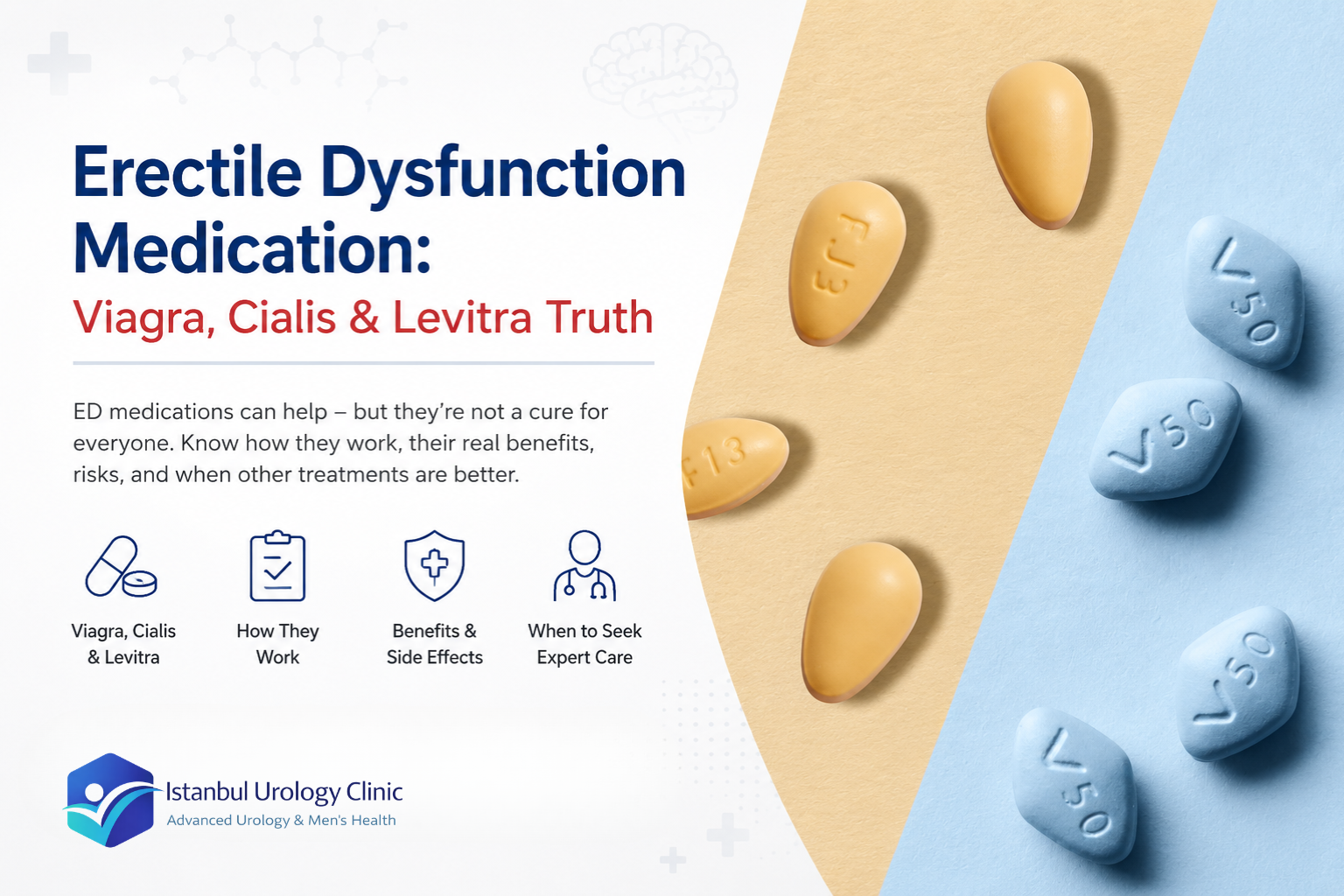
Most men reading this have already taken at least one of these three pills. Some have taken all three. Some have quietly doubled the dose, switched brands hoping for a stronger response, or ordered a higher-strength version online from a source they cannot verify.
Erectile dysfunction medication has a place. It works for the right man in the right situation. But the honest truth is something most pharmacy websites will not tell you: these pills are not designed for every type of erectile dysfunction, they carry side effects that can be serious, and for a meaningful share of men, taking them is treating the wrong problem.
This article is not a buyer’s guide. It is the conversation a careful doctor has with a patient before writing the first prescription. What these pills actually do. What they do not fix. Why they sometimes stop working. The side effects that get downplayed. And why proper evaluation usually matters more than reaching for a prescription pad.
- How ED Medication Actually Works (And What It Doesn't Do)
- Sildenafil (Viagra): The Fast Worker
- Tadalafil (Cialis): The Long Window
- Vardenafil (Levitra): The Less Common Option
- Side-by-Side: How These Three Compare in Practice
- Why Erectile Dysfunction Medication Sometimes Stops Working
- Side Effects of ED Medication You Must Take Seriously
- Who Should Never Take These Pills
- Why Treating the Cause Matters More Than Treating the Symptom
- The Natural Foundation: Where Real Recovery Starts
- When Erectile Dysfunction Medication Has a Place, and When It Does Not
- When a Penile Doppler Ultrasound Makes More Sense Than Another Pill
- The Bottom Line on Erectile Dysfunction Medication
- How ED Medication Actually Works (And What It Doesn't Do)
- Sildenafil (Viagra): The Fast Worker
- Tadalafil (Cialis): The Long Window
- Vardenafil (Levitra): The Less Common Option
- Side-by-Side: How These Three Compare in Practice
- Why Erectile Dysfunction Medication Sometimes Stops Working
- Side Effects of ED Medication You Must Take Seriously
- Who Should Never Take These Pills
- Why Treating the Cause Matters More Than Treating the Symptom
- The Natural Foundation: Where Real Recovery Starts
- When Erectile Dysfunction Medication Has a Place, and When It Does Not
- When a Penile Doppler Ultrasound Makes More Sense Than Another Pill
- The Bottom Line on Erectile Dysfunction Medication
Key Points
- Erectile dysfunction medication does not cause an erection. It amplifies the signal your body produces when aroused. Without arousal, the pill does nothing.
- Each pill (sildenafil, tadalafil, vardenafil) has a different onset, duration, and side-effect profile. A stronger dose does not mean a better result.
- Combining these medications with nitrate-based heart drugs can be fatal. They should never be taken without proper medical screening.
- For a significant share of men, ED medication produces only partial results because the real problem is structural, hormonal, or psychological.
- When the pill stops working, the answer is rarely a higher dose. It is usually a proper diagnostic workup.
- Treating the root cause through cardiovascular health, hormonal balance, and lifestyle usually produces more durable results than long-term reliance on pills.
How ED Medication Actually Works (And What It Doesn't Do)
All three medications belong to the same family: PDE5 inhibitors. They relax the smooth muscle inside the arteries of the penis. When you become aroused, more blood flows in. The erection that follows is your own, but the inflow is amplified by the medication.

This is the part most men miss. ED medication does not cause an erection. It does not flip a switch. A man who takes a pill and waits passively will wait a long time, because nothing happens without sexual stimulation. The pill is silent until your brain and body produce the signal. What the medication does is amplify that signal once it starts.
Think of it as a volume control, not a power button. If the original signal is healthy, the pill makes it stronger. If the signal is weak or interrupted somewhere along the chain (the brain, the nerves, the hormones, the veins), the pill has nothing to amplify.
This is why these pills do not work in isolation. They do not create arousal. They do not repair damaged nerves. They do not seal leaking veins. They do not correct low testosterone. They do not address the anxiety that turns the bedroom into a test. They open the inflow side of a complicated system and do that one job well. For a deeper look at how this mechanism interacts with different types of ED, see the guide on venous leakage and why pills often fail to fix it.
Sildenafil (Viagra): The Fast Worker
Sildenafil was the first of these pills to reach the market, and it is still the most recognized name. Its profile is straightforward.
When it works best: a man with mild to moderate vascular ED, generally healthy arteries elsewhere in the body, no significant heart issues, and no need for a long sexual window. You take it, you wait roughly 30 to 60 minutes, and the medication is active for 4 to 6 hours.
Where it falls short: sildenafil is sensitive to food. A heavy or fatty meal slows absorption, sometimes by more than an hour. Men who plan intimacy after dinner often blame the pill when the real problem is what they ate. Side effects tend to be more noticeable than with tadalafil. Headache, facial flushing, nasal congestion, and a faint blue tint to vision are the most commonly reported.
A common pattern: a man takes sildenafil, has a heavy dinner, drinks alcohol, and the pill underdelivers. He decides the medication does not work for him. The medication was working. The conditions were not.
Tadalafil (Cialis): The Long Window
Tadalafil has the longest duration of the three. Once it is in your system, it stays active for around 24 to 36 hours, which is why some men call it the weekend pill. That long window changes how it is used and how it is dosed.
There are two real ways to take tadalafil, and the choice between them is one of the most useful conversations to have with a doctor who actually understands erectile dysfunction medication.
- Taken 30 to 60 minutes before sex
- Stays active for up to 36 hours
- Best for planned weekends or specific occasions
- No daily commitment to taking medication
- Side effects concentrated around the dose
- Small dose taken at the same time each day
- Pill is always active for spontaneous intimacy
- Used when ED is paired with prostate symptoms (BPH)
- Standard in penile rehabilitation after prostate surgery
- Milder side effects because the dose is lower
Daily dosing is not the right choice for everyone. It is a treatment commitment, not a convenience. For the right profile, especially men dealing with both ED and benign prostatic enlargement, or those in the early stages of vascular damage, the daily approach often produces a more natural, less anxiety-driven sexual life than waiting for a pill to kick in. Tadalafil’s food interaction is much weaker than sildenafil’s. Most men can eat normally and still get a reliable response.
Vardenafil (Levitra): The Less Common Option
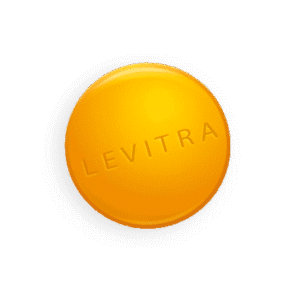 Vardenafil is the least prescribed of the three. Its profile sits between sildenafil and tadalafil, with a fast onset and a duration of 4 to 6 hours. For some men, it produces fewer side effects than sildenafil.
It earns its place in two situations: men with diabetes whose response to sildenafil has weakened, and men who tolerate sildenafil poorly but still want a short-window pill rather than tadalafil’s long duration. The mechanism is identical to the other two, so it is not a miracle alternative when both have failed.
Side-by-Side: How These Three Compare in Practice
Each pill behaves differently in the body. The differences are small in theory and significant in real life. The table below sums up what matters when you are weighing one against another.
| Feature | Sildenafil (Viagra) | Tadalafil (Cialis) | Vardenafil (Levitra) |
|---|---|---|---|
| Onset | 30 to 60 minutes | 30 to 60 minutes | 25 to 60 minutes |
| Duration | 4 to 6 hours | 24 to 36 hours | 4 to 6 hours |
| Food interaction | Strong. Fatty meals delay onset significantly. | Minimal. Most meals do not affect it. | Moderate. Heavy meals can slow absorption. |
| Typical dose range | 25 to 100 mg | 2.5 to 20 mg | 5 to 20 mg |
| Daily-dose option | No | Yes (2.5 to 5 mg) | No |
| Most reported side effects | Headache, flushing, nasal congestion, blue-tinted vision | Headache, back pain, muscle aches, indigestion | Headache, flushing, nasal congestion |
Why Erectile Dysfunction Medication Sometimes Stops Working
One of the most frequent reasons men seek a second opinion is this exact sentence: “The pill used to work for me, and now it does not.” Sometimes it stops working suddenly. Sometimes the response fades over months or years. Either way, it is one of the most important moments in a man’s ED journey, because what happens next depends entirely on understanding why the response has changed.
Erectile dysfunction medication does not lose its potency over time the way some men assume. The chemistry of the pill is the same on day one and day one thousand. What changes is everything around the pill, and there are six common reasons the response weakens.
The point is that “the pill stopped working” is almost never about the pill. It is about something else changing in the body or around it. The answer is rarely a higher dose. It is almost always a proper investigation of what has shifted.
Background: 51-year-old patient convinced his sildenafil had stopped working. Six years on it, started at 50 mg, escalated to 100 mg, then to two 100 mg tablets per attempt. High blood pressure, well-controlled type 2 diabetes for nine years, family history of cardiovascular disease.
Evaluation: Penile Doppler ultrasound and full hormonal panel before any prescription change. The Doppler showed reduced arterial inflow on one side and early venous leakage on the other. Testosterone came back low. Two structural problems and one hormonal problem sitting underneath a pill that had quietly become outmatched.
New plan: Tight blood sugar and blood pressure control, testosterone optimization with his endocrinologist, daily low-dose tadalafil to preserve tissue health, and an honest conversation about future steps if response did not improve within six months.
Outcome: Eight months later, function had improved meaningfully on a lower total medication load than he had been taking on his own. The pill had not failed him. The picture underneath the pill had changed, and nobody had been looking.
Side Effects of ED Medication You Must Take Seriously
Drug packaging lists side effects. Pharmacies hand the leaflet across the counter, the patient skims it, and the pill is taken. The problem is that the side effects most often discussed (headache, flushing, mild stomach upset) are not the side effects that send men to emergency rooms. The serious ones are rarer, but they are real, and you should know what they look like before you ever swallow the first pill.
Common side effects that are usually mild and pass within a few hours
- Headache, often felt as pressure across the forehead
- Facial flushing or a warm feeling in the upper body
- Nasal congestion that can last most of the day
- Indigestion or stomach discomfort
- Muscle aches or back pain, more common with tadalafil
- Brief changes in colour vision, more common with sildenafil
These are uncomfortable but not dangerous in healthy men. They reflect the medication doing exactly what it was designed to do (relaxing blood vessels) in places other than the penis.
The side effects you must take seriously
Sudden vision loss or significant changes in vision. A condition called NAION (non-arteritic anterior ischemic optic neuropathy) has been reported in men taking PDE5 inhibitors. It is rare, but it can cause permanent vision damage. Stop the medication immediately and seek medical care if vision changes are sudden or severe.
Sudden hearing loss or ringing in the ears. Also rare. Also potentially permanent. The same rule applies. Stop, and seek medical attention.
A prolonged erection that will not subside (priapism). This is the side effect men hear about, nod at, and dismiss. It is also the one most likely to cause permanent damage if it happens. Any erection lasting more than four hours, especially one that becomes painful or rigid without sexual stimulation, is a medical emergency. The blood trapped inside the penis loses oxygen, and tissue damage starts within hours. The risk rises sharply with higher-than-prescribed doses, mixing ED medication with recreational drugs, or certain blood conditions such as sickle cell disease. If an erection persists beyond two hours and shows no sign of resolving, go to an emergency room.
Severe drop in blood pressure. Particularly when combined with nitrates, alpha-blockers, or alcohol. A man can pass out, fall, and seriously injure himself before he understands what is happening.
Chest pain or shortness of breath during sex. This is not necessarily caused by the pill, but the pill should never mask a cardiac event. ED is sometimes the first warning sign of cardiovascular disease. A man who feels chest pain during intercourse needs cardiac evaluation, not a higher dose.
The European Association of Urology guidelines on Sexual and Reproductive Health set the international standard for how PDE5 inhibitors should be screened, prescribed, and monitored. Most of the serious events linked to these pills happen when those safety steps are skipped.
Your erection lasts longer than four hours, even if it does not feel painful at first. You experience sudden vision or hearing changes. You feel chest pain, severe dizziness, or shortness of breath during or after taking the medication. These reactions are uncommon, but they can become serious quickly. The window to prevent permanent damage is measured in hours, not days.
Who Should Never Take These Pills
Some men should not take erectile dysfunction medication under any circumstances. This is not a precaution. It is a hard line drawn by the way these drugs interact with other medical conditions and medications. The contraindications below are not “extra caution” categories. They are reasons to find a different treatment path entirely.
Men taking nitrate-based heart medication
Nitroglycerin tablets, sprays, patches, or any related nitrate drug. Combined with PDE5 inhibitors, nitrates cause a sudden, dangerous drop in blood pressure that has killed patients. There is no safe gap. If you have ever been prescribed nitrates, speak to your cardiologist before any ED pill.
Men on riociguat or pulmonary hypertension drugs
The interaction is the same as with nitrates: severe hypotension. This is an absolute contraindication with no exceptions.
Recent cardiac event or severe heart disease
Heart attack within six months, severe heart failure, unstable angina, or uncontrolled arrhythmia. Sexual activity itself is a cardiovascular workload, and the medication adds another layer. A cardiologist’s clearance is required before any prescription.
Uninvestigated low blood pressure or uncontrolled hypertension
Both extremes carry significant risk with PDE5 inhibitors. Blood pressure must be assessed and stable before any prescription. This is one of the most overlooked screening steps in online pharmacy prescriptions.
Severe liver or kidney impairment
Both organs metabolize the medication. When they are not working properly, doses accumulate in the body and side effects become unpredictable. Even standard doses can become dangerous in patients with significant organ impairment.
History of NAION or inherited retinal conditions
Previous non-arteritic anterior ischemic optic neuropathy (NAION) or conditions such as retinitis pigmentosa are absolute contraindications. The risk of permanent vision damage outweighs any potential benefit from the medication.
Men on strong CYP3A4 inhibitors
Some HIV protease inhibitors, certain antifungal medications (ketoconazole, itraconazole), and some macrolide antibiotics can dangerously raise the blood level of the PDE5 inhibitor. Even short-term courses of these drugs require pausing or adjusting any ED medication.
Users of recreational nitrites (“poppers”)
The hypotension risk is the same as with prescription nitrates. This is a common cause of emergency-room visits among younger men using ED pills socially. The combination has been involved in fatal cases. There is no safe co-use.
Notice what is not on this list: age, simple high blood pressure under control, well-managed diabetes, or mild heart conditions. None of these are automatic contraindications. They all require a proper medical conversation before you take the first dose. Buying these pills online without a prescription bypasses the entire safety check that exists for very real reasons.
Why Treating the Cause Matters More Than Treating the Symptom
There is a question almost no pharmacy website will ask you, because the answer does not sell pills. Here it is.
What is actually causing your erectile dysfunction?
Erectile dysfunction medication treats the symptom. It increases blood flow to the penis. That is a real benefit, and for some men it is exactly the right intervention. But blood flow is rarely the original problem. Most cases of ED are downstream consequences of something else.
Vascular damage from years of high blood pressure or high cholesterol. Hormonal shifts that have gone undetected. Nerve damage from poorly controlled diabetes. Performance anxiety hardening into a loop over time. Sleep apnea silently lowering testosterone. A medication you started two years ago for an unrelated condition.
When you treat only the symptom, three things happen over time. The underlying problem keeps progressing in the background. The dose required to produce the same response slowly increases. And the moment the medication stops working, you are left with a more advanced version of the condition than the one you started with.
This is why a proper first consultation almost never ends with a prescription. It ends with an evaluation.
- Pill prescribed based on symptom alone
- No investigation of underlying cause
- No vascular or hormonal assessment
- Dose increased over time as response fades
- Brands switched in search of stronger result
- Underlying condition progresses silently for years
- Cardiovascular health and blood pressure reviewed
- Testosterone, prolactin, and hormonal panel checked
- Penile Doppler added when vascular cause suspected
- Current medications screened for interference
- Lifestyle, sleep, and psychological context considered
- Treatment matched to diagnosis, not assumption
The cause matters because the treatment that follows looks completely different depending on what is found.
- If the picture points toward venous leakage, the right next step is a Doppler study, not a stronger pill.
- If diabetes is involved, blood sugar control and vascular health become as important as any prescription.
- If the cause is psychological and the loop has been running for years, structured psychological work outperforms medication every time.
- If you are recovering from prostate surgery, the dosing and timing of medication is part of a much larger rehabilitation protocol, not a standalone solution.
The Natural Foundation: Where Real Recovery Starts
Before any prescription is considered, there is a baseline that every man with erectile dysfunction should be working on. It is not glamorous, and it does not produce results overnight. The men who actually recover (rather than manage) their ED are almost always the men who took this foundation seriously.
These are not lifestyle tips in the general magazine sense. Each one has a specific, measurable effect on erectile function. The American Urological Association guideline on erectile dysfunction places lifestyle modification as a foundational step alongside any medical treatment, not as an afterthought.
None of these steps is glamorous, and none produces a result you can measure in 30 minutes the way a pill does. The men who build this foundation often discover that the foundation alone gave them most of what they needed. The medication, when it is added, works better on a healthy body than on a neglected one.
When Erectile Dysfunction Medication Has a Place, and When It Does Not
None of this means erectile dysfunction medication is wrong. It means it has a role, and the role is narrower than most men assume when they first reach for a prescription.
The men who genuinely benefit from PDE5 inhibitors tend to share certain features. The ED is mild to moderate. The vascular system is mostly intact. The underlying causes are being addressed in parallel rather than ignored. Expectations are realistic, meaning the pill is treated as a useful tool rather than a permanent solution. And the dosing follows medical advice rather than escalating quietly over time.
The men for whom pills become a long-term trap usually share a different pattern. The original cause was never investigated. The dose has been increased multiple times. The pill is treated as essential rather than supportive. And the natural foundation has been ignored because the medication feels easier.
If you take one thing from this article, let it be this. Erectile dysfunction medication is a tool, not a destination. Used in the right context, with the right safety checks, alongside real attention to the cause and the natural foundation, it can restore quality of life for a long time. Used as the only answer, without diagnosis and without the foundation, it tends to mask a problem that keeps growing until the pill stops working at all.
When a Penile Doppler Ultrasound Makes More Sense Than Another Pill
Frequently Asked Questions
The Bottom Line on Erectile Dysfunction Medication
If you have read this far, you already know more about erectile dysfunction medication than most men who walk into a pharmacy holding a prescription. The pills do not create erections. They amplify a signal that has to be there in the first place. They treat a symptom, not a cause. They carry side effects that range from inconvenient to life-threatening, and the dangerous ones happen most often when the pills are taken without proper medical screening.
This does not mean the pills are bad. It means they have a place, and the place is narrower than the marketing suggests. For the right man, at the right dose, alongside attention to the underlying cause, ED medication can restore quality of life for years. For the wrong man, taking it without investigation, the same pill becomes a slow way to ignore a problem that keeps growing in the background.
The honest path: build the natural foundation. Find out what is causing your ED before committing to any long-term prescription. Use the medication under medical supervision, not from an unverifiable online source. And recognize the moment when “the pill stopped working” is really your body asking for a deeper conversation than the next prescription will give.
A real consultation does not start with a pill. It starts with finding out why you need one. That is the difference between treating erectile dysfunction and managing it for the rest of your life.