
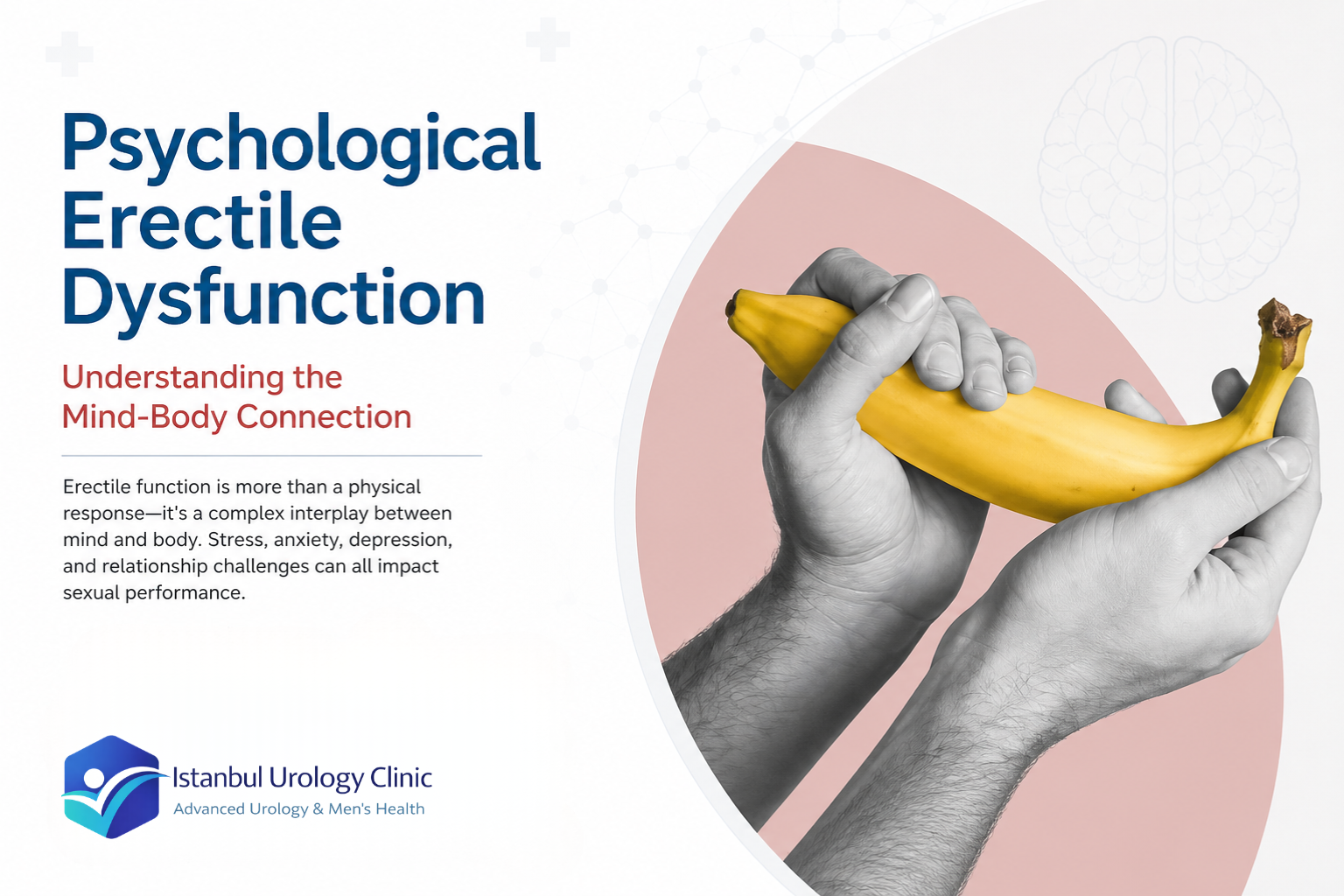
The pattern that brings you here is usually the same one. You can get an erection alone without thinking about it. Morning erections still happen. Then a real moment with a partner arrives, and your body acts like a different body. The harder you try to make it work, the less it cooperates.
That gap, between what your body is clearly capable of and what it does when it matters, is the defining feature of psychological erectile dysfunction. Nothing is mechanically broken. Blood flow is fine, hormone levels are normal, the nerves are intact. The interruption happens somewhere between thought and response, and it shows up in the most specific situations.
Most men reach this article after weeks or months of confusion. You may have tried a Viagra to see what would happen. Maybe it worked once, maybe it half-worked, maybe nothing really changed. You have probably already searched whether this is “all in your head,” and read enough conflicting answers to feel less clear than before.
The honest version is this. Psychological ED is real, it has a recognizable pattern, and it follows a mechanism that can be broken. It is also one of the few types of erectile dysfunction where understanding the cycle is half the treatment. The men who stay stuck for years are usually the ones who never had the loop explained to them in the first place.
This guide is written from the consultations we run every week at Istanbul Urology Clinic with men in exactly your situation. It walks through how the cycle forms, why pills alone often make it worse rather than better, the three places where the loop can actually be interrupted, and the specific point where psychological ED stops being purely psychological and starts damaging the vascular system itself. By the end, you should know whether your case can be managed without surgery, and what the next step looks like if you decide to act on it.
One thing to settle early. A situational pattern is the strongest single clue that the cause is psychological, but it is not proof. This article assumes you have already noticed that pattern. If your morning erections have also disappeared, or if erection quality is identical whether you are alone or with a partner, the cause is more likely vascular and this article is not your answer. We address that distinction in the next section before going any further.
- Psychological vs Physical ED: How to Tell the Difference
- The Loop That Keeps You Stuck
- What Causes Psychological Erectile Dysfunction
- Why Pills Alone Often Make It Worse
- Psychological Erectile Dysfunction Treatment: Three Intervention Points
- When Psychological ED Quietly Becomes Physical
- When to Stop Self-Managing
- What Recovery Actually Looks Like
- Conclusion
- Psychological vs Physical ED: How to Tell the Difference
- The Loop That Keeps You Stuck
- What Causes Psychological Erectile Dysfunction
- Why Pills Alone Often Make It Worse
- Psychological Erectile Dysfunction Treatment: Three Intervention Points
- When Psychological ED Quietly Becomes Physical
- When to Stop Self-Managing
- What Recovery Actually Looks Like
- Conclusion
Key Points
- Psychological erectile dysfunction is defined by a situational pattern: erections work alone or in the morning, but fail during partnered sex.
- The condition runs on a self-reinforcing loop. One failed attempt creates anxiety, anxiety blocks the next erection, and the cycle locks itself in.
- Pills like Viagra and Cialis can break the loop early, but using them as a long-term crutch often deepens the anxiety they were meant to relieve.
- The fastest recoveries come from working on the mind, the body, and the relationship at the same time, not from chasing one solution at a time.
Psychological vs Physical ED: How to Tell the Difference
The label “psychological” gets attached to too many cases of erectile dysfunction by default, often by doctors who never investigated further. Before you accept that explanation for your own situation, three patterns are worth checking against your own experience.
Psychological ED is almost always situational. The same body that fails during sex performs normally during masturbation, on its own at night, or first thing in the morning. The breakdown is tied to a specific context: a partner, a setting, a moment of pressure. If your erections behave the same way regardless of context, the cause is probably not in your head.
The onset also tells you something. Psychological ED tends to start suddenly, usually traceable to a specific event or period: a stressful month, a relationship change, one experience that did not go well. Vascular ED is gradual. It develops over years, slowly, often alongside cardiovascular risk factors you may not have connected to it.
The third pattern is morning erections. If you still wake up with firm erections most days, your erectile machinery is mechanically intact. That single fact rules out most physical causes. If morning erections have faded or disappeared, the situation reverses, and the cause is far more likely to be vascular than psychological.
When Self-Identification Is Not Enough
A situational pattern is a strong clue, not a diagnosis. The single test that resolves this question reliably is a penile Doppler ultrasound, which measures arterial inflow and venous retention directly. We routinely see men who were told for years that their ED was psychological, only to discover an arterial or venous cause on Doppler. If your case is not improving with the loop-breaking work in this article, get the test before assuming the cause is mental.
The Loop That Keeps You Stuck
Psychological erectile dysfunction is not really about a single failed erection. It is about what that single failure does to the next attempt, and the attempt after that. The mechanism is a closed loop, and once it forms, it sustains itself without any new cause being added.
The Performance Anxiety Loop Explained
The loop starts with a trigger moment. Maybe you were tired, distracted, had too much alcohol, or were with a new partner. The erection did not happen the way it usually does, or it faded faster than expected. In isolation, this is a normal biological fluctuation. Every man has these moments. The problem is what happens next.
The brain registers the moment as a threat. The next time intimacy approaches, attention shifts away from the partner and toward your own body. You start monitoring the erection in real time, watching for signs that it might fail again. That self-monitoring is the killer. The same nervous system that controls arousal also runs the stress response, and the two cannot operate at full strength simultaneously. Watching your erection happen is the surest way to stop it from happening.
By the third or fourth attempt, the loop has hardened. You enter every sexual situation already braced for failure. The body interprets that bracing as stress. Stress signals constrict blood flow and divert it away from the penis. The erection fails again. Your prediction was correct, but only because you made it.
The Trigger Moment
A single normal failure: fatigue, alcohol, distraction, or a new partner. In isolation, this is biology, not a problem.
The Threat Memory
The brain flags the experience and prepares to defend against it. The next encounter is approached with caution rather than anticipation.
Self-Monitoring Takes Over
Attention shifts from the partner to your own body. The same nervous system that controls arousal cannot run full-strength while watching itself.
The Predicted Failure
The erection fails again. The brain records confirmation. The prediction was correct, but only because you made it.
Understanding this is more than academic. Every effective treatment for psychological ED works by interrupting the loop at one of these four points. The treatments that fail are the ones that try to force an erection without touching the cycle that is blocking it.
“The men who come to us with psychological erectile dysfunction rarely arrive after one bad night. They arrive after months of watching their own erections instead of being present with their partner. The fix is almost never another pill. It is teaching the body that sex is not a performance being graded in real time.”
Prof. Dr. Ö. Onuk
Professor of Andrology, Istanbul Urology Clinic
What Causes Psychological Erectile Dysfunction
Loops do not appear out of nothing. There is almost always an initial trigger, and identifying it matters because the intervention point depends on what started the cycle. Four trigger patterns account for most psychological erectile dysfunction cases we evaluate.
| Trigger Type | How It Starts | Recognizable Pattern | Recovery Speed |
|---|---|---|---|
| Single Failed Experience | Sudden, traceable to a specific night | Loop forms within weeks; anxiety locks in fast | Fast: weeks to a few months |
| Chronic Life Stress | Slow, no identifiable single event | Background reduction in arousal during a stressful period | Moderate: improves as the underlying stress resolves |
| Relationship Friction | Gradual, tied to one specific partner | Normal alone or with other partners; fails with current one | Variable: depends on whether the relationship can be repaired |
| Pornography Patterns | Slow, often years of escalation | Reduced arousal with real partners despite normal solo function | Slow: usually requires a structured reset over months |
The four patterns are not mutually exclusive. Many men carry more than one, and the dominant trigger often shifts over time. The sections below walk through each pattern in the way men actually experience it.
Why Pills Alone Often Make It Worse
Almost every man with psychological erectile dysfunction tries a PDE5 inhibitor at some point. Viagra, Cialis, Levitra, or one of the generic equivalents. The logic seems obvious: if you can produce one reliable erection on the pill, you break the failure pattern and confidence returns naturally.
Sometimes that works. More often it does not, and the reason is worth understanding before you fill another prescription.
Short-Term Bridge Use
Used alongside loop-breaking work
A low dose during the first weeks of confidence rebuilding, paired with attention and partner work. The pill guarantees a few early successes, the brain updates its prediction, and the medication is deliberately tapered as the loop weakens. The pill is scaffolding, not the building.
Long-Term Crutch Use
Used as the only strategy
Sex becomes impossible without the pill. Each success belongs to the medication, not to you. Going without it now carries more anxiety than the original problem. Doses escalate, brands get switched, and the loop hardens around the prescription instead of weakening.
The deeper issue is that PDE5 inhibitors work on blood flow, not on attention. A man fully locked into self-monitoring can take a full dose of Cialis and still fail to produce a usable erection, because the signal that initiates blood flow never reaches the right pathway. The pill is treating the wrong part of the system. When this happens, men often double the dose, switch brands, or assume the medication has stopped working. None of these moves address what is actually blocking the response.
The honest rule we follow with our patients: medication is a short-term ally, not a long-term strategy. If the loop is not being worked on directly, the pill is buying time at the cost of deeper dependency.
Psychological Erectile Dysfunction Treatment: Three Intervention Points
Psychological erectile dysfunction is reliably manageable, but the recovery rarely comes from a single intervention. The men who recover quickly work on three fronts at once: the mind that runs the loop, the body that responds to it, and the relationship that surrounds it. Pulling on only one of the three usually produces partial, fragile results.
This framework is consistent with the position statement on the psychosocial approach to erectile dysfunction published by the European Society of Sexual Medicine, which recommends combining cognitive and behavioral techniques with partner involvement rather than relying on medication alone. The clinical evidence supports what we see in practice: integrated treatment outperforms any single modality, including PDE5 inhibitors used in isolation.
Mind Side: Cognitive and Attentional Work
The core technique is cognitive behavioral therapy adapted for sexual function, often combined with sensate focus exercises. The goal is not to stop thinking about the erection through willpower. It is to retrain attention so that it sits with sensation and connection rather than with self-monitoring. Mindfulness practice supports this, but it works best as a daily habit, not a sexual technique applied in the moment. Patients typically see meaningful change within six to ten weeks of consistent work.
Body Side: Controlled Exposure and Selective Medication
The body needs successful experiences to update its prediction. This means gradually rebuilding sexual encounters without the pressure of intercourse as the marker of success. Touch, mutual exploration, and arousal without the goal of penetration are clinical tools, not just romance. A PDE5 inhibitor may be used during the early weeks to guarantee a few successes, then deliberately tapered as confidence returns. The medication is the scaffolding, not the building.
Partner Side: Removing the Performance Frame
Most men carry the loop alone, hiding it from their partner and trying to manage it in secret. That secrecy is part of what holds the loop in place. When a partner understands what is happening and stops interpreting failed erections as rejection or boredom, the pressure surrounding intimacy drops sharply. In many couples, a single honest conversation moves the needle more than weeks of solo work. Couples therapy or guided sex therapy accelerates this when communication has already broken down.
None of these interventions require flying to Istanbul, and none of them are surgical. The cases that do reach us at the clinic are usually the ones where the loop has been running for years, the pills have stopped working entirely, or a separate physical issue has developed on top of the psychological one. The next section explains how that crossover happens.
Case Example: When the Loop Was the Whole Problem
A 34-year-old patient flew in convinced he needed a penile implant. He had been struggling for eighteen months. Erections were normal alone, normal in the morning, and consistently failed with his partner of two years. He had tried sildenafil, then tadalafil, then double doses of both. Each one worked the first time and progressively less afterward.
His Doppler was completely normal. Peak Systolic Velocity 38 cm/sec, End Diastolic Velocity 2 cm/sec. No vascular cause. The diagnosis was straightforward psychological erectile dysfunction with a hardened performance anxiety loop.
We did not prescribe a new medication. We outlined the three-side intervention: weekly sessions with a CBT-trained sex therapist back home, structured sensate focus exercises with his partner, and a tapered low-dose tadalafil regimen for the first six weeks only. He reported reliable erections without medication at the four-month follow-up. No surgery. No long-term prescription. The loop was the entire problem, and the problem responded to the right intervention.
When Psychological ED Quietly Becomes Physical
One of the things we do not discuss often enough is that psychological erectile dysfunction, left running for years, does not stay purely psychological. The body pays a measurable cost for being held in a chronic stress state, and some of that cost shows up in exactly the vascular system that controls erections.
The mechanism is straightforward. Chronic anxiety keeps cortisol elevated. Elevated cortisol promotes endothelial dysfunction, meaning the inner lining of blood vessels stops releasing the signals that allow them to relax and fill properly. The small arteries that supply the penis are some of the most sensitive in the body to this change. Over years, what started as a purely mental block can produce real, measurable arterial impairment.
Psychological ED Symptoms That Signal a Physical Shift
The clinical signature of this transition is that the situational pattern blurs. Erections that used to be normal alone start becoming less reliable. Morning erections weaken. The response to PDE5 inhibitors fades, not because the dose is wrong, but because the underlying blood flow has changed.
When a patient describes this progression, the conversation shifts. The next step is no longer therapy or pill optimization. It is a penile Doppler ultrasound to see what the vascular system is actually doing. In cases where the leak side has progressed, the picture connects directly to venous leakage, which has its own treatment path.
The reason we mention this is not to alarm anyone. It is to make a specific point. Psychological ED is highly treatable in the first one to two years. It becomes harder to fully reverse once the vascular system has been retrained by years of stress signalling. The cost of postponing the loop work is rarely measured in months.
When to Stop Self-Managing
Most psychological erectile dysfunction can be worked through without ever seeing a urologist. The mind-side, body-side, and partner-side work outlined above produces real change when applied consistently for two to three months. If your case is improving, even slowly, you are on the right path and do not need a clinic appointment.
There are five situations where self-management is no longer the right strategy and a proper medical evaluation becomes the next step.
- The pattern has stopped being situational. Erections are now unreliable alone as well as with a partner, or morning erections have weakened or disappeared. This is the clearest signal that a physical cause has either developed or was present all along.
- Six months of consistent work has produced no change. Therapy, lifestyle adjustments, and partner-side work usually start showing results within ten to twelve weeks. A complete plateau after six months means the diagnosis itself deserves a second look.
- PDE5 inhibitors have stopped working at full dose. Loss of medication response is one of the strongest indicators that a vascular component has emerged. A Doppler study clarifies the question directly.
- The condition is affecting your mental health more broadly. Persistent low mood, withdrawal from your partner, or avoidance of intimacy that has crossed into the rest of your life deserves clinical attention regardless of the underlying cause.
- You are about to make a major decision based on assumption. Some men reach a point where they consider a penile implant or another major intervention without a confirmed diagnosis. No man should undergo surgery for ED without a Doppler study and a full clinical evaluation. The cost of the test is small. The cost of operating on the wrong problem is not.
When any of these apply, the right starting point is a structured consultation rather than another round of self-experimentation. The Doppler resolves the question of cause in a single visit, and the rest of the plan follows from there.
“The patients I worry about are not the ones who come in early. They are the ones who spent three years convinced the problem was in their head, then arrive with vascular damage that did not exist when the loop first started. There is a window where psychological ED is fully reversible. The window closes quietly, and most men do not notice until the pills stop working.”
Prof. Dr. Ö. Onuk
Professor of Andrology, Istanbul Urology Clinic
What Recovery Actually Looks Like
The expectation many men carry into treatment is that recovery means returning to the erections they had at twenty-two: instant, unthinking, immediately responsive to any stimulus. This expectation makes recovery harder, because every imperfect encounter gets coded as a failure even when the trajectory is clearly improving.
Realistic recovery looks different. The first sign is usually not a perfect erection. It is the absence of the dread that used to precede intimacy. The self-monitoring quiets down. The partner stops feeling like a witness and starts feeling like a partner again. Erections become more reliable over weeks, not days, and the occasional off night stops triggering a relapse because the loop no longer has the same grip.
For most men working consistently on all three sides of the intervention, meaningful improvement appears within eight to twelve weeks. Full stabilization, where intimacy no longer carries any background anxiety, often takes four to six months. Some men move faster, some slower. The variable is not effort. It is how long the loop was running before the work started.
“Psychological ED is all in your head. If you just relax, the problem goes away on its own.”
“Relaxing” is not a strategy a man in this loop can execute on command. The harder he tries to relax, the more he monitors himself, which is the exact pattern that holds the loop together. Recovery requires retraining attention, rebuilding successful experiences gradually, and changing the dynamic with the partner. None of this happens passively, and waiting it out usually deepens the cycle rather than resolving it.
The men who recover well are usually the ones who treat psychological erectile dysfunction the same way they would treat any other clinical condition: with a plan, a timeline, and the patience to let the body update its predictions. The men who stay stuck are usually the ones who keep trying the same single intervention and waiting for a different result.
Frequently Asked Questions
This is the signature pattern of psychological erectile dysfunction. The body's erectile machinery is mechanically intact, which is why erections work during masturbation, sleep, and in the morning. The breakdown is triggered by partnered sex specifically, because that is the context where performance pressure, self-monitoring, and the loop activate. The same nervous system that controls arousal also runs the stress response, and when attention shifts to watching your own body during intimacy, arousal cannot fully take hold. The partner is not the cause. The shift in attention is.
Yes. In severe cases, performance anxiety can prevent any erection from occurring during partnered sex, even when morning erections remain firm and reliable. The mechanism is the same as milder cases, just amplified: the stress response fully overrides the arousal response, and blood flow is actively diverted away from the penis at the moment it should be increasing. This level of failure is psychologically distressing but clinically reversible. Men who present with this pattern often recover faster than men with partial failure, because the situational contrast is so stark that the diagnosis is rarely missed.
Usually no. Reliable morning erections are one of the strongest indicators that erectile machinery is intact and the cause is psychological. The Doppler becomes relevant when the situational pattern starts to blur, when PDE5 inhibitors stop working at full dose, or when six months of consistent loop-breaking work has produced no improvement. If morning erections are still firm and you are within the first months of working on the cycle, focus on the intervention first. The test can wait until the clinical picture justifies it.
Three to six months of consistent work on all three sides, mind, body, and partner, is the realistic window. Meaningful improvement typically appears within eight to twelve weeks when the intervention is structured and applied daily, not when therapy is done in isolation. If you have completed six months of genuine effort with no measurable change in erection reliability, the diagnosis itself deserves a second look. A urology consultation with a Doppler at that point is not a failure of therapy. It is the next logical step in clarifying what is actually happening.
Most men see early improvement within eight to twelve weeks of consistent work on the mind, body, and partner sides at once. Full stabilization, where sex no longer carries background anxiety, usually takes four to six months. The variable is not how much effort you put in. It is how long the loop has been running before the work started.
Yes, and this is one of the most underestimated risks. Chronic stress maintained over years promotes endothelial dysfunction in the small arteries that supply the penis. What started as a mental block can produce measurable vascular impairment by the time a man finally seeks evaluation. This is why working on the loop early matters clinically, not just emotionally.
A PDE5 inhibitor can be useful as a short bridge during the first weeks of loop-breaking work, by guaranteeing a few successful experiences that update the brain's prediction. Using it as a permanent solution without addressing the loop usually deepens the dependency and shifts the anxiety onto the medication itself. Short-term tool, not long-term strategy.
The strongest single clue is a situational pattern: erections work alone, in the morning, or with one partner but not another, and fail in specific contexts. The clue is not proof. The test that resolves the question reliably is a penile Doppler ultrasound, which measures arterial inflow and venous retention directly. We see men every week who were told for years that their ED was psychological, only to find a vascular cause on Doppler.
Cognitive behavioral therapy adapted for sexual function, often combined with sensate focus exercises, is the most evidence-supported non-medication treatment for psychological ED. It works because it directly targets the attention pattern that holds the loop in place. The men who get the most out of therapy are the ones who pair it with the body-side and partner-side work rather than relying on talk alone.
It is the most common form of erectile dysfunction in men under forty, especially when there are no cardiovascular risk factors and morning erections are still normal. The triggers vary: a single failed experience, heavy pornography use, relationship pressure, or chronic life stress. The mechanism is the same regardless of age, and so is the treatment framework.
See a urologist when the pattern stops being situational, when six months of consistent self-management produces no change, when PDE5 inhibitors stop working at full dose, when the condition starts affecting your mental health more broadly, or when you are considering a major intervention without a confirmed diagnosis. A structured consultation, including a Doppler study, removes guesswork and is the right starting point in any of these situations.
Sometimes, yes. If the trigger was a single stressful period or a one-time failed experience, the loop can resolve on its own once the underlying stressor is gone. The cases that resolve spontaneously are usually under three months old. Once the loop has been running for six months or more, it rarely fades without active intervention. Waiting it out is one of the most common mistakes we see, because every month the cycle continues, it gets harder to break.
The signature symptom is situational failure: erections work alone or in the morning, but fail during partnered sex. Other patterns include erections that start strong then fade as soon as attention shifts to performance, normal arousal during masturbation but reduced arousal with a partner, sudden onset traceable to a specific event, and persistent self-monitoring during intimacy. Morning erections remain intact in almost all psychological ED cases, which is one of the clearest distinguishing features from vascular causes.
The diagnosis is primarily clinical, made through a detailed history of how the erection pattern actually behaves. A urologist will ask about onset, situational vs generalized failure, morning erections, response to past medications, and stress or relationship factors. Physical examination and basic labs rule out hormonal or vascular causes. When the picture is unclear, a penile Doppler ultrasound resolves the question by measuring blood flow directly. Most psychological ED cases do not require advanced imaging, but the Doppler is the test that confirms the cause when self-identification is not enough.
Conclusion
Psychological erectile dysfunction is one of the few erectile conditions where understanding the mechanism is most of the treatment. The body is not broken. The vascular system works, the nerves work, the hormones are in range. What has been disrupted is the chain of attention and response that allows arousal to take hold without interference.
The loop can be broken. The work is not glamorous, and it does not happen in a single visit, but it is reliable when applied consistently and on all three sides at once: the mind that is running the cycle, the body that needs new successful experiences, and the relationship that surrounds both.
If your case fits the situational pattern described here, the first step is not booking a surgery consultation. It is starting the loop work and giving it the eight to twelve weeks it needs to show results. If it does not, or if the pattern starts shifting toward something that no longer feels situational, that is the point where an in-person evaluation and a Doppler study become the right next move. Either way, the worst decision is to keep waiting for the problem to fix itself. It rarely does.