
You have lived with diabetes for years. You manage your blood sugar, you take your medications, you have learned what your body does and does not tolerate. Then you notice a bend during erection that was not there before, or a hard area under the skin of the penis, or a curvature that has been getting worse over months. The combination of diabetes and Peyronie’s disease is more common than most men realize, and it does not behave the way standard Peyronie’s does.
The information you find online then assumes you are an average patient. The general statistics, the typical progression, the standard treatment options are all written for men without a chronic metabolic condition shaping how their tissues heal. The reality is that diabetic Peyronie’s disease is not the same condition as Peyronie’s disease in a non-diabetic man, even when the diagnosis name is identical. It is more common, it progresses faster, it resists conservative treatment more often, and the surgical decisions that work for the average Peyronie’s patient sometimes do not apply to the diabetic patient at all.
This is not a story about diabetes causing one more complication to manage. It is a story about two fibrotic processes happening inside the same body at the same time, and how that combination changes the clinical picture in ways that matter for every treatment decision that follows. If you are a diabetic man dealing with new or progressing penile curvature, the most useful thing you can do before anything else is understand how your situation differs from the standard Peyronie’s case.
This guide covers why diabetic Peyronie’s is a different clinical entity, the numbers behind that difference, the mechanism that drives it, why conservative treatments tend to fail faster, what glycemic control has to do with surgical decisions, and what device selection looks like when the time comes. If you want a fuller view of Peyronie’s disease independent of the diabetic context, our Peyronie’s disease guide covers phases and treatment options. If you are managing diabetic erectile dysfunction alongside the curvature, that connection is covered in a dedicated guide.
- Why Diabetic Peyronie's Disease Is a Different Clinical Entity
- The Numbers Behind the Difference
- Why Diabetes Makes Fibrosis Worse
- Why Conservative Treatment Fails Faster in Diabetic Patients
- The HbA1c Question Before Any Surgical Decision
- Surgical Considerations Specific to the Diabetic Patient
- The Most Useful Step Right Now
- Why Diabetic Peyronie's Disease Is a Different Clinical Entity
- The Numbers Behind the Difference
- Why Diabetes Makes Fibrosis Worse
- Why Conservative Treatment Fails Faster in Diabetic Patients
- The HbA1c Question Before Any Surgical Decision
- Surgical Considerations Specific to the Diabetic Patient
- The Most Useful Step Right Now
Why Diabetic Peyronie's Disease Is a Different Clinical Entity
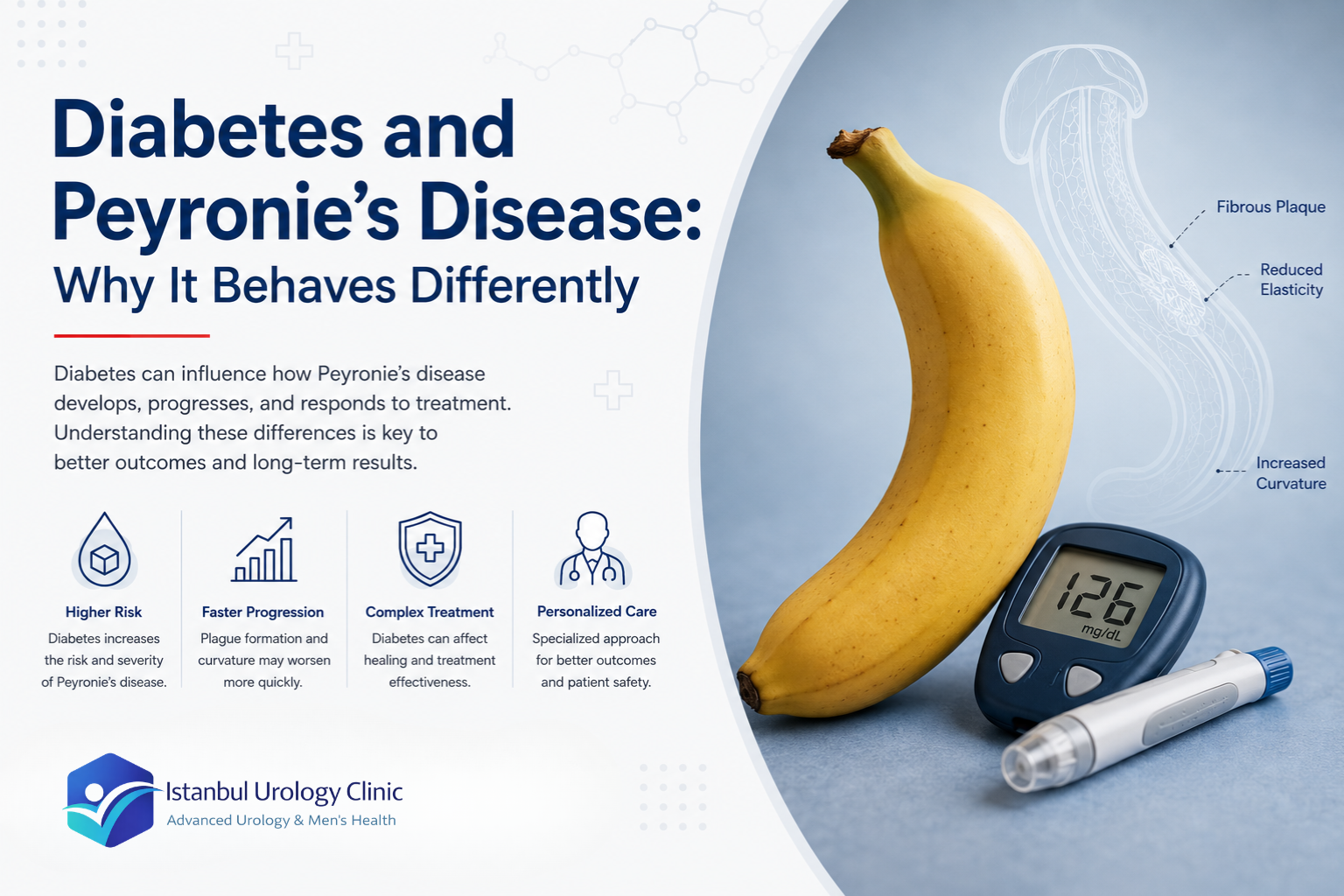
The most useful framing for a diabetic man with Peyronie’s disease is to stop thinking of it as “Peyronie’s plus diabetes” and start thinking of it as a distinct clinical entity that happens to share its name with non-diabetic Peyronie’s. The visible symptoms look the same. The curvature, the plaque, the potential for shortening and erectile dysfunction. The biology underneath, the trajectory of the disease, and the response to treatment are not the same.
Diabetic Peyronie’s disease behaves differently from non-diabetic Peyronie’s because diabetes alters the fundamental process of tissue healing. The same diagnosis produces a more aggressive disease in the diabetic patient.
Four specific differences make this distinction matter. The first is prevalence. Peyronie’s disease occurs in roughly 3 to 9 percent of men in the general population. In diabetic men, the rate is significantly higher. The body that is already producing excessive fibrosis in blood vessels, nerves, and kidneys is also more likely to produce excessive fibrosis in the tunica albuginea of the penis when given the opportunity.
The second is severity. When Peyronie’s develops in a diabetic patient, the curvature tends to be more pronounced, the plaques are often larger or more numerous, and complications like hourglass deformity and significant shortening occur more frequently. The disease produces a more extensive footprint in the same amount of time.
The third is progression speed. Non-diabetic Peyronie’s typically progresses through its active phase over 12 to 18 months before stabilizing. Diabetic Peyronie’s often has a longer active phase, more progression during that phase, and a smaller window where conservative treatments can meaningfully influence the outcome.
The fourth, and the most practical for treatment decisions, is response to therapy. Every level of treatment, from oral medications to injections to shockwave therapy to surgical reconstruction, tends to produce less reliable results in diabetic patients than in non-diabetic patients with comparable disease severity. The reasons trace back to the same underlying mechanism that drives the differences above. Diabetes does not just add a complicating factor. It changes what the disease is doing biologically.
The Numbers Behind the Difference
Statistics in medicine are usually background context. In diabetic Peyronie’s disease, the prevalence numbers tell the story of why this combination deserves to be treated as its own clinical scenario rather than a footnote in the general Peyronie’s discussion.
The 20.3 percent figure comes from published research on diabetes and Peyronie’s disease, and it represents one of the largest disease-specific risk multipliers in male sexual health. A diabetic man is several times more likely to develop Peyronie’s than a non-diabetic man of the same age. The risk increases further with longer duration of diabetes, poor glycemic control, and the presence of other diabetic complications.
The overlap with erectile dysfunction is also substantially higher. Men with Peyronie’s disease as a whole develop erectile dysfunction in a meaningful proportion of cases, but in diabetic Peyronie’s the comorbidity is closer to the rule than the exception. Most diabetic patients who develop Peyronie’s already have some degree of erectile dysfunction before the curvature appears, and the combined picture tends to advance together rather than as two separate problems.
What these numbers mean in clinical practice is that a diabetic man with new penile curvature is not in a low-probability situation. He is in a high-probability disease state with a predictable trajectory, and the clinical picture justifies earlier evaluation and more decisive treatment planning than the same symptoms in a non-diabetic patient would.
Why Diabetes Makes Fibrosis Worse
The reason diabetic Peyronie’s disease behaves more aggressively than non-diabetic Peyronie’s comes down to how high blood sugar changes the body’s wound healing process. The penis is not a special case. The same biological changes that produce diabetic complications in other organs also affect how the tunica albuginea responds to injury, and the result is a tissue environment that produces more scar tissue, with thicker plaques, and with less ability to remodel back to normal.
Four mechanisms drive this. They overlap and compound one another rather than acting independently, which is part of why the effect on Peyronie’s is more than the sum of the parts.
| Mechanism | What It Does | Why It Matters for Peyronie’s |
|---|---|---|
| Advanced glycation end-products | High blood sugar produces sticky molecules that bind to collagen and connective tissue, making them stiffer and less able to remodel. | The tunica albuginea loses elasticity. Once scar tissue forms, it is harder for the body to break it down or reshape it. |
| Chronic oxidative stress | Diabetes raises levels of damaging free radicals throughout the body’s tissues. | Inflammation in the penile tissues persists longer, extending the active phase of Peyronie’s and producing more fibrosis. |
| Impaired wound healing | Diabetic tissues heal slower and tend toward excessive scar formation rather than clean tissue repair. | Small injuries that would heal cleanly in a non-diabetic patient produce larger, denser plaques in a diabetic patient. |
| Vascular damage | Diabetic microvascular damage reduces blood flow to the penile tissues, lowering oxygen delivery. | Poor oxygenation accelerates smooth muscle fibrosis inside the erectile chambers, compounding the structural problem and contributing to erectile dysfunction. |
The compound effect of these four mechanisms is what produces the clinical picture. A diabetic patient does not just have Peyronie’s that progresses normally on top of an underlying disease. He has Peyronie’s that is biologically primed to produce more aggressive fibrosis from the start. The same minor injury that triggers a 15 degree curve in a non-diabetic patient may produce a 35 degree curve with hourglass deformity in a diabetic patient with poorly controlled blood sugar.
This is also why glycemic control matters not just for diabetes management in general but specifically for the trajectory of Peyronie’s disease. Better blood sugar control during the active phase does not eliminate the disease, but it does measurably reduce the pace and severity of fibrosis progression. The earlier this control is established, the better the long-term outcome tends to be.
Why Conservative Treatment Fails Faster in Diabetic Patients
The conservative treatment ladder for Peyronie’s disease is the same regardless of diabetes status. Oral medications during the active phase, intralesional injections for plaque-specific effect, shockwave therapy for inflammation and pain, and observation for mild cases that do not need active intervention. The treatments are the same. The results are not.
Each step of the ladder tends to produce smaller effects, less durable improvements, and faster failure in diabetic patients than in non-diabetic patients with comparable Peyronie’s severity. This is not a failure of the treatments themselves. It is a reflection of the underlying tissue environment they are working against.
| Treatment | Non-Diabetic Response | Diabetic Response |
|---|---|---|
| PDE5 inhibitors | Often effective when ED is present, supports tissue oxygenation | Less reliable response, effect diminishes faster as disease advances |
| Intralesional injections | Modest curvature reduction in selected patients | Smaller curvature reductions, plaques more resistant to remodeling |
| Shockwave therapy | Helps with pain, supports tissue quality | Pain relief similar, but tissue improvement is more limited |
| Observation | Reasonable for mild stable disease | Risky strategy, disease often advances faster than expected |
The practical implication is that a diabetic patient working through the conservative treatment ladder often reaches the point of needing to consider surgery sooner than a non-diabetic patient with the same starting severity. The years that a non-diabetic patient might spend cycling through conservative options without dramatic worsening become a window where active disease progression often outpaces the treatment effect in a diabetic patient.
This is not an argument for skipping conservative options entirely. Many diabetic patients still benefit from injections, shockwave, or oral therapy during the active phase, and these treatments remain part of the standard care pathway. It is an argument for honest expectations during the conservative phase, and for not interpreting a slower-than-hoped-for response as something other than the disease behaving the way diabetic Peyronie’s tends to behave. The faster failure is not the patient doing something wrong. It is the underlying tissue environment producing a predictable result.
The HbA1c Question Before Any Surgical Decision
Once conservative treatments have been exhausted or have clearly stopped delivering useful results, the conversation shifts toward surgery. For a diabetic patient, this conversation cannot begin without addressing glycemic control. The state of the patient’s diabetes at the time of surgery directly affects how the operation goes, how the tissue heals, and how durable the result will be over time.
HbA1c is the most useful single marker for this assessment. It reflects average blood sugar control over the preceding 2 to 3 months, which is the timeframe that matters for surgical healing. The number itself is not the whole picture, but it is the starting point for the conversation.
The clinical preference among most surgeons performing elective Peyronie’s surgery on diabetic patients is to see HbA1c around 7.5 percent or lower before scheduling the operation. This is not an absolute rule. Some patients with higher HbA1c but excellent overall health, no diabetic complications, and stable disease can be operated on safely. Some patients with lower HbA1c but other complicating factors may need additional preparation. The number is a meaningful input to the decision, not the decision itself.
What matters more than hitting a specific HbA1c target is the trajectory and the broader clinical picture. A patient whose HbA1c has dropped from 9 percent to 7.8 percent over the past three months is in a different position than a patient sitting stably at 8.5 percent with no recent improvement. The first patient demonstrates that glycemic control is achievable and that the surgical window is opening. The second patient may need a more structured preoperative period before the operation becomes the right next step.
For patients with poorly controlled diabetes who want surgery soon, the most useful conversation is about a structured preoperative period of 8 to 12 weeks focused specifically on bringing glycemic control into a better range. This is not about hitting a perfect number. It is about giving the surgical site the metabolic environment it needs to heal predictably.
Surgical Considerations Specific to the Diabetic Patient
When surgery becomes the right answer for a diabetic patient with Peyronie’s disease, the operation is not identical to the same surgery performed on a non-diabetic patient. The decisions about timing, approach, device selection in cases requiring an implant, and postoperative care all shift to reflect the underlying tissue environment. A surgeon who understands diabetic Peyronie’s specifically tends to make different calls during planning and during the operation itself than one who treats it as a standard case.
In non-diabetic Peyronie’s, conservative options often manage the situation for years before surgery becomes necessary. In diabetic Peyronie’s, the combined trajectory of advancing fibrosis and progressive erectile dysfunction frequently brings the patient to the implant decision faster, with less productive time spent on intermediate treatments that were going to fail eventually.
The first major decision in diabetic surgical planning is whether the operation needs to be a curvature correction alone or a combined procedure addressing both curvature and erectile dysfunction. In most diabetic cases that have reached the surgical threshold, the erectile dysfunction is already significant enough that combined surgery is the more honest answer than reconstruction alone. The same combined logic that applies in non-diabetic patients with advanced disease applies even more strongly when diabetes has been driving both processes simultaneously.
Device Selection in Diabetic Cases
When an implant is part of the plan, device selection in diabetic patients depends on four factors that matter more than brand preference: corporal fibrosis severity, length recovery goals, hand strength for device operation, and infection-risk planning. Each of these inputs changes which device is the right fit. Polyurethane cylinder designs such as the Coloplast Titan tend to hold up better in dense scar tissue, and length-recovery cylinders such as the AMS 700 LGX work well when the tissue still supports cylinder expansion. The full device comparison logic is covered in our penile implant surgery guide, which goes through the brand-by-brand decisions in detail.
Pump selection is its own consideration. Reduced hand strength from diabetic neuropathy or general aging affects how easily the patient can operate the device after surgery. Low-force pumps and easier deflation mechanisms are preferred when hand function is a concern, regardless of which cylinder system is being used.
Higher Infection Risk Requires Stricter Protocols
Diabetic patients carry a measurably higher baseline infection risk for any implanted device, and this risk increases with poorly controlled blood sugar. Modern implants come with antibiotic coatings that significantly reduce this risk, but the patient’s preoperative preparation, surgical technique, and postoperative protocol all matter more than in non-diabetic cases. This is one of the reasons that diabetic patients benefit specifically from clinics that perform diabetic implant cases routinely, where the protocols have been refined for this exact patient population.
Frequently Asked Questions
The Most Useful Step Right Now
Diabetic Peyronie’s disease is a more aggressive version of a condition that already requires careful management. The realistic outlook is not that the disease is untreatable or that outcomes are poor. It is that the timeline is compressed, the conservative window is smaller, and the decisions matter more than they would in a non-diabetic patient with the same starting picture. Recognizing this earlier rather than later is the most useful single step a diabetic man with new curvature can take.
The patients who do best with diabetic Peyronie’s are the ones who get evaluated early, work on glycemic control as part of the broader treatment plan, accept that conservative treatments may have a shorter useful window than they would in a non-diabetic patient, and make the surgical decision when the clinical picture clearly justifies it rather than waiting until more fibrosis develops. This is not about rushing. It is about understanding that the trajectory of diabetic Peyronie’s rewards earlier decisions more than later ones.
If the description in this guide matches your situation, the right next step is a structured evaluation that establishes where you are on the trajectory, what your specific clinical picture looks like, and what treatment direction makes sense based on the full assessment rather than the average case.