If prostate cancer surgery is behind you and your erections have not come back the way you were told they might, you are not the first man to read this at 2am with the same fear running under every sentence. Is this permanent. The honest answer is that for most men it is not, but the path back is longer and more specific than most patients are told before surgery. Erectile dysfunction after prostatectomy follows a recovery curve that lasts roughly 24 months, and what you do during that window matters more than the surgeon’s optimism on discharge day suggested.
This guide is for the man still inside that window, trying to understand what is happening, what should be happening, and when waiting turns into deciding. The recovery curve has four distinct phases, and the right decision at month four is rarely the right decision at month twenty. Men in their first three months are still figuring out what changed. Men at month nine are often confused about why rehabilitation feels like it is doing nothing. Men at month 18 are watching slow gains and wondering if those gains will continue. Men at month 24 or later have given the process honest effort and now need to decide what comes next. The phase you are in determines what the right next move actually is.
For the broader context of how this fits into other vascular, hormonal, neurogenic, and psychological causes of ED, see the complete guide to erectile dysfunction treatment. This article narrows in on the post-prostatectomy patient specifically, because the recovery logic is different enough to deserve its own conversation.
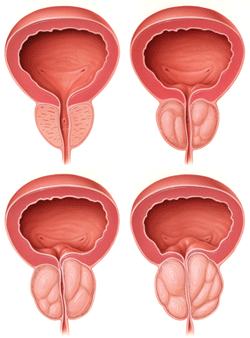 Before any conversation about recovery makes sense, you need to know what surgery actually changed inside the body. Most men leave the hospital with a general explanation that the nerves were affected. That is true, but it skips the mechanism, and the mechanism is what determines what happens next.
The Nerves Run Along the Prostate
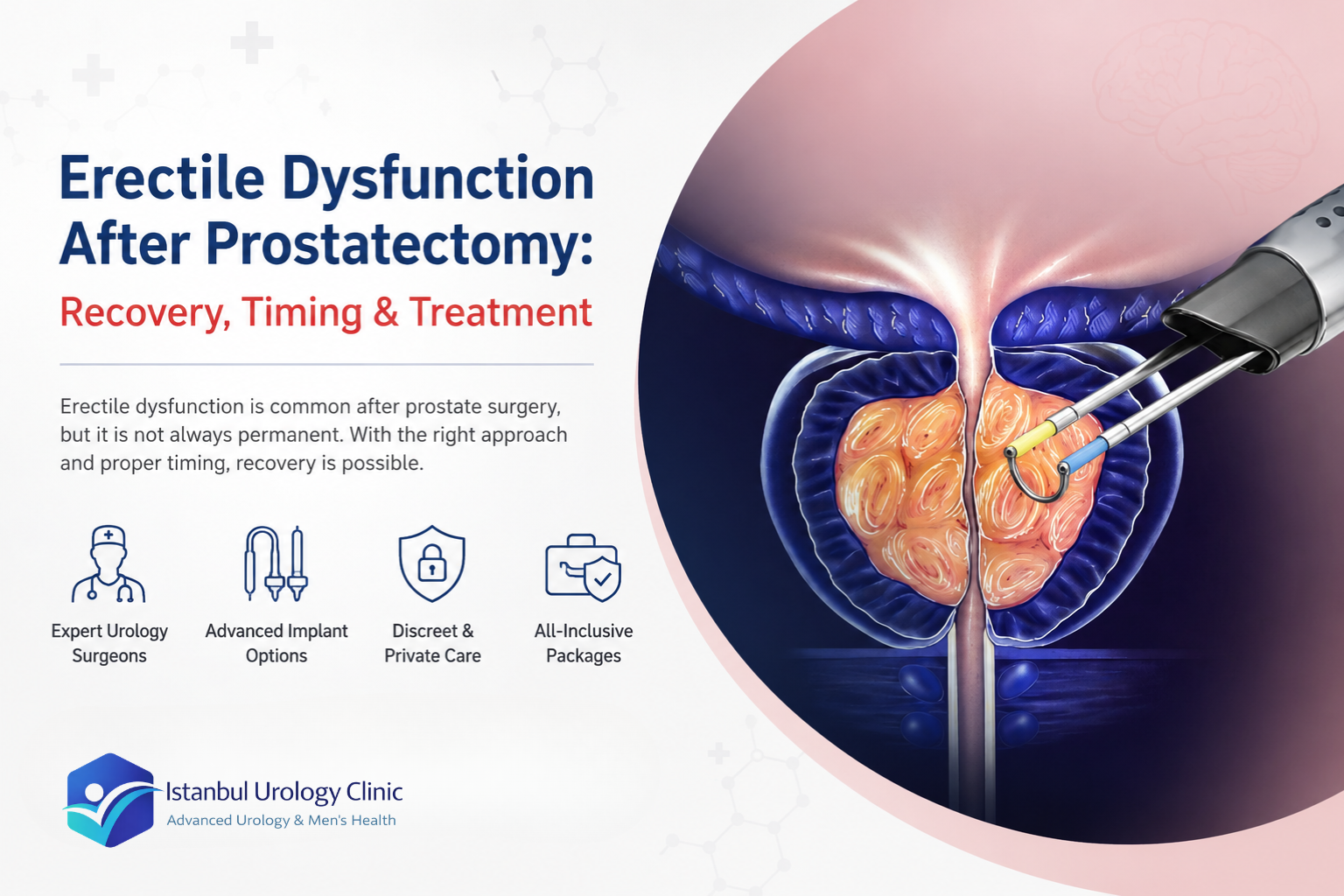
The cavernous nerves, the ones responsible for triggering erections, run along both sides of the prostate gland inside two thin neurovascular bundles. They sit so close to the prostate capsule that even the most precise surgical technique disturbs them. In nerve-sparing surgery the bundles are preserved, but they are still stretched, handled, and exposed to inflammation. This causes neuropraxia, which is a temporary nerve shock where the wiring is intact but the signal is not transmitting properly. Neuropraxia is not nerve damage in the permanent sense. It is the nerves going quiet while they recover, and recovery takes months.
In non-nerve-sparing surgery, where the bundles had to be removed for oncological reasons, the wiring itself is gone on that side. The mechanism for natural arousal-driven erections is no longer there, regardless of how patient you are with the recovery process.
The Tissue Changes Even When the Nerves Are Spared
Erections do more than serve sexual function. The penile tissue is built to expand and fill with oxygenated blood regularly, and that oxygenation keeps the tissue elastic and healthy. When erections stop happening, even temporarily, the tissue loses oxygen. Over months, this can lead to fibrosis, which is the formation of scar tissue inside the erection chambers. Fibrosis shortens the penis, reduces elasticity, and makes future erections harder to produce even after the nerves themselves have recovered.
This is the reason penile rehabilitation matters. The point is not to force erections during a time when arousal cannot reliably produce them. The point is to keep the tissue oxygenated and elastic so that when nerve signaling returns, the tissue is still capable of responding. A man who does nothing during the first 12 months and a man who follows a structured rehabilitation protocol can have similar nerve recovery and very different functional outcomes, because one of them preserved the tissue and the other did not.
Knowing this changes how you read the rest of this article. Erectile dysfunction after prostatectomy is not one problem. It is the combination of slow nerve recovery and ongoing tissue change, and effective treatment has to address both.
Nerve-Sparing vs Non-Nerve-Sparing: What Your Surgery Type Predicts
The single biggest predictor of how your recovery will unfold is what kind of surgery you had. Two men with identical health profiles, identical ages, and identical rehab effort will have very different outcomes depending on whether one, both, or neither of the neurovascular bundles were preserved during prostatectomy. Before you measure your progress against any timeline, you need to know which category you fall into. Your operative report will state this clearly. If you do not have it, request a copy from the surgical team. It changes everything that follows.
Bilateral Nerve-Sparing
Both neurovascular bundles preserved
The best-case scenario for erectile recovery. Both sides of the nerve pathway were left intact during surgery, and the dysfunction you are experiencing now is mostly neuropraxia rather than permanent loss. With structured rehabilitation and time, somewhere between 40% and 80% of men in this group recover erections firm enough for intercourse within 24 months. Younger patients, men with healthy vascular baseline, and those who started rehab early sit at the higher end of that range.
Unilateral Nerve-Sparing
One side preserved, one side removed
The middle group. Half the wiring is gone, half is intact and recovering. Functional recovery is possible but takes longer, the response to oral medication is less reliable, and the realistic outcome is often partial. Roughly 20% to 40% of men in this group recover unassisted erections, and a larger proportion regain function with the help of medication, vacuum support, or injection therapy during the rehabilitation phase.
Non-Nerve-Sparing
Both bundles removed (oncological priority)
When cancer extension required removing both neurovascular bundles, the natural arousal-to-erection pathway is no longer present. Spontaneous erections do not return. This does not mean intimacy is over. It means the realistic conversation moves toward injection therapy or a penile implant earlier than it would in nerve-sparing cases. Rehabilitation in this group is still valuable, but the goal shifts from recovery of natural function to preservation of tissue health for future treatment.
If you do not know which category applies to your case, that is the first thing to resolve before reading further. Realistic expectations and meaningful rehabilitation depend on it.
The 24-Month Window: Four Phases of Recovery
Erectile recovery after prostatectomy does not happen on a steady upward line. It happens in phases, and each phase has its own pattern, its own clinical priority, and its own typical patient experience. The timeline below reflects what we see in clinic with bilateral and unilateral nerve-sparing patients on structured rehabilitation. Non-nerve-sparing cases move through a compressed version of the same phases, with the decision point arriving earlier.
1
Phase 1: The Quiet Phase (Months 0 to 3)
This is the period of deepest neuropraxia. Spontaneous erections are absent or very weak. Morning erections, the ones that should happen naturally during sleep, are gone. Oral medication produces little to no response. None of this is failure. The nerves are not transmitting properly yet, and the tissue is at risk of losing oxygenation. The clinical priority is starting rehabilitation early, even if the body is not responding visibly. The men who skip this window are the ones who run into fibrosis problems later.
2
Phase 2: The Active Phase (Months 3 to 12)
The phase where rehabilitation matters most. Some response to oral medication usually returns during this window in nerve-sparing patients, often partial and inconsistent at first. Morning erections may reappear, weaker than they used to be. The protocol should be running daily by now. This is when most measurable recovery happens, and it is also the phase where men give up too early because progress feels invisible week to week. The body is updating slowly. Trust the timeline even when nothing seems to be changing.
3
Phase 3: The Pattern Phase (Months 12 to 18)
Your specific trajectory becomes clear during this window. By month 12, you can usually see which group you are in. Recovering well with oral medication, recovering partially and needing injection support, or recovering slowly enough that the conversation will eventually shift toward more definitive options. This is also the phase where rehabilitation protocols often get adjusted based on what is actually working for you. The goal is no longer to wait. The goal is to optimize what your body has shown it can do.
4
Phase 4: The Decision Phase (Months 18 to 24+)
By 18 months, the recovery curve has usually flattened. Whatever function returned has mostly returned. What has not returned by now usually does not return spontaneously. This is the honest decision point. For some men, the answer is to keep using medication or injections indefinitely because the result is good enough. For others, the answer is to consider a more permanent solution. Waiting beyond 24 months rarely changes the answer. It usually just delays it.
Knowing which phase you are in is the most useful thing you can do for yourself right now. The right rehabilitation effort in Phase 2 is overkill in Phase 4, and the right decision conversation in Phase 4 is premature in Phase 2.
Penile Rehabilitation: What We Actually Prescribe and Why
Penile rehabilitation is the clinical centerpiece of recovery from erectile dysfunction after prostatectomy, and it is also the part most poorly explained to patients before they leave the hospital. The protocol is not complicated, but it requires consistency, and it has to start early. Men who begin rehabilitation within the first 6 to 8 weeks after surgery consistently do better than men who wait six months to address the problem.
The goal of rehabilitation is not to force erections. It is to keep the tissue oxygenated, prevent fibrosis, and create the best possible foundation for whatever functional recovery is going to happen. Think of it as physical therapy for the penis. You are not waiting for the body to heal. You are actively keeping the tissue healthy while the nerves recover.
Our standard protocol combines four elements in sequence, layered in based on what your body is showing during follow-up:
- Daily low-dose oral PDE5 inhibitor. A small daily dose of tadalafil (5 mg) starting around week 4 to 6 after surgery. The daily dose is not for performance. It is to maintain background blood flow to the penile tissue and support nocturnal erections that the body is trying to produce. This is the foundation of modern rehabilitation, and it runs for at least 12 months.
- On-demand higher-dose oral therapy for attempts at intercourse. Once you are cleared by your oncology team, a higher on-demand dose (sildenafil 50 to 100 mg or tadalafil 20 mg) is added before intimacy attempts. Even when the medication does not produce a usable erection in the early months, the attempt itself matters. The body is updating.
- Vacuum erection device, starting from month 2 or 3. A vacuum pump used at home, 2 to 3 times per week, draws blood into the penis mechanically. Even without arousal. This is purely a tissue-health intervention, and it is one of the most evidence-supported pieces of the rehab protocol.
- Intracavernosal injection therapy when oral medication is insufficient. If oral medication is producing little to no response by month 4 to 6, low-dose injection therapy is added. The injection is small, the needle is fine, and most men adapt to it within a few attempts. It is the most reliable way to produce an erection during the rehabilitation phase when natural pathways are not yet responding.
The exact mix is adjusted based on your nerve-sparing status, your overall vascular health, and what your body responds to during follow-up. International guidance on this protocol is consistent. The European Association of Urology Sexual and Reproductive Health Guidelines recommend early initiation of pharmacological rehabilitation after radical prostatectomy, with combination therapy in cases where single-agent treatment fails.
The mistake we see most often is treating rehabilitation as something the body does on its own while the patient waits. It is not. Rehabilitation is active work, and the men who recover function are almost always the ones who started early and stayed consistent through the months when nothing seemed to be changing. The body is updating quietly during that period. The men who stopped because they could not feel a difference are usually the same men who arrive at the 18-month mark with less function than they could have had.
Prof. Dr. Ö. Onuk
Professor of Andrology, Istanbul Urology Clinic
One last clinical point. Rehabilitation does not guarantee recovery. It optimizes the chance of recovery. Some men do everything right and still end up needing more definitive treatment, because nerve recovery is biological and not entirely within anyone’s control. The value of rehabilitation is that it removes one of the variables you can actually influence. The men who skip it never know whether the outcome they got was the best they could have had.
When Pills Are Not Enough: Vacuum Devices and Injection Therapy
Most post-prostatectomy patients arrive at a moment, usually somewhere between months 3 and 9, when oral medication is producing inconsistent results or no results at all. This is not a sign that recovery has failed. It is a sign that the nerve pathway is not yet active enough to respond to pills that work by amplifying signals the nerves are supposed to be sending. When the signal is weak, amplifying it does not help much. Two tools step in during this period, and they work through different mechanisms.
← Swipe to see full table →
| Aspect | Vacuum Erection Device | Intracavernosal Injection |
|---|
| How it works | A handheld pump creates negative pressure around the penis, drawing blood in mechanically. A retention ring at the base holds the erection in place for intercourse. | A small needle is used to inject a vasodilator medication directly into the side of the penis. The medication forces local blood vessels to open and produces an erection within 5 to 15 minutes. |
| When we recommend it | From month 2 or 3 after surgery, used 2 to 3 times per week without the retention ring as a pure tissue-health intervention. Adding the ring for intercourse becomes useful from month 4 onward. | Added when oral medication is not producing a usable erection by month 4 to 6. Particularly important in non-nerve-sparing and unilateral cases where nerve recovery is slower or partial. |
| Compliance reality | The device is simple but requires routine. Men who set a schedule stay consistent. Men who use it only when they feel like it usually stop within weeks. | The needle worry fades after the first few attempts. The real adherence challenge is integrating it into intimacy without making it feel clinical. Partner involvement helps. |
| Limitations | The erection feels cooler and less natural than a medication-supported erection. The retention ring can be uncomfortable and should not be left in place beyond 30 minutes. | Dose has to be titrated carefully. Too low and nothing happens. Too high and the erection lasts too long, which is a medical issue requiring intervention. |
| When it fails | Usually because of inconsistency rather than the device itself. Tissue too fibrotic from skipped rehab is the other reason. | Less commonly. Most men respond if the dose is right and the technique is correct. When injection therapy stops working over time, the conversation usually shifts to a permanent solution. |
One is not better than the other. They serve different roles. The vacuum device is preventive, used regularly to keep tissue healthy. The injection is reactive, used when an erection is needed and the body will not produce one. Most men use both during the active rehabilitation phase, in different ratios depending on what their body responds to.
The Second Layer: When Post-Prostatectomy ED Becomes Psychological
One pattern reported consistently in post-prostatectomy follow-up, and rarely discussed before surgery, is the development of a second problem on top of the original one. Many men with erectile dysfunction after prostatectomy go through enough failed attempts during the recovery window that performance anxiety builds on top of the physical issue. The nerves may be slowly coming back, but the mental loop that watches every attempt for signs of failure is now interfering with whatever recovery is happening underneath.

The clue this is happening is usually a mismatch in the pattern. Erections during sleep or in the morning are slowly returning, the medication is producing partial response in private moments, and yet attempts at intercourse with a partner consistently fail. When the body is showing signs of recovery in low-pressure situations but failing in high-pressure ones, the issue is no longer purely physical.
The treatment for this layer is different from the rehabilitation work covered above. It involves the same loop-breaking interventions used in pure psychological erectile dysfunction: cognitive work to retrain attention, controlled exposure to rebuild successful experiences, and partner involvement to reduce the performance frame. Continuing to push oral medication harder rarely helps. The pill is working on blood flow. The block is in attention.
If this pattern matches your experience, the full framework is covered in our guide to psychological erectile dysfunction. Treating both layers in parallel is usually faster than treating them in sequence.
The 18 to 24 Month Decision Point: When Rehabilitation Has Reached Its Ceiling
Somewhere between month 18 and month 24, the recovery curve flattens. The gains made over the previous year stop accumulating, and the picture at that point is roughly the picture going forward.
The signs that rehabilitation has reached its ceiling are clearer when looked at together: no measurable improvement across the previous 6 months, morning erections still absent or very weak, oral medication producing only partial response on a good day, and injection therapy still working but no movement toward function without it. None alone is decisive. Together, they say the body has done what it is going to do.
How to Know Rehabilitation Has Plateaued
Four signs to look for: no functional improvement across the previous 6 months despite consistent rehab, no return of spontaneous morning erections by month 18, persistent need for injection therapy to achieve intercourse, and Doppler findings (when performed) showing established vascular and tissue changes rather than ongoing recovery. Three or four signs together shift the conversation from continued rehabilitation to what comes next.
At this stage, a penile Doppler ultrasound is the most useful single test available. It shows whether the underlying vascular bed can still support natural erections with more aggressive rehab, or whether the tissue and vascular changes have reached the point where no medication-based approach will produce reliable results. The answer determines whether to continue, intensify, or move toward a definitive solution.
The American Urological Association Erectile Dysfunction Guideline sets the standard: structured rehabilitation deserves a 12 to 24 month trial, and patients who have not recovered function within that window are appropriate candidates for second-line and third-line therapies including penile implants.
Waiting beyond 24 months rarely changes the answer. It delays the decision and adds another year of treatment fatigue. If the picture at month 24 is clear, the question is not whether to decide. It is what to decide.
If You Decide to Proceed: The Implant Conversation After Prostatectomy
If rehabilitation has reached its ceiling and the result is not enough, the next conversation is usually about a penile implant. Post-prostatectomy patients are one of the most consistent groups in terms of implant satisfaction, because the implant solves the specific problem they have. Reliable erections on demand, independent of nerve signaling and vascular response, both of which have already proven unreliable in their case.
Before any implant surgery is scheduled, your oncology team needs to confirm that your PSA is stable and that no active cancer treatment is planned within the next 12 months. This is a standard coordination step, not a hurdle. Once cleared, the implant decision becomes a conversation about which device fits your specific anatomy, hand function, and lifestyle.
The full picture of what implant surgery involves, candidate criteria, and what to expect is covered in our complete guide to penile implant surgery in Turkey. For the device most commonly placed in post-prostatectomy patients, including a real case from our practice, see our AMS 700 implant guide. And for the cost framework, including what an all-inclusive package covers, see our penile implant cost in Turkey guide.