
Most men who walk into my consultation room for penis enlargement surgery aren’t chasing extreme size. You’re here because something specific has been on your mind for years. Maybe it’s how the penis looks in the mirror. Maybe it’s how it feels during intimacy. Maybe it’s a number you saw online that you’ve been measuring yourself against ever since.
Whatever brought you to this page, the first useful thing to know is this: penis enlargement surgery isn’t one operation. It’s a category of medical procedures, each designed to solve a different concern. The full range of penile enlargement procedures my team offers exists because the man who wants more visible length needs a very different approach than the man who wants more girth, and both are different from the man whose real issue is appearance rather than measurement.
Choosing the right one starts with understanding what is actually causing the dissatisfaction. That’s where every honest consultation begins, and that’s where this guide will start as well.
What you’ll find below is the framework I use in every first consultation. The three dimensions worth separating. The realistic gains you can expect from each procedure. The conditions that disqualify a patient before surgery is even discussed. The misconceptions I correct most often. And a clear way to decide which direction fits you.
No pricing, no patient logistics, no marketing claims. That belongs on a different page. This one is for understanding the procedure itself, before the conversation about anything else.
- What Penis Enlargement Surgery Actually Means
- The Three Dimensions You Need to Separate
- Realistic Results from Penis Enlargement Surgery
- Categories of Penis Enlargement Surgery
- Surgical vs Non-Surgical Options
- Common Misconceptions I Correct Most Often
- Who Is a Good Candidate?
- What Penis Enlargement Surgery Cannot Do
- How to Decide What's Right for You
- The Bottom Line on Penis Enlargement Surgery
- What Penis Enlargement Surgery Actually Means
- The Three Dimensions You Need to Separate
- Realistic Results from Penis Enlargement Surgery
- Categories of Penis Enlargement Surgery
- Surgical vs Non-Surgical Options
- Common Misconceptions I Correct Most Often
- Who Is a Good Candidate?
- What Penis Enlargement Surgery Cannot Do
- How to Decide What's Right for You
- The Bottom Line on Penis Enlargement Surgery
What Penis Enlargement Surgery Actually Means
 A patient who walks in saying he wants “enlargement” is rarely saying what he means. The word is too broad. It groups together procedures that work in completely different ways, solve different problems, and produce different results.
When my team uses the term penis enlargement surgery, we’re describing a category, not a single operation. Three distinct surgical directions sit under that umbrella.
The first works on length, which is the visible portion of the shaft. A significant part of the penis sits inside the body, anchored to the pelvis. Length surgery releases more of that hidden portion externally, so it becomes visible without altering the internal anatomy.
The second works on girth, which is the thickness or circumference. This is added either by using your own fat tissue around the shaft, or by placing a custom silicone implant beneath the skin.
The third works on appearance, which is how the penis presents visually. A normal penis can look much smaller than it actually is because of excess pubic fat, scrotal webbing, or a buried position. Correcting these does not change the underlying anatomy at all. It reveals what’s already there.
These three directions sometimes overlap in the same patient, which is why some operations are performed together. But they’re not interchangeable. Choosing a girth procedure to solve a length concern produces a satisfied surgeon and a confused patient who looks in the mirror and still wonders why nothing got longer. The procedure worked. It just wasn’t the right procedure.
That’s why the first useful conversation isn’t about technique. It’s about which of the three you actually want changed. The technique only makes sense once that question is answered.
The Three Dimensions You Need to Separate
The single most useful question I ask in a first consultation isn’t “how big do you want to be?” It’s “when you look in the mirror, what specifically bothers you?” The answer almost always falls into one of three categories, and which category you’re in decides the entire treatment plan.
Length
Length is the visible portion of the penile shaft, measured from the pubic bone to the tip. What you see externally is only part of the anatomy. A significant portion sits inside the body, anchored by structures called the suspensory ligaments. Length surgery releases those internal anchors so more of the shaft becomes externally visible.
Realistic gains sit between 2 and 5 cm of flaccid appearance, depending on how much hidden length you have to work with. Erect length changes are far more modest, roughly 1 cm. The reason is anatomical. The erect penis is anchored by internal structures that no surgery alters. So the dramatic gain you see in the flaccid state doesn’t translate into the same gain when fully erect.
Girth
Girth is the thickness or circumference of the shaft. For most men who finally book a procedure, girth ends up being the dimension that matters more than length, because thickness has a stronger visual and sensory presence both for you and for your partner.
Girth is increased in two ways. Fat transfer (also called lipofilling) uses your own fat tissue, harvested from the abdomen or thighs and injected around the shaft. The result feels natural because it’s your own tissue. Silicone implants like Peniflex and Penuma are placed permanently beneath the skin, delivering a fixed girth increase that doesn’t depend on biological reabsorption.
Visual Appearance
This is the dimension most patients never think to mention, and it’s often the real reason they’re unhappy. The penis itself may be perfectly normal in length and girth. What’s altered is how it presents visually, hidden by excess pubic fat, pulled upward by scrotal webbing, or retracted into the surrounding tissue (buried penis).
These aren’t enlargement problems. They’re correction problems. The underlying penile length is already there. The procedure reveals it instead of adding to it. The visual change can be dramatic without a single centimeter being added anywhere.
Once you separate these three, the right procedure becomes obvious. The wrong one becomes obvious too. The table below summarizes how each dimension is addressed surgically.
| Dimension | What It Addresses | How It Is Treated |
|---|---|---|
| Length | Visible shaft length, mainly flaccid | Suspensory ligament release, V-Y advancement |
| Girth | Shaft thickness and circumference | Fat transfer (lipofilling), silicone implants (Peniflex, Penuma) |
| Visual Appearance | How the penis presents visually | Suprapubic correction, penoscrotal plasty, fat pad reduction |
Realistic Results from Penis Enlargement Surgery
This is where consultations succeed or fail. A realistic expectation is a clearly defined goal, not a number you saw online. A patient who tells me he wants his flaccid penis to look noticeably longer in the mirror is far easier to satisfy than a patient who tells me he wants to add 10 cm to his erect length. The first goal is achievable. The second isn’t, with any technique, anywhere in the world.
A 2024 systematic review of penile augmentation surgical outcomes, covering 46 studies and published in Medicina, confirms what experienced surgeons see in practice: meaningful but bounded gains, with the strongest results coming from suspensory ligament release combined with adjunct techniques.
Here is what I tell every patient about what penis enlargement surgery can realistically deliver.
| Procedure | Main Goal | Permanence | Realistic Gain |
|---|---|---|---|
| Suspensory Ligament Release | Length | Permanent | +2 to +5 cm flaccid, ~+1 cm erect |
| Suprapubic Liposuction | Visual length | Permanent | Reveals buried length |
| Penoscrotal Plasty | Visual length | Permanent | Immediate correction of webbing |
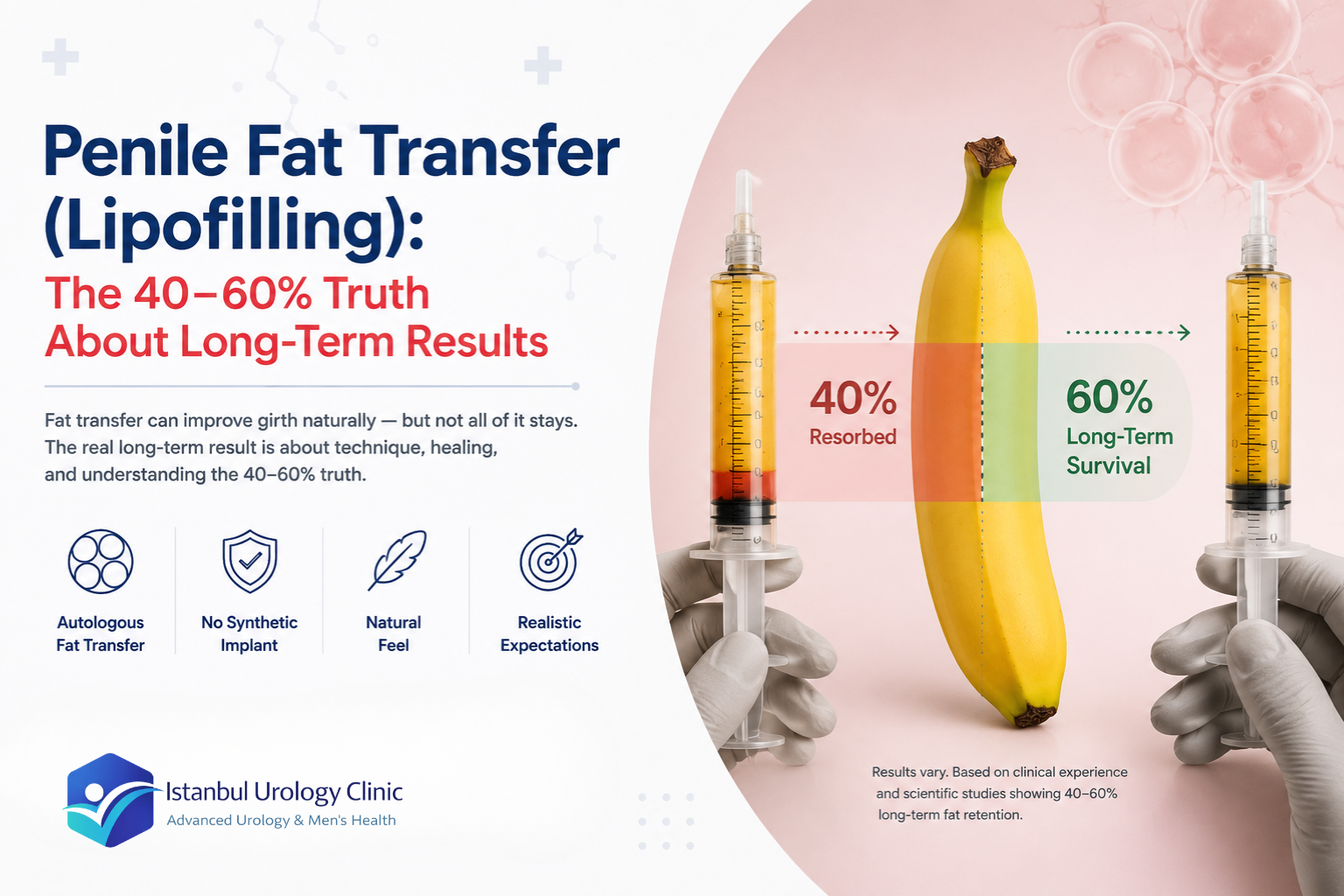
| Fat Transfer (Lipofilling) | Girth | Partially permanent | +2.5 to +5 cm girth, ~40–50% retained long-term |
| Hyaluronic Acid Filler | Girth | Temporary | Visible girth, lasts several months |
| Peniflex Silicone Implant | Girth | Permanent | +2.5 to +5 cm girth, fixed result |
| Penuma Silicone Implant | Girth + visual length | Permanent | Custom sizing, FDA-cleared |
The numbers in the table aren’t best-case scenarios. They’re honest ranges based on what consistently happens after healing is complete, around 6 to 12 months post-surgery.
For length procedures, flaccid gain is significantly larger than erect gain. This is anatomy, not technique. The hidden internal portion of the penis is what we work on, and that portion shows up most visibly when the penis is relaxed.
For fat transfer girth procedures, the body absorbs back roughly 40 to 50 percent of the injected fat during the first year. This is why fat is injected in controlled excess at the time of surgery. The result you live with long-term, around 12 months out, is the result both sides planned for. The remaining fat becomes permanent shaft tissue.
For silicone implant girth procedures (Peniflex, Penuma), the result is immediate, fixed, and doesn’t depend on biological reabsorption. Day one looks the same as month twelve.
If anywhere online you have seen claims of 10 cm of erect gain from any surgery, that claim is false. The clinic making it is either misleading you or quoting flaccid numbers and labeling them as erect. There is no exception to this.
Categories of Penis Enlargement Surgery
Once you know which dimension you want changed, the procedure direction becomes clear. My clinic divides penis enlargement surgery into three categories. The visual below shows them side by side, and the sections below go deeper into the techniques inside each one.
Length Enhancement Procedures
Length is added by releasing internal anchors, not by growing new tissue. Four techniques cover the range of what is anatomically possible: suspensory ligament release, V-Y advancement, suprapubic liposuction, and penoscrotal plasty. They are sometimes performed alone, more often combined in the same operation, depending on which anchor is the limiting factor for the patient on the table.
Ligament release is the core operation. V-Y advancement supports it so the released length does not retract during healing. Suprapubic liposuction removes the fat pad that buries the base. Penoscrotal plasty repositions the scrotal skin that pulls the underside upward. Which of these you actually need depends on which anchor is holding your visible length back, and that is decided at the in-person examination.
The full technical detail of each technique, the expected gain per anatomy, the recovery timeline, and which combinations work best together are covered in our dedicated guide on penile lengthening surgery.
Girth is added in two ways. The first uses your own tissue. The second uses a permanent silicone implant. Each one has a place, and the choice depends on what you value more: a natural feel that may partially reabsorb, or a fixed result that does not change over time.
Fat transfer (lipofilling) harvests fat from the abdomen or thighs and injects it around the shaft. The result feels natural, and what survives the first-year reabsorption becomes permanent shaft tissue.
Hyaluronic acid filler is the non-surgical girth option. It delivers visible girth without an operation but fades over 12 to 18 months. It suits men who want to test the look of added girth before committing to a permanent procedure.
Peniflex is a soft silicone sleeve placed permanently beneath the penile skin, designed around comfort and flexibility with a girth-only outcome. Full detail in our Peniflex implant article.
Penuma (also known as Himplant) is an FDA-cleared silicone implant designed primarily for visible flaccid presence in addition to permanent girth. Full detail in our Penuma Himplant article.
The decision between Peniflex and Penuma is not about which implant is better. It is about which result you actually want: a softer feel and girth-only outcome, or a stronger flaccid presence and a more visible profile at rest. That decision is made during evaluation, not from a product page.
Combined Length and Girth Procedures
Most international patients who travel for penis enlargement surgery want both length and girth in the same trip. Combined procedures perform the lengthening and girth-enhancing techniques in the same operation, under the same anesthesia, with a single recovery.
The result feels proportionate rather than exaggerated, because both dimensions are planned together from the start. The most common combinations are lipofilling with lengthening (tissue-based girth), Peniflex with lengthening (silicone sleeve girth), and Penuma with lengthening (FDA-cleared silicone implant).
A combined procedure is cost-effective in two ways. You save one recovery period and one set of travel costs, and the surgical team can plan the proportions of length and girth together so the final outcome looks balanced.
Surgical vs Non-Surgical Options
Patients arriving at my clinic often ask the same question early in the consultation: do I really need surgery? The honest answer depends on what you want to change and how long you want the result to last. Surgical and non-surgical options are not direct replacements for each other.
They serve different patients, with different goals, and different appetites for recovery. The comparison below shows where each one fits.
- Significant length and girth gain possible
- Permanent or partially permanent
- Single recovery period of 4 to 6 weeks
- General or regional anesthesia
- One-time investment, no repeat sessions
- Addresses length, girth, and visual appearance
- Modest girth improvement only
- Temporary, lasts several months
- Minimal downtime, back to routine within days
- Local anesthesia or topical only
- Lower upfront cost, but repeat sessions add up
- Doesn’t address length or visual appearance
If you want a lasting, visible change, surgery is the only direction that delivers it. If you want to test the look of added girth before committing, or you have a short-term goal in mind, hyaluronic acid filler is a legitimate medical option. What it isn’t is a permanent substitute. Any clinic that markets filler as a long-term replacement for penis enlargement surgery isn’t being straight with you.
Common Misconceptions I Correct Most Often
Every patient who walks into my consultation room has already done research. Some of it was useful. Some of it was misleading marketing dressed up as medical information. These are the three corrections I make most often before any decision about penis enlargement surgery is finalized.
Pills, supplements, and creams do not permanently enlarge the penis. No oral product has ever been shown to produce a permanent change in penile size, and many of them contain undeclared pharmaceutical ingredients that can be genuinely harmful. The honest breakdown of what the marketing claims, what the products actually contain, and what regulatory inspections keep finding is covered in our article on penis enlargement pills.
Surgery doesn’t add dramatic length to the erect penis. This is the most common disappointment I have to manage before it becomes a real one. Lengthening surgery primarily changes flaccid appearance. The erect gain is roughly 1 cm, sometimes less, and there’s no technique anywhere that changes this. If your goal is a dramatically longer erect length, no honest surgeon can deliver it.
Bigger isn’t always better. The most satisfying results from penis enlargement surgery look natural and proportionate, not extreme. Over-injected fat creates lumps that have to be revised later. Over-sized implants stretch tissue beyond comfort. Excessive lengthening produces visual outcomes that look unnatural. The patients I see the highest long-term satisfaction in are the ones who came in asking for a sensible result, got it, and stopped thinking about it.
If something you’ve read about enlargement sounds too convenient, too dramatic, or too cheap to be true, it usually is.
Who Is a Good Candidate?
Not every patient who books a consultation is scheduled for surgery, and that’s intentional. A good candidate isn’t simply someone who wants the procedure. It’s someone whose anatomy, health, and expectations make a real, lasting result achievable.
The patients I clear for penis enlargement surgery generally share a clear set of characteristics:
- Age 21 or older. Penile development is complete by this point, so the result is stable for life.
- Good general health. Healing is faster, and the risk of complications is significantly lower.
- Healthy erectile function. Strong, full erections support the integrity of the surgical result over time.
- Realistic expectations. Satisfaction depends on matching the right procedure to the right goal, not on chasing extreme numbers.
- Stable body weight. Significant weight changes after surgery affect the visual outcome, especially for fat-based girth procedures.
- Non-smoker, or willing to pause smoking. Smoking slows healing and raises complication risk for any surgical procedure.
On the other side, several conditions need to be evaluated or treated before surgery can be planned. This isn’t about turning patients away. It’s about protecting both the result and the patient.
- Severe erectile dysfunction. Function is addressed first. The size conversation, if still relevant, comes after.
- Uncontrolled diabetes. Blood sugar must be stabilized before any surgical intervention to ensure proper healing.
- Active genital or urinary infection. Resolved fully before surgery is scheduled, with no exceptions.
- Bleeding or clotting disorders. Evaluated case by case to assess surgical safety.
- Severe obesity. Weight optimization is recommended first, both for safety and for a better visual outcome.
- Unrealistic expectations. Addressed in an honest consultation before any procedure is offered.
A special note on micropenis: standard penis enlargement surgery is not designed for true micropenis, and recommending it to a patient with this condition would not deliver a meaningful result. These cases follow a separate evaluation pathway that may involve hormonal assessment, specialized surgical techniques, or a combined treatment plan. Full detail is available in our micropenis treatment guide.
What Penis Enlargement Surgery Cannot Do
This is the section most marketing-driven pages avoid. I’ll cover it directly, because patients who know the limits before surgery are the ones who leave satisfied after it.
Penis enlargement surgery cannot add 10 cm to your erect length. No technique, used by any surgeon, anywhere in the world, has ever consistently produced that. Erect gain is modest. Flaccid gain is where the visible change happens.
It cannot treat erectile dysfunction. A penis that doesn’t reach full rigidity will look shorter and feel less satisfying than the same penis at full erection. If incomplete erections are part of the picture, that gets evaluated first. Adding length or girth to a penis that can’t sustain a firm erection doesn’t solve the actual problem.
It cannot guarantee partner satisfaction. Intimacy involves attention, communication, comfort, and physical chemistry that no surgery touches. The procedure can change measurements. It cannot change relationships.
It cannot trade function for form. Any operation that compromises sensation, erectile function, or urinary function is a failed operation, regardless of how the result looks. The whole point is to improve what you see without compromising what you feel.
How to Decide What's Right for You
If you’ve read this far, you have most of what you need to make an informed decision. The framework is simple, and it boils down to three honest questions.
1. What specifically do you want to see change? Length, girth, or appearance? Once you’ve answered that one with precision, the procedure category narrows immediately. Vague answers like “I want it bigger” don’t lead anywhere useful. Clear answers like “I want my flaccid penis to look noticeably longer” or “I want more thickness during intimacy” map directly to specific surgical directions.
2. What’s your appetite for recovery? Surgical penis enlargement surgery delivers a permanent result, but it requires four to six weeks of structured recovery and a six-week pause on sexual activity. Non-surgical girth filler delivers a temporary result with no real downtime. Different patients, different priorities.
3. Do you have any condition that needs to be addressed first? Severe erectile dysfunction, uncontrolled diabetes, active infection, significant obesity, or unrealistic expectations all change the path. Honest evaluation surfaces these early, before they become problems.
Once you can answer all three clearly, you’re ready for a personal evaluation. That’s the conversation that translates this framework into a specific plan built around your anatomy and your goals. Until then, this article gives you the structure you need to walk into that conversation with the right questions.
Frequently Asked Questions
The Bottom Line on Penis Enlargement Surgery
The patients who walk out of my clinic genuinely satisfied are rarely the ones who walked in chasing the biggest possible number. They are the ones who arrived clear about what they wanted to change, listened to an honest assessment of what was achievable, and let the surgical plan be built around their anatomy instead of around a number they had in their head.
A successful result is not the largest result. It is the right result, performed for the right reasons, on the right anatomy.
The first principle is choosing the right procedure. Length, girth, and appearance are three different concerns that require three different surgical directions. The wrong procedure cannot produce the right outcome, no matter how skillfully it is performed.
The second is realistic expectations. Patients who arrive expecting outcomes that fall outside anatomical limits leave disappointed even by surgeries that are technically perfect. Patients who arrive with clear, achievable goals leave satisfied even with modest results.
The third is proportion. The most satisfying results look natural and balanced. Excessive enlargement does not produce excessive satisfaction. It usually produces complications and the need for future correction.
The fourth is preserving function. Sexual function, sensation, and erectile capacity matter more than any aesthetic gain. Any operation that trades the second for the first is a failed operation, no matter how the result looks.
Penis enlargement surgery, done correctly, is a one-time decision that you live with for the rest of your life. That is why it deserves a precise diagnosis first, a personal conversation second, and the procedure third. In that order.