
Most men ask about size first. The question that matters more, you usually only think of later: what will it feel like to live with, every day, for the next thirty years.
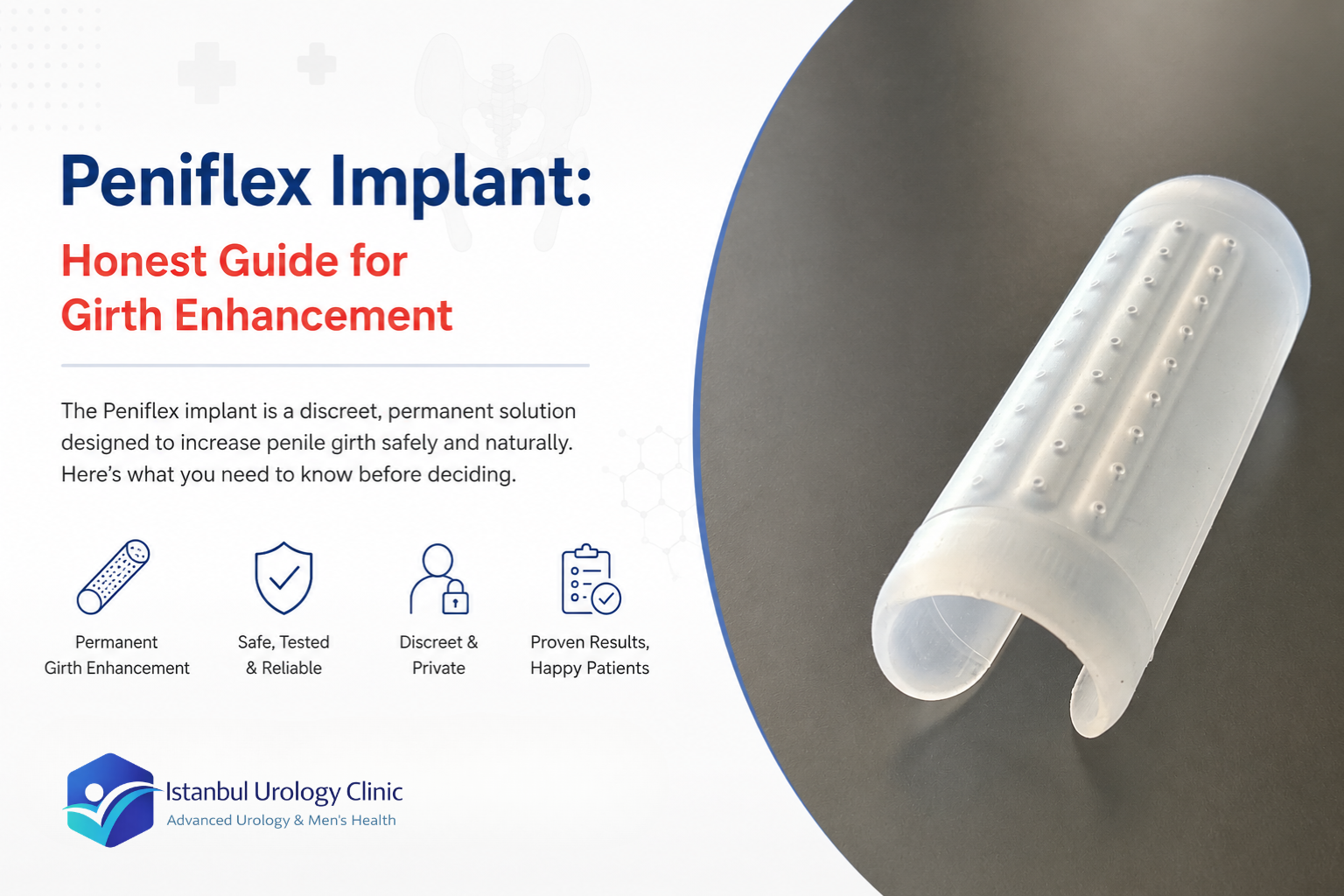
Peniflex was built around that second question. It is a soft, medical-grade silicone shell placed under the skin of the penis to add permanent girth. The design priority is not maximum thickness on paper. It is a thicker shaft that still moves naturally when you walk, sit, or wear fitted clothing, and stays soft when not erect rather than feeling firm the way older implant designs tended to feel.
That softness is also why candidacy is narrower than most patients expect. Peniflex performs at its cleanest on tissue that has never been worked on before. No fillers, no PMMA, no fat transfer in the past. It does not extend erection length, it does not change flaccid length, and it does not treat erectile dysfunction. One outcome, done permanently, on the right anatomy. The rest of this article is the honest version of who that fits and who it does not.
- What Is the Peniflex Implant?
- What Makes Peniflex Different: Flexibility, Comfort, Daily Movement
- Who Peniflex Was Built For, and Why Clean Tissue Matters
- Circumcision and Peniflex
- Peniflex in Daily Life: Clothing, Movement, and Flaccid Appearance
- Peniflex and Mild ED: Where to Draw the Line
- Peniflex Surgery, Step by Step
- Recovery: Week by Week
- Realistic Results: What Peniflex Gives You, and What It Doesn't
- Sex Life and Sensation After Peniflex
- Risks and Possible Complications
- Peniflex vs Penuma: Two Implants, Two Different Goals
- Peniflex vs Fillers vs Fat Transfer
- A Case From Our Practice
- The Bottom Line on Peniflex
- What Is the Peniflex Implant?
- What Makes Peniflex Different: Flexibility, Comfort, Daily Movement
- Who Peniflex Was Built For, and Why Clean Tissue Matters
- Circumcision and Peniflex
- Peniflex in Daily Life: Clothing, Movement, and Flaccid Appearance
- Peniflex and Mild ED: Where to Draw the Line
- Peniflex Surgery, Step by Step
- Recovery: Week by Week
- Realistic Results: What Peniflex Gives You, and What It Doesn't
- Sex Life and Sensation After Peniflex
- Risks and Possible Complications
- Peniflex vs Penuma: Two Implants, Two Different Goals
- Peniflex vs Fillers vs Fat Transfer
- A Case From Our Practice
- The Bottom Line on Peniflex
Key Points
Five things to understand before you read any further. If any of these change the conversation for you, the rest of the article will be more useful.
- Peniflex is a permanent girth implant made from soft medical-grade silicone.
- It sits under the skin of the penis, completely outside the erectile chambers.
- It does not increase erection length, and it does not noticeably change flaccid length. This is where Penuma takes a different direction.
- Surgery is performed under anesthesia and usually requires one night in the hospital.
- The most predictable results come from patients whose tissue has never had fillers, PMMA, or fat transfer.
What Is the Peniflex Implant?
Peniflex is a soft silicone shell manufactured from medical-grade material, designed to sit under the skin of the penis and add circumference. Once the implant is in place, the body adjusts to it over the following weeks, and the result is a thicker shaft in both the flaccid and erect states. The shell stays flexible, so the penis continues to move naturally during walking, sitting, or intimacy.
What Peniflex is not, matters as much as what it is. It is not a prosthesis for erectile dysfunction. It does not replace or interact with the erectile chambers. It does not pull length from inside the body the way a ligament release surgery does. And it is not a lengthening device. If your concern is rigidity or length, you are looking at a different category of procedure entirely.
Soft Medical-Grade Silicone
A flexible silicone shell, biocompatible and designed for long-term implantation under the penile skin. The softness is what allows the implant to move with the body rather than feel rigid.
Under the Skin, Outside the Erectile Chambers
Placed in the layer between the skin and the underlying tissues. The implant does not touch the structures responsible for erection, which is why erectile function is preserved.
Permanent Girth Only
Designed for one outcome: permanent thickness. Length and erectile function are handled by other procedures, and combining them is a decision made during evaluation.
What Makes Peniflex Different: Flexibility, Comfort, Daily Movement
Size is usually the first question men ask about Peniflex. Comfort becomes the bigger question after surgery. An implant that adds the right amount of girth on paper, but feels rigid when you sit, walk, or wear fitted clothing, is not a result anyone wants to live with for the next thirty years.
This is the part of the procedure that separates a good outcome from a satisfying one. Peniflex was designed around four practical priorities: how the implant moves with the body, how it feels when flaccid, whether sensation stays intact, and how stable the result remains over time.
Who Peniflex Was Built For, and Why Clean Tissue Matters
Not every man interested in girth enhancement is a fit for Peniflex. The implant works best on a specific kind of anatomy: soft, untouched tissue, with normal erections and realistic expectations. When those conditions are present, the result is predictable. When any of them is missing, the surgery becomes more complex, and so does the recovery.
What About Hidden Penis or Buried Penis?
Not every man considering enlargement has an unusually small penis. Some have what is called hidden penis or buried penis, where part of the shaft is concealed by excess pubic fat or skin coverage, making the penis look shorter than it actually is. Others have measurements within the normal range but feel dissatisfied with thickness or overall proportions. Peniflex helps in selected cases by improving visible girth and proportion, but when buried penis anatomy is the main issue, fat reduction or skin adjustment often gives a stronger visual result before or instead of implant placement.
If You’ve Had Previous Enlargement Procedures
Previous fillers, PMMA, or fat transfer change how the tissue accepts a new implant. Peniflex can still be possible in selected cases, but the surgery becomes a revision case with a different evaluation, different planning, and sometimes a staged approach over two surgical sessions. A separate guide on revision cases after previous enlargement procedures covers how each material affects the decision and what realistic outcomes look like.
The pathway below is the same one used during your first consultation. It is the reason a detailed assessment matters more than the brand name on the implant.
Clean tissue with no previous enlargement procedures, stable erectile function, realistic expectations about a girth-only outcome, and good general health.
Previous fillers, PMMA, fat transfer, mild erectile weakness, or hidden penis anatomy. The plan changes and a separate assessment is needed.
Uncontrolled diabetes, active infection, severe erectile dysfunction expecting Peniflex to restore rigidity, or unrealistic expectations about size. Other treatments come first, or instead.
If you are still comparing options across length, girth, and combined approaches before narrowing down to a specific procedure, the full range of penile enlargement options walks through how each method is matched to anatomy and goals.
Circumcision and Peniflex
Circumcision is not required for every Peniflex patient. Whether it is recommended depends on your foreskin anatomy, skin elasticity, hygiene, and the planned implant size. Because Peniflex increases circumference, the skin needs to adapt comfortably to the new shape. During consultation, the foreskin and surrounding tissues are checked to decide whether circumcision will improve the final result or whether your existing anatomy is already a good fit.
If circumcision is recommended in your case, three sequences are possible. Each one has trade-offs that are discussed before surgery.
Peniflex in Daily Life: Clothing, Movement, and Flaccid Appearance
Most of your day is spent walking, sitting, working, or wearing normal clothes, not measuring. The practical concerns that come up before surgery are usually about how the implant feels in real life. The honest answers are simpler than most men expect.
Clothing and Concealment
After healing, normal trousers, jeans, shorts, and fitted clothing fit without an obvious change in contour. The soft silicone keeps the flaccid shape natural rather than projecting through fabric. Most men find that nothing visible changes in how they dress, including in business attire or athletic wear.
Walking, Sitting, and Normal Movement
Once recovery is complete, walking, driving, sitting at a desk, traveling, and intimacy do not require any special adjustment. The implant is designed to flex with the body. Strenuous physical activity stays restricted only during the first weeks of healing, then returns to normal.
Flaccid Appearance
The shaft looks fuller and projects more naturally at rest, while staying soft and movable. This is the visible change most men notice in everyday situations, more than during intimacy itself. The flaccid result is one of the most appreciated outcomes after recovery, even though it gets less attention before surgery.
The concerns that bring most men into the consultation are usually the ones that fade fastest after recovery. What remains a year later is comfort, not the fear of being noticed.
Peniflex and Mild ED: Where to Draw the Line
Peniflex is not a treatment for erectile dysfunction. The implant sits outside the erectile chambers and does not interact with the mechanism that creates an erection. If your erections are weak, soft, or unreliable, adding girth on top of that does not solve the underlying problem. It usually makes the conversation harder afterward, because the size has changed but the rigidity has not.
Mild erectile weakness is a different situation. If your erections are generally functional and the main goal is cosmetic, Peniflex can still be considered after a proper evaluation that looks at blood flow, hormone levels, medication response, and lifestyle factors. If the assessment shows that erection quality is the real concern, the conversation moves toward erectile dysfunction treatment first, and the cosmetic decision is revisited only once function is restored. Fixing the wrong problem rarely produces a satisfied patient.
Peniflex Surgery, Step by Step
The procedure itself is short. Most of the planning happens before you arrive at the hospital, and most of the recovery happens after you leave. The trip below reflects how the process is actually delivered for international patients, from arrival in Istanbul to the flight home.
The total trip averages 7 to 10 days for most patients. The exact length depends on how recovery progresses and on whether circumcision or any additional procedure is performed during the same operation.
Recovery: Week by Week
Recovery happens in clear phases. The first week is about protecting the area while the tissues begin to heal. The following weeks are about returning to normal life. The final shape settles over several months as swelling fully resolves and the implant integrates with the surrounding tissue.
Settling and Protecting
Mild swelling, bruising, firmness, and temporary discomfort are expected during the first days. Keep the area clean, take prescribed medications, and avoid unnecessary movement. Supportive underwear helps the implant settle comfortably in position.
Returning to Normal Routine
Swelling decreases and daily activities become easier. Desk work and normal routines usually resume within this window. Minor firmness or asymmetry can still be present and does not reflect the final result. Demanding physical activity stays restricted. Sexual activity, including masturbation, is postponed for around six weeks.
Final Shape and Long-Term Result
The implant continues to soften and integrate with the surrounding tissue. The result you see at month three is close to the final outcome, with small refinements continuing for several more months. Travel home, gym, and intimacy resume normally well before this point.
Realistic Results: What Peniflex Gives You, and What It Doesn't
Setting expectations honestly is the part of the consultation that decides whether a patient is happy at the one-year follow-up. Peniflex delivers a specific result. It does not deliver everything men sometimes hope for from enlargement surgery, and pretending otherwise is how patients end up disappointed.
That is the realistic range. Some patients gain slightly less, some slightly more, depending on anatomy and the implant size selected. The numbers align with the broader literature on subcutaneous silicone girth implants. A 2024 study published in Therapeutic Advances in Urology reviewing outcomes from 92 subcutaneous silicone implant cases reported an average circumference increase of 3.1 cm, consistent with what we observe in clinical practice. The goal is balanced proportion, not the largest possible number. Pushing implant size beyond what the tissue can comfortably accept is one of the main causes of complications later on.
- Adds permanent circumference, in the typical range above.
- Creates a fuller shaft in both the flaccid and erect states.
- Keeps the penis soft and naturally movable when not erect.
- Preserves normal sensation and erectile function.
- Removes the cycle of fillers and maintenance sessions.
- Does not extend the length of your erection. Erection length stays the same.
- Does not noticeably change flaccid length. If flaccid length is your goal, Penuma works differently and is built for that.
- Does not treat erectile dysfunction or improve erection rigidity.
- Does not deliver dramatic transformations. The result is balanced, not extreme.
- Does not produce the same outcome on tissue that has had previous enlargement work.
Sex Life and Sensation After Peniflex
The questions men ask before surgery are usually about size. The questions they care about after surgery are usually about how it feels. Confidence, comfort, and normal sensation matter as much as the measurement on the tape.
Erections continue to work the way they did before surgery. Because the implant sits outside the erectile chambers, the natural erection mechanism is not touched. Men with normal erectile function before surgery keep that function afterward. Men with significant erectile weakness do not gain erection quality from Peniflex, which is why candidacy matters at the beginning, not after the fact.
Sensation usually dips temporarily during healing as the tissues recover from surgery, then returns as swelling resolves. The implant does not sit on or interfere with the main sensory nerves of the penis. By the time the final shape settles, most men report sensation that feels close to what it was before surgery, with a fuller shaft underneath it. That combination is usually where the satisfaction comes from, more than the centimeters alone.
Risks and Possible Complications
Peniflex is considered a safe procedure in experienced hands, but no surgery is risk-free. The honest picture includes temporary effects that almost everyone has during early recovery, less frequent complications that need active management, and rare scenarios where corrective surgery becomes necessary. Knowing all three categories before surgery is part of an informed decision.
| Category | What to Expect |
|---|---|
| Common Temporary Effects | Swelling, bruising, mild discomfort, temporary tightness, and brief sensitivity changes during the first weeks of healing. These resolve on their own. |
| Less Common Complications | Infection, prolonged swelling, asymmetry, implant positioning issues, delayed wound healing, or dissatisfaction with the cosmetic result. Most are managed with conservative care. |
| Rare Revision Cases | A small number of patients may need corrective surgery, repositioning, or implant removal if a significant complication develops. |
| How Risk Is Reduced | Careful candidate selection, proper implant sizing, sterile surgical technique, smoking cessation before surgery, and strict adherence to recovery instructions. |
The single biggest factor that lowers risk is the front end of the process: choosing the right patient, the right implant size, and the right timing. Most complications that show up later are problems that were already visible during evaluation, if anyone was looking carefully enough.
Peniflex vs Penuma: Two Implants, Two Different Goals
Peniflex and Penuma are often mentioned in the same sentence because both are soft silicone girth implants placed under the penile skin. The similarity stops there. They were designed around different priorities, they behave differently in daily life, and the patients who do best with each one are not the same patients. The most important difference, and the one most men miss when researching, is what each implant does to flaccid length.
| Aspect | Peniflex | Penuma |
|---|---|---|
| Main Goal | Girth only, permanent circumference | Girth plus visible flaccid length |
| Flaccid Length Effect | No noticeable change | Visible increase, stronger presence at rest |
| Feel and Movement | Softer, more adaptive, built around flexibility | More structured, firmer external profile |
| Best Suited For | Comfort and girth-only outcome on clean tissue | Visible flaccid presence over softness |
Choosing between the two is less about which implant is better and more about which result you actually want. If a softer, more natural feel and a girth-only outcome matter most, Peniflex is built for that. If a stronger flaccid presence and a more visible result at rest matter more, Penuma is built for that, and the Penuma Himplant guide covers that procedure in detail. Anatomy, skin elasticity, lifestyle, and previous procedures all influence the final recommendation, which is why this decision is made during evaluation rather than from a product page.
Peniflex vs Fillers vs Fat Transfer
| Aspect | Peniflex | Hyaluronic Acid Fillers | Fat Transfer |
|---|---|---|---|
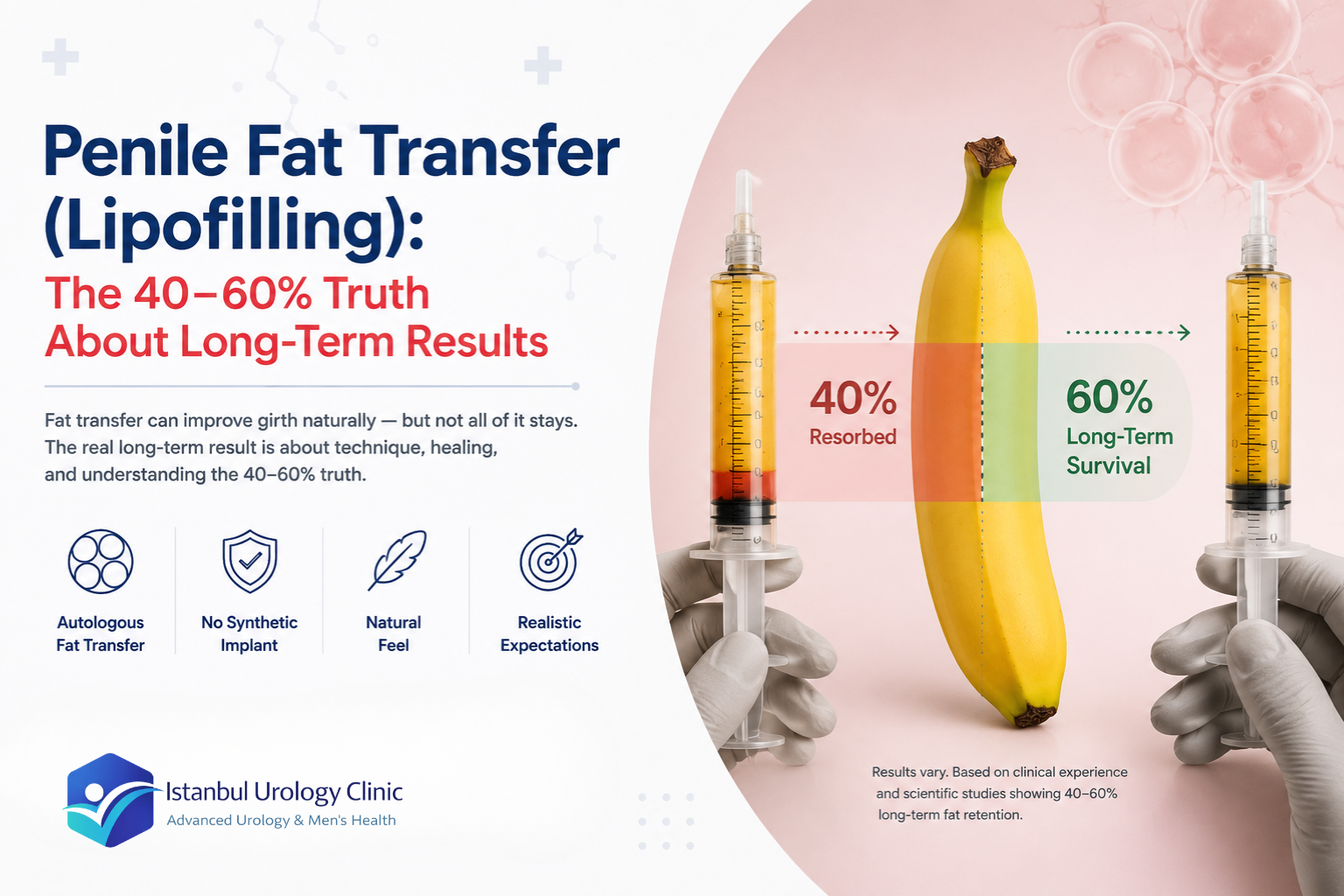
| Permanence | Permanent silicone implant | Temporary, 12 to 18 months on average | Partial. Around 40 to 60 percent of the fat reabsorbs in the first year |
| Maintenance | None expected after healing | Repeat sessions needed to keep the result | Sometimes a second session for volume retention |
| Predictability | High. Implant size is selected and stays | Variable. Material breaks down unevenly over time | Variable. Fat survival differs between patients |
| Procedure Type | Surgery under anesthesia, one night in hospital | In-clinic injection, no hospital stay | Surgery with fat harvesting from belly or thighs |
| Reversibility | Removable surgically if needed | Reabsorbs naturally over time | Not directly reversible |
| Best Suited For | Long-term stability on clean, untouched tissue | Trying girth enhancement before committing to surgery | A more natural approach using your own tissue |
A Case From Our Practice
The story below is shared with the patient’s permission, with identifying details removed. It reflects a situation that comes up in our clinic more often than men realize, and it is one of the clearest ways to explain how Peniflex fits into the bigger picture of girth enlargement.
A patient in his early forties came to us after roughly four years of repeated hyaluronic acid filler sessions. He was happy with the initial girth gain each time, but the filler was thinning out every twelve to fifteen months, and the last two sessions had left areas that were not as even as he wanted. His question to me was simple: is there a way to stop doing this every year.
We discussed all three options, including continuing with fillers, switching to fat transfer, or moving to a permanent silicone implant. His tissue was still in reasonable condition, the residual filler had largely reabsorbed, and his priority was stability, not extra size. Peniflex was the right fit for that goal.
We performed the implantation in one session, he stayed one night, recovered at the hotel for the rest of the week, and flew home twelve days later. At his one-year follow-up, his main feedback was not about the size. It was that he had stopped thinking about maintenance appointments. For me, that is the result that matters most.
Not every man who has had previous fillers is a candidate, and the outcome described above is one specific patient, not a guaranteed result. The reason this case matters is what it shows about the decision process. The right procedure is the one that matches what you actually want from surgery, evaluated against tissue that has been examined in person, not chosen from a brochure.
Frequently Asked Questions
The Peniflex implant is generally considered safe when performed by an experienced surgeon in an appropriate medical setting. Careful patient selection, proper surgical technique, and following post-operative instructions all play an important role in reducing complications.
Peniflex is designed as a long-term silicone implant for permanent penile girth enhancement. Unlike fillers or fat injections, it does not gradually dissolve or get absorbed by the body.
The implant is intended to remain in place long term. Once healing is complete, most patients do not require routine replacement, although long-term outcomes depend on overall health, healing quality, and any future medical issues.
Yes. If medically necessary or desired by the patient, the implant can be surgically removed. However, removal should always be discussed carefully with an experienced surgeon because tissue changes may occur over time.
No. Peniflex is not an erectile implant and does not create or replace erections. It is positioned beneath the penile skin and does not replace the erectile chambers responsible for rigidity.
Most patients maintain normal penile sensation after recovery. Temporary sensitivity changes may occur during healing, but these usually improve as tissues settle.
Peniflex is primarily designed to increase girth rather than length. Some men notice a fuller flaccid appearance, but it should not be considered a penile lengthening procedure.
The degree of enhancement varies according to anatomy and implant selection. Many patients achieve a noticeable increase in circumference, often in the range of approximately 1.5 to 2 inches (3.5 to 5 cm).
Neither option is universally better for every patient. Fillers are non-surgical and temporary, while Peniflex is a surgical solution designed for long-term girth enhancement. The most appropriate choice depends on individual goals and expectations.
In selected cases, Peniflex may be combined with penile lengthening procedures. Whether combination treatment is appropriate depends on anatomy, surgical goals, and overall treatment planning.
Once healing is complete, the goal is a natural appearance that blends with the patient’s anatomy. Visibility depends on implant size, body type, healing characteristics, and surgical outcome.
The Peniflex implant is made from medical-grade silicone and does not contain metallic components. Patients can generally undergo MRI examinations, although informing the radiology team about any implant is always recommended.
Most patients are advised to avoid sexual activity for approximately six weeks. The exact timing depends on healing progress and surgeon assessment.
Patients with uncontrolled medical conditions, active infections, unrealistic expectations, severe psychological concerns related to body image, or anatomy unsuitable for implantation may require further evaluation or alternative treatment options.
The Bottom Line on Peniflex
Peniflex is a focused procedure. It does one thing, and it does it permanently. Soft silicone, placed under the skin, on tissue that has not been worked on before. That is where the implant performs at its cleanest, and matching that condition with realistic expectations is what separates the men who are satisfied at the five-year mark from the men who are not.
Most of the decision happens before surgery, not during it. Whether Peniflex is right for you depends on what result you actually want, what your anatomy can support, and whether you have had any previous enlargement work. If all three line up, the procedure is one of the more predictable cosmetic operations we perform. If any of them does not, the conversation moves toward a different procedure, a different timeline, or sometimes no procedure at all.
That last part matters. Not every man who asks about Peniflex leaves with a recommendation to proceed, and the men we turn away are often the ones who were closest to a bad outcome. Saying no when the case is not right is part of the standard, and it is what protects the patients who do go ahead.