Many men who walk into our clinic asking about a penile implant end up leaving with an inflatable system. A smaller group genuinely does better with a malleable, and the line between those two groups is sharper than patients expect.
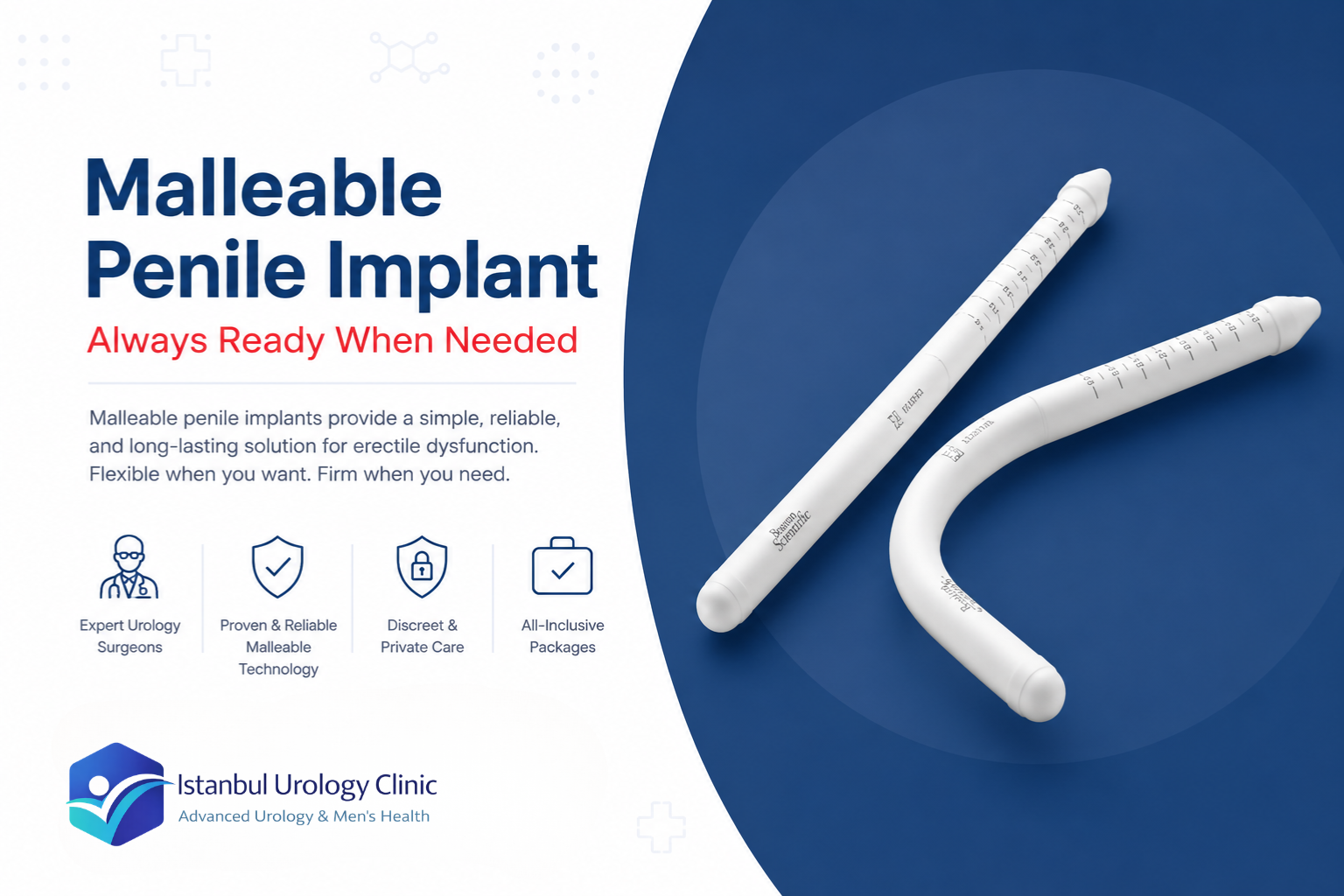
A malleable penile implant is the most mechanically straightforward solution we offer for severe erectile dysfunction. Two semi-rigid rods replace the erectile tissue, with no pump, no reservoir, and no learning curve. The penis is bent up for intercourse and bent down for daily life. That is the entire user manual.
The simplicity is exactly why it works for some patients, and exactly why it is the wrong choice for others. According to the European Association of Urology guidelines on male sexual health, penile prosthesis implantation is indicated when other treatments fail or when a patient prefers a permanent solution. A malleable is not a budget version of an inflatable. It is the correct device for specific clinical situations where simpler is safer, more reliable, or more practical across fifteen to twenty years of daily use.
This guide is built around the question that actually matters: are you in the group that genuinely benefits from a malleable, or are you in the group that should be looking at an inflatable instead?
Key Points
- The malleable implant is a permanent surgical treatment, not a reversible one.
- Two bendable rods replace the natural erectile tissue inside the corpora cavernosa.
- The penis stays semi-rigid at all times, never fully flaccid, never fully expanding.
- No pump means no hand dexterity required and far less to fail mechanically.
- Best suited for specific clinical profiles, not the general erectile dysfunction population.
- Recovery to sexual activity is typically around 4 to 6 weeks after surgery.
- The procedure does not increase penile length, and shortening from longstanding ED may already exist before surgery.
- Younger or socially active patients typically do better with an inflatable system.
What a Malleable Penile Implant Actually Is?
A malleable penile implant is a pair of bendable silicone-covered rods surgically placed inside the corpora cavernosa, replacing the spongy erectile tissue that normally fills with blood during a natural erection. The rods keep the penis in a permanent semi-rigid state, firm enough for intercourse when bent upward and discreet enough for daily activity when bent downward. There is no pump, no fluid, and no activation step.
This is what makes it mechanically different from every other implant category. An inflatable system creates an erection through hydraulics. A malleable system removes the question of an erection entirely, because rigidity is built into the device itself.
The Patients Who Actually Need a Malleable
The malleable penile implant is not a device we offer to every patient who fails oral medications. It is reserved for clinical situations where the mechanical simplicity of the device delivers something an inflatable cannot: usability, safety, or surgical feasibility. Three distinct patient profiles consistently benefit from it.

1. Patients With Reduced Hand Function
An inflatable penile implant requires the patient to locate, squeeze, and release a scrotal pump multiple times to achieve and deflate an erection. For many men this is straightforward within a few weeks of recovery. For a subgroup of patients, it never becomes reliable.
This includes men with advanced rheumatoid arthritis, Parkinson’s disease, multiple sclerosis with hand involvement, post-stroke hemiplegia, essential tremor, and high-level spinal cord injury affecting upper limb dexterity. For these patients, we do not ask them to demonstrate hand function during consultation. We ask their spouse or partner what daily tasks have become difficult, and the answer usually settles the implant choice.
A 71-year-old patient we treated last year had been declined for an inflatable implant by two urologists abroad because of moderate Parkinson’s. He came to Istanbul looking for a second opinion, and the right device for him was clearly a Rigi10 malleable. Eighteen months later, he and his wife describe the implant as the easiest medical device he has ever managed.
2. Severe Corporal Fibrosis or Revision Cases
When the corpora cavernosa are scarred, narrowed, or have been previously operated on, inserting an inflatable cylinder becomes technically demanding and the risk of cylinder migration or perforation rises. This applies to patients with priapism-related fibrosis, removed prior infected implants, severe Peyronie’s-related scarring, and certain post-radiation pelvic anatomy.
In these cases, a narrower malleable rod, particularly the Rigi10 with its 9 mm and 14 mm distal tip options, allows the surgeon to navigate scarred tissue through a smaller corporotomy with less force. Surgical time drops, infection risk drops, and the device sits stably in tissue that would have rejected a fully expanded inflatable cylinder.
3. Older Patients Prioritizing Simplicity Over Concealment
For a man over 75 whose sexual activity is intermittent and whose social exposure to locker rooms, gyms, or public swimming is minimal, the concealment advantage of an inflatable matters less than the maintenance simplicity of a malleable. Fewer mechanical components means fewer reasons to need revision surgery a decade later, which is a meaningful consideration when life expectancy and tolerance for additional surgery are factors.
This is not an age cutoff. We have implanted inflatables in men in their late seventies who were marathon-walking and dating actively. The question is lifestyle and priorities, not the number on the birth certificate.
A fourth, smaller group also benefits: men with significantly elevated infection risk, such as poorly controlled diabetes combined with previous abdominal surgery, where shortening surgical time and avoiding a fluid reservoir lowers the perioperative risk profile. These cases are evaluated individually rather than fitting a fixed rule.
If You Are Unsure Which Profile You Fall Into
Implant selection is not made by reading an article. It is made after reviewing anatomy, medical history, and how you actually live day to day. If you are leaning toward a malleable mainly because it sounds easier, that is the wrong reason to choose it. The right reason is a clinical or lifestyle factor that genuinely makes the simplicity an advantage rather than a default.
When an Inflatable Is the Better Call
The same honesty works in the opposite direction. If a malleable is the right device for specific profiles, an inflatable is the right device for everyone else, and we say so during consultation rather than after.

For younger and socially active men who go to the gym, swim, date, or simply prefer a natural flaccid appearance under clothing, the permanent semi-rigid state of a malleable is harder to live with than expected. The penis stays in a controlled curve, never truly flaccid, and that constant shape is more apparent under athletic wear than patients assume during consultation. An inflatable like the AMS 700, Coloplast Titan, or Rigicon Infla10 deflates to a state that is visually and functionally close to a natural flaccid penis.
For patients with significant penile shortening from long-standing ED, severe Peyronie’s, or post-prostatectomy fibrosis, a malleable cannot reverse the loss. The rods are sized to existing corporal length and do not stretch tissue during use. Inflatable models engineered for bidirectional expansion, such as the AMS 700 LGX or Rigicon Infla10 AX, support gradual length recovery over the first year with consistent post-operative cycling.
The third factor most articles skip is partner involvement. Partner satisfaction tracks closely with patient satisfaction in published data from the Sexual Medicine Society of North America. When the partner is uncomfortable with the idea of a permanently semi-rigid penis, the malleable rarely succeeds long-term regardless of how well it functions technically. If concealment, appearance during intimacy, or the natural flaccid state are emotionally significant to the couple, an inflatable is the better long-term decision even when a malleable might be technically simpler to implant.
After years of placing both implant types, the pattern is consistent. Patients who choose a malleable for the right clinical reason are highly satisfied long-term. Patients who choose it because it sounded simpler often regret it within the first year. The implant works. The mismatch is what fails.
ÖO.
Prof. Dr. Özkan Onuk
Lead Urologist · Istanbul Urology Clinic
Inside the Body: How the Device Works
Understanding what happens mechanically helps set realistic expectations before surgery. The malleable system is the simplest implant in prosthetic urology, and that simplicity is built into three engineering decisions.

The Rods Replace the Erectile Tissue
During surgery, the spongy tissue inside the corpora cavernosa is dilated to create space for two flexible cylinders. These cylinders sit along the full length of the corporal bodies, from the crura at the base to just behind the glans. Once placed, they take over the structural role that blood-engorged tissue normally performs during a natural erection.
The cylinders are not solid silicone. Inside each rod is a flexible metallic core, typically a braided stainless steel or nitinol structure depending on the model, surrounded by a silicone outer layer. This core is what holds a bend without springing back. When you position the penis upward, the core deforms and stays. When you bend it down, it stays.
Rigidity Comes From the Core, Not Blood Flow
This is the conceptual shift patients need to make. A natural erection is a vascular event. A malleable penile implant erection is a mechanical one. Blood flow, nerve signaling, and arousal continue to function normally after surgery, but they no longer produce rigidity. The device produces rigidity, full time, regardless of mood, medication, or vascular health.
This is why diabetic vasculopathy, post-prostatectomy nerve damage, venous leak, and severe Peyronie’s-related fibrosis all become irrelevant once a malleable penile implant is in place. The conditions that destroyed the natural mechanism are bypassed entirely.
No Pump, No Reservoir, No Activation
An inflatable implant has three components inside the body: cylinders, a pump in the scrotum, and a fluid reservoir in the abdomen. A malleable has only the cylinders. There is nothing to activate, nothing to deflate, and nothing to maintain. The device is in working mode from the moment surgery ends, even before healing is complete.
The trade-off is the absence of a true flaccid state. The penis is always firm enough for penetration. This is the defining feature of the system and the reason patient selection matters as much as it does.
What Daily Life Actually Feels Like
The everyday reality of a malleable penile implant settles into routine faster than patients expect, with a few specific adjustments worth knowing in advance.
The penis stays firm enough for penetration at all times because rigidity comes from the device rather than from blood flow, which means arousal, orgasm, and ejaculation continue to function normally on top of a constant baseline. The adjustments that follow are practical rather than functional.
← Swipe to see full table →
| Concern | Reality |
|---|
| Sitting and walking | Background sensation after 2 to 3 weeks of healing, then fades during normal activity. |
| Clothing visibility | Loose trousers conceal easily. Tight jeans, athletic wear, and thin swimwear show a more noticeable outline than an inflatable would. |
| Sleeping positions | Back or side only during the first six weeks, then any position including stomach. |
| Gym and sports | Gym at 4 to 6 weeks, swimming at 6 weeks, cycling at 8 to 12 weeks due to saddle pressure. |
| Partner experience | Some notice the constant firmness, some do not. Many partners value the reliability more than the mechanical difference. |
| Travel and MRI | Airport scanners may register the metallic core. We provide an implant card for security and MRI scheduling. |
The visibility question is the one most underestimated before surgery. The penis sits in a controlled curve rather than hanging fully soft, and that constant shape is more apparent under athletic wear than patients assume during consultation. For most men, a small wardrobe adjustment in the first few months solves it. For men whose lifestyle revolves around tight-fitting clothing, this is one of the reasons we steer them toward an inflatable instead.
The Models We Implant
Three malleable systems dominate prosthetic urology today: the Rigicon Rigi10, the Boston Scientific Tactra, and the Coloplast Genesis. At our clinic, the Rigi10 is the implant we reach for in the majority of cases because its diameter range fits more anatomies than any other rod on the market. The other two remain on the table for specific clinical situations where their engineering offers something the Rigi10 does not.
← Swipe to see full table →
| Model | Core Technology | When We Choose It |
|---|
| Rigicon Rigi10 | Flexible Rod Technology with bending up to 135 degrees, diameter range from 9 mm to 14 mm, HydroShield antibacterial coating | Our default choice. Fibrotic or revision cases needing a 9 mm tip, wider anatomy needing the 14 mm option, diabetic patients |
| Boston Scientific Tactra | Nitinol-based dual-layer core with balanced rigidity and downward concealment | Patients specifically requesting Boston Scientific, or conversions from a previously placed AMS implant |
| Coloplast Genesis | Silver-coated central wire wrapped in stainless steel coils, resistant to metal fatigue | Spinal cord injury, high-risk surgical candidates, cases requiring predictable positional memory under repeated bending |
The Rigi10 became our primary malleable for one reason: it fits more anatomies than any other rod available. The 9 mm narrow tip handles fibrotic and revision cases where the corpora will not accept a wider cylinder, and the 14 mm option fits patients whose anatomy would otherwise leave a standard rod sitting loose. Beyond sizing, the Flexible Rod Technology holds positional memory more reliably than older malleable designs, and the HydroShield coating adds infection protection that matters in diabetic and revision cases. Full specifications are in our Rigicon penile implants guide.
The Tactra is the implant we use when a patient specifically requests Boston Scientific or is undergoing revision from a previously placed AMS device. Its dual-layer nitinol core holds bends predictably and resists the positional memory loss that affected older malleable designs after years of use, but it does not match the diameter range of the Rigi10, which is why it sits in second position in our practice rather than first.
The Genesis sits in a narrower clinical role. Its silver-coated wire core is engineered to survive sharp angle adjustments and repeated bending without kinking or fracturing, which makes it the model we choose for spinal cord injury patients where the implant is bent and repositioned frequently as part of catheter management and transfers. Our Coloplast penile implant guide covers the engineering in detail.
None of these implants is universally superior. The right device is the one matched to the corporal measurements taken during surgery, the patient’s clinical situation, and the surgeon’s experience with that specific system. The Rigi10 wins most cases on anatomical fit. The Tactra and Genesis hold their place for the specific situations where their design genuinely outperforms the alternative.
What Changes, What Stays the Same
Realistic expectations are the strongest predictor of long-term satisfaction after penile implant surgery, and regret cases often trace back to assumptions that were never corrected before the operation. The list below separates what the implant changes from what it leaves untouched.
What the Implant Changes
- Rigidity becomes mechanical and permanent. The device provides firmness independent of arousal, medication, or vascular health.
- Spontaneous erections end. The corporal tissue is modified during surgery, and natural blood-flow erections cannot return afterward.
- The flaccid state is replaced by a permanent semi-rigid curve. The penis no longer hangs fully soft.
- The procedure is irreversible. Implant removal is possible if complications occur, but natural function does not return.
What the Implant Leaves Untouched
- Penile sensation. Skin sensitivity and arousal pathways continue to function normally.
- Orgasm. The implant does not affect the orgasmic mechanism in any way.
- Ejaculation. Continues normally if it was normal before surgery.
- Penile length. Not increased. Shortening that developed before surgery is not reversed by the implant.
The two expectations that cause the most disappointment after surgery are length and spontaneous erection. A malleable restores rigidity, not size, and the rods are fitted to the corporal space as it exists on the day of surgery.
Patients concerned specifically about pre-existing shortening should consider an inflatable model engineered for bidirectional expansion instead, which is covered in our inflatable implant guide. The honest conversation about these two points during consultation predicts long-term satisfaction more reliably than any other preoperative factor.
Surgery and Risks Specific to Malleable
The general framework of penile implant surgery, including preoperative testing, hospital stay, and recovery timeline, is covered in our penile implant surgery guide. This section focuses only on what is genuinely different about a malleable procedure.
The operation itself is faster and mechanically simpler than an inflatable. A single small incision near the penoscrotal junction gives access to both corpora cavernosa, and the surgeon dilates each corporal body before placing the rods. There is no reservoir to position in the abdomen, no pump to seat in the scrotum, and no hydraulic tubing to route. Total operative time is typically 45 to 75 minutes, compared with 90 to 120 minutes for a three-piece inflatable. For high-risk surgical candidates, that shorter operative window is one of the clinical reasons we choose a malleable in the first place.
The risks specific to malleable implants, distinct from the general risks shared with any prosthetic surgery, come directly from the permanent semi-rigid state of the device:
- Glans hypermobility. The natural tissue at the tip of the penis can become loose over the rigid cylinders, causing the glans to flop forward during intercourse. This is more common with malleable than inflatable implants and may require a surgical adjustment in selected cases.
- SST deformity. A bend at the junction between the rod and the soft glans, sometimes called the “supersonic transport” deformity. Modern designs like the Rigi10 and Tactra minimize this, but it remains a malleable-specific issue.
- Erosion through the corporal wall. Constant outward pressure from the rods, particularly in patients with thin or fibrotic corporal tissue, can cause the cylinder to slowly erode through the tunica albuginea over years. Detected early, this is manageable. Detected late, it requires revision surgery.
- Visible outline under tight clothing. Not a medical risk, but the most common source of post-surgical regret in patients who underestimated this point during consultation.
Infection risk, mechanical failure rates, and general perioperative complications follow the same patterns as any penile implant. The AUA Erectile Dysfunction Guideline covers the broader risk framework for prosthetic surgery for patients who want a clinical reference.