
- What the LGX Cylinder Does Differently
- What Length Recovery Actually Looks Like
- Why Length Is Lost in the First Place
- The Cycling Protocol That Determines Your Results
- Who the LGX Is For, and Who It Isn't
- LGX vs Rigicon Infla10 AX: The Real Decision
- Where the LGX Sits in the AMS 700 Family
- A Real Patient Outcome
- Surgery and Recovery in Brief
- The Honest Takeaway
- What the LGX Cylinder Does Differently
- What Length Recovery Actually Looks Like
- Why Length Is Lost in the First Place
- The Cycling Protocol That Determines Your Results
- Who the LGX Is For, and Who It Isn't
- LGX vs Rigicon Infla10 AX: The Real Decision
- Where the LGX Sits in the AMS 700 Family
- A Real Patient Outcome
- Surgery and Recovery in Brief
- The Honest Takeaway
Key Points
- The LGX is the only AMS cylinder engineered for bidirectional expansion, growing in both length and girth during inflation rather than firmness alone.
- Realistic length recovery is 1 to 3 centimeters over 6 to 12 months, with the average closer to 2 cm in patients who follow the cycling protocol consistently.
- Cycling is the active ingredient, not the surgery alone. Patients who skip the post-operative inflation protocol get rigidity restoration without meaningful length gain.
- Tissue elasticity decides candidacy. Advanced fibrosis, dense Peyronie’s plaque, or heavily scarred corpora limit what the cylinders can expand into.
- The LGX flaccid state is genuinely softer than the CX, which makes it a highly concealable inflatable option under normal clothing.
What the LGX Cylinder Does Differently
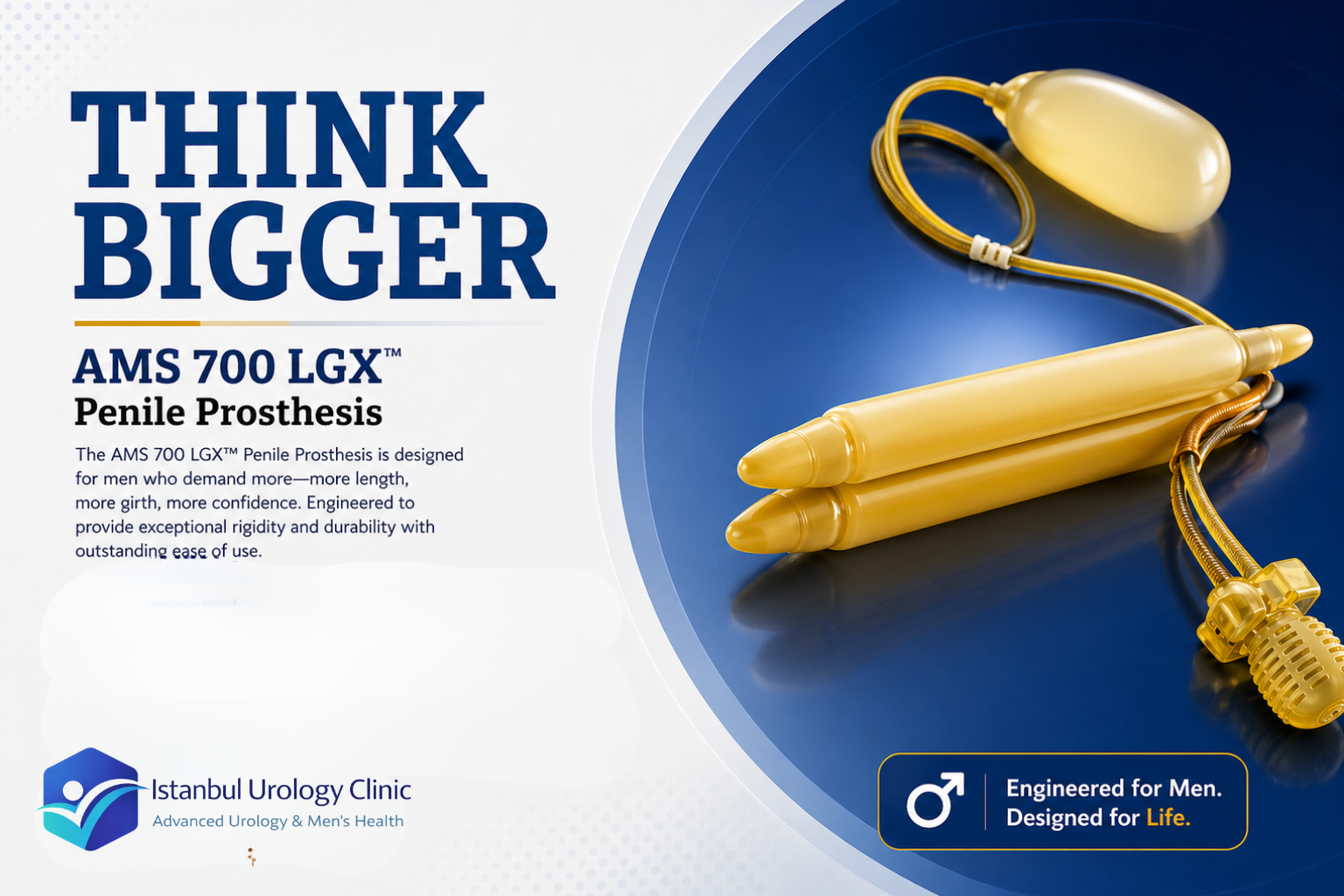
Every modern inflatable penile implant works the same basic way. It has three connected parts: two cylinders placed inside the penis, a pump placed inside the scrotum, and a small fluid container placed behind the abdominal muscle. When the patient squeezes the pump, fluid moves from the container into the cylinders, and the penis becomes firm enough for intercourse. What separates one implant from another is the design of the cylinders themselves, and this is where the LGX stands alone in the AMS 700 family.
Standard cylinders, including the AMS 700 CX and CXR, get wider when inflated but stay the same length. They restore firmness at whatever length the penis already has. The LGX cylinder is built with an extra layer inside that lets it grow longer too, not just wider. The growth happens gradually over the months following surgery, as the pressure of the fluid inside the cylinder gently stretches the surrounding tissue.
The gradual pace is intentional. After years of erectile dysfunction, the tissue inside the penis loses some of its natural ability to stretch. This hardening of tissue is called fibrosis, and stretching it suddenly would cause pain and risk injury. The LGX is designed to expand only as much as the tissue can safely allow at each stage, which is why measurable length recovery develops over six to twelve months, not in the first weeks after surgery.
What Length Recovery Actually Looks Like
Healing, Not Expansion
No length change happens during the early recovery window. The cylinders are in place but not yet being cycled. Swelling settles, the surgical pocket relaxes around the implant, and the patient adjusts to having the device internally. Any “length gain” reported during this stage is swelling, not tissue expansion.
First Measurable Girth Change
Once the device is activated and daily cycling begins, girth expansion responds first. Patients commonly notice a fuller circumference during inflation before any length change registers. This is normal LGX behavior and not a sign that length recovery is failing.
Length Begins to Move
This is when measurable longitudinal change appears in patients with preserved tissue elasticity. The corpora respond to repeated controlled stretching, and the cylinders extend slightly further with each cycle. Patients who recover length typically see the first centimeter during this window.
Stabilization and Final Result
By the end of the first year, the cylinders have reached the practical expansion limit the patient’s tissue allows. Final measured length is usually 1 to 3 cm beyond the pre-surgery erect length, averaging closer to 2 cm. Continued cycling after month 12 maintains the result rather than adding to it.
Why Length Is Lost in the First Place
Penile shortening is not a random side effect of erectile dysfunction. It happens for a clear reason. A healthy erection brings oxygen-rich blood into the penis several times a week, including during sleep. This regular flow and stretching is what keeps the tissue inside the penis flexible and healthy.
When erections become weak, rare, or stop completely for years, the oxygen supply drops. The healthy muscle tissue inside the penis slowly hardens into scar-like tissue. This hardening is what we call fibrosis, and it is much less flexible than the original tissue. As more fibrosis builds up, the penis loses its ability to stretch to its original length, and it settles into a shorter size both when soft and during erection. Diabetes speeds up this process. Peyronie’s disease makes it worse by adding hard scar areas that physically pull the penis inward. Surgery for prostate cancer can compress years of this process into months by stopping erectile function suddenly.
Fibrosis is the problem. The LGX is the response. The cylinder works by gradually re-stretching tissue that has lost its ability to stretch on its own. This is also why the LGX delivers very little to patients whose tissue has already hardened past the point where it can stretch again.
The Cycling Protocol That Determines Your Results
The principle behind cycling is endorsed across the field of prosthetic urology. The Sexual Medicine Society of North America describes post-operative cycling as essential to gently stretching the tissues around the prosthesis, preventing scar formation, and ensuring the implant functions effectively long-term. The AUA Erectile Dysfunction Guideline outlines the same principle as part of standard post-prosthetic care.
What the LGX protocol adds to that foundation is a deliberate extension of the inflation duration during months three to six, which is where the length-recovery benefit specific to expandable cylinders is built. The surgery places the cylinders. The cycling teaches the tissue to expand around them.
Here is the protocol our AMS 700 LGX patients follow, refined across years of post-operative outcomes. It is the exact sequence we hand to every patient at discharge.
Two failures account for almost every disappointing LGX outcome in second-opinion consultations. The first is patients who cycle inconsistently during months two through six, missing days or skipping the extended hold phase, then conclude the implant did not work. The second is patients who were never told the protocol existed at all and assumed the surgery itself would produce length recovery. Both are preventable. Neither is a failure of the device.
Who the LGX Is For, and Who It Isn't
LGX disappointment in second-opinion consultations often traces back to one decision: the wrong cylinder was placed in the right patient, or the right cylinder was placed in the wrong patient. The AMS 700 LGX is an exceptional implant for a specific patient profile, and a mediocre choice for everyone outside that profile. The honest fit looks like this.
- Measurable penile shortening from long-standing erectile dysfunction, with preserved corporal tissue elasticity on examination.
- Mild to moderate Peyronie’s disease where curvature can be corrected during the same surgery without extensive grafting.
- Post-prostatectomy patients whose shortening developed within the past 12 to 24 months, before fibrosis becomes structural.
- Motivated patients willing to commit to the 12-month cycling protocol with daily inflation and remote follow-up.
- Patients who prioritize a soft flaccid state and discreet concealment under normal clothing.
- ✕
Advanced corporal fibrosis where the tissue has lost the elasticity required for the expansion mechanism to work. - ✕
Severe Peyronie’s disease with dense plaque or significant curvature requiring extensive reconstruction. The CX or Coloplast Titan delivers stronger structural support. - ✕
Revision surgery cases with narrow corporal space. The CXR is engineered for this anatomy, the LGX is not. - ✕
Patients seeking cosmetic enlargement. The LGX restores lost length, it does not add beyond the body’s pre-disease baseline. - ✕
Patients unwilling or unable to follow the cycling protocol, who will receive a standard inflatable result without the length benefit.
Candidacy is decided on examination, not online. Tissue elasticity is something a prosthetic urology surgeon assesses through physical exam, ultrasound where indicated, and review of the patient’s erectile history. A patient who reads this list and identifies as a strong fit may still be redirected to the CX, Titan, or Infla10 AX after evaluation, and that redirection is a sign of careful surgical planning rather than a downgrade.
LGX vs Rigicon Infla10 AX: The Real Decision
At LGX-depth, the meaningful comparison is not against the CX, the CXR, or the Coloplast Titan. Those implants serve different anatomical situations and a separate set of clinical priorities. The real decision a length-recovery candidate faces is between the two implants on the global market engineered specifically for bidirectional expansion: the AMS 700 LGX and the Rigicon Infla10 AX.
Both deliver controlled length and girth expansion. Both require the same 12-month cycling commitment. The differences sit in track record, pump ergonomics, warranty, and the small engineering choices that matter to specific patients.
← Swipe to see full table →
| Decision Factor | AMS 700 LGX | Rigicon Infla10 AX |
|---|---|---|
| Expansion mechanism | Bidirectional length and girth expansion through internal expansion layer | Bidirectional length and girth expansion through modern expandable cylinder design |
| Length recovery range | 1 to 3 cm over 6 to 12 months with consistent cycling, averaging closer to 2 cm | 1 to 3 cm over 6 to 12 months with consistent cycling, comparable published outcomes |
| Clinical track record | 50+ years of platform refinement, 600,000+ AMS 700 implants worldwide, 15-year revision-free survival data published | Newer platform with strong early outcomes, growing peer-reviewed dataset, less long-horizon follow-up |
| Pump ergonomics | TENACIO pump (current generation) with refined squeeze dynamics, suitable for most hand strength profiles | Pulse pump engineered for lower hand-force operation, practical advantage for patients with diabetes or mild arthritis |
| Antibiotic coating | InhibiZone (rifampin and minocycline) integrated into the implant surface | Hydrophilic coating designed for antibiotic immersion in the operating room |
| Warranty | Standard manufacturer warranty with documented revision policies | Lifetime product replacement warranty on mechanical failure |
| Flaccid state | Softer than the CX, one of the most concealable inflatable options | Comparable soft flaccid state with similar concealment under clothing |
The honest summary is shorter than the table. Choose the AMS 700 LGX when long-horizon clinical data is the priority and the patient wants the implant with the deepest published outcome record. Choose the Infla10 AX when pump effort is a real concern, when the lifetime warranty matters to the patient’s decision, or when newer cylinder engineering is the preferred choice.
Both implants are used routinely at our clinic. The selection is made after examination, not from a comparison table. A patient leaning toward one device may still be redirected to the other when anatomy, hand function, or surgical history points clearly in a particular direction.
Patients arrive convinced that the LGX is the answer because they read about length recovery online. On examination, the question changes. Sometimes the tissue cannot support what the cylinder is engineered to do, and the right recommendation is a different implant. Sometimes the patient is unwilling to commit to a year of daily cycling, and the LGX result will not happen regardless of how well the surgery goes. The implant is a tool. The outcome depends on whether the tool fits the tissue, and whether the patient is willing to do the work the device is designed around.
Where the LGX Sits in the AMS 700 Family
The LGX is one of three cylinders in the AMS 700 family, and the right choice only for the patient profile this article describes. For most cases of severe erectile dysfunction where length is not a concern, the AMS 700 CX delivers stronger firmness during erection and is the cylinder our surgical team chooses by default. For patients with heavy scar tissue inside the penis, a narrower internal space, or a previous implant that needs replacing, the AMS 700 CXR is designed for that tighter anatomy. The LGX is the right cylinder when length recovery is the main goal and the tissue is still flexible enough to stretch. All three models share the same pump, the same fluid container, and the same antibiotic coating. The cylinder is the only part that changes.
The full AMS 700 platform breakdown, including the pump generation, fluid container options, and the decision tree we use during consultation, is covered in our AMS 700 platform guide.
A Real Patient Outcome
A patient from South Africa, mid-fifties, came to consultation with two overlapping problems. Long-standing erectile dysfunction from poorly controlled diabetes had not responded to medication for several years, and a moderate dorsal curvature from Peyronie’s disease had appeared during the same period. He had measured himself across a decade and quantified the change. His erect length had reduced by approximately 2.5 cm, and the curvature had begun to interfere with intercourse.
On examination, his corporal tissue elasticity was preserved enough to support an LGX cylinder, the Peyronie’s plaque was mild enough to correct through intraoperative modeling without grafting, and his hand function was intact. The combination made him a strong LGX candidate. We performed AMS 700 LGX implantation with simultaneous curvature correction in a single 75-minute operation under general anesthesia. He stayed one night for monitoring and flew home on day seven.
By month three, he reported full rigidity, restored girth, and a straightened erect axis. By month nine, with consistent cycling, his measured erect length had increased by roughly 2 cm from his pre-surgery baseline. At the twelve-month follow-up he described his outcome as functional restoration of what he had lost over a decade of disease, not enlargement. That framing is the one we hear from patients whose LGX results match their realistic expectations.
Surgery and Recovery in Brief
AMS 700 LGX surgery takes 60 to 90 minutes under general or spinal anesthesia, performed through a single small incision at the penoscrotal junction. The cylinders are placed inside the penis, the pump in the scrotum, and the small fluid reservoir behind the abdominal muscle. Cylinder size is measured intraoperatively to match the patient’s anatomy precisely. One night of hospital observation is standard.
Return to office work happens around day 10 to 14. Device activation training occurs at week 4 to 5 under surgeon supervision. Intercourse is cleared at the six-week mark, and the cycling protocol begins after that and continues for the full year.
The full surgical sequence and anesthesia options are in our penile implant surgery guide. The day-by-day recovery picture is mapped in our penile implant recovery timeline. For patients comparing total treatment investment across implant types, our penile implant cost guide covers what each package covers.
Frequently Asked Questions
The Honest Takeaway
The AMS 700 LGX is the right implant for one specific patient: the man with measurable penile shortening, preserved corporal tissue elasticity, and the willingness to follow a twelve-month cycling protocol after surgery. For that patient, no other AMS cylinder delivers what the LGX delivers, and only one other implant on the global market (the Rigicon Infla10 AX) offers a comparable mechanism. For every other patient, a different cylinder is the better clinical answer, and a surgeon who recommends the LGX without examining the corpora is recommending it for the wrong reasons.
If length recovery is genuinely your priority, the next step is not booking surgery. It is a clinical evaluation that confirms your tissue can support what the cylinder is engineered to do, and a direct conversation about whether the year of cycling that follows fits your life. The implant is a tool. The outcome depends on whether the tool fits the tissue, and whether the patient is willing to do the work the device is designed around.