
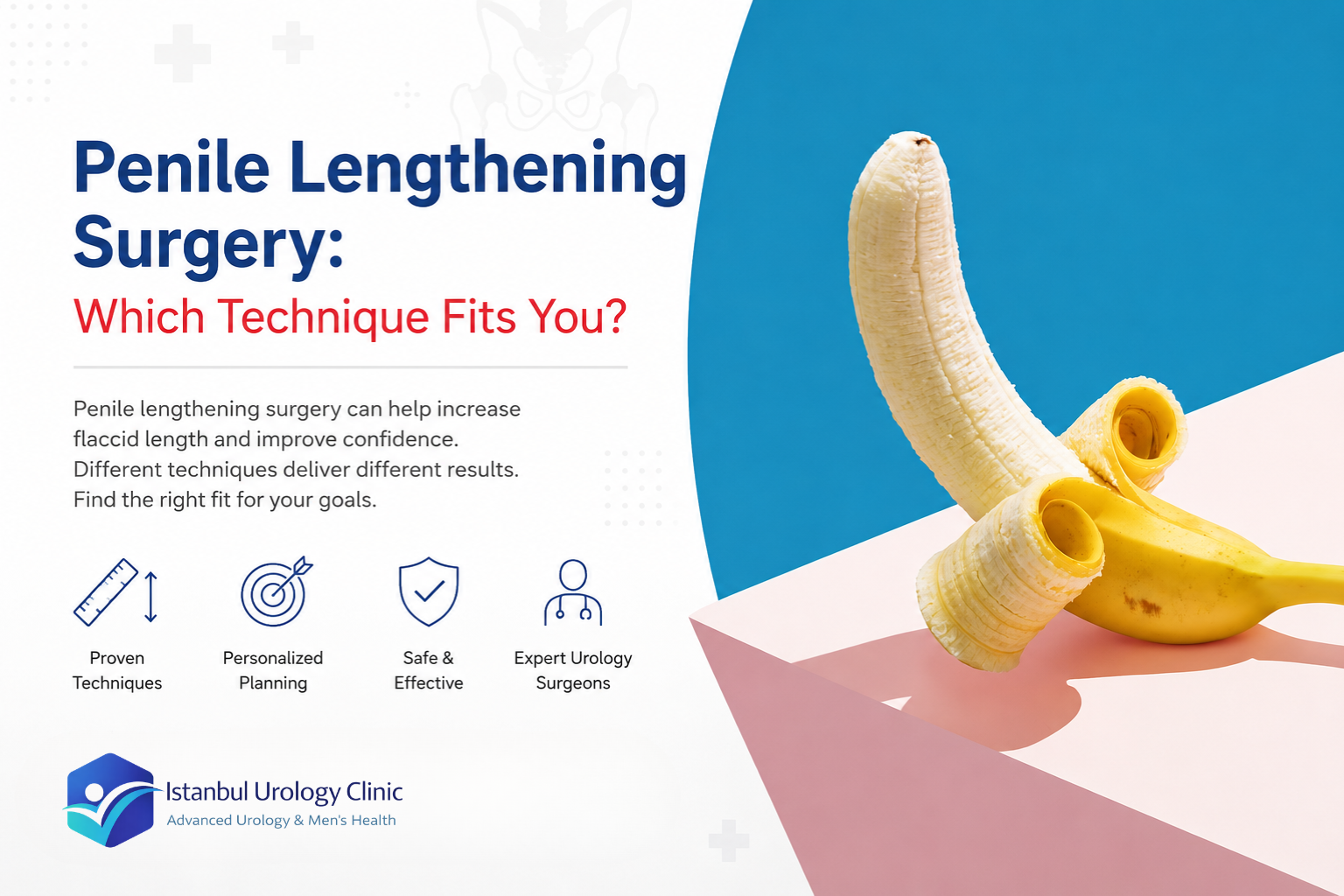
A penis cannot be made longer by surgery. It can be made more visible. The distinction sounds semantic until you understand the anatomy behind it, and once you do, every question about technique, gain, and recovery becomes easier to answer.
Around forty percent of the penile shaft sits inside the body, anchored to the pubic bone by a ligament most patients have never been told about. The visible penis, the part a man can see and measure, is the portion that has escaped that anchor. Penile lengthening surgery is the operation that changes the ratio between what is hidden and what is visible. Tissue is not added. Tissue is uncovered.
This is also why penile lengthening surgery is not a single operation. Four distinct surgical techniques exist, each one designed to solve a different anatomical obstacle: a ligament that holds the shaft tight against the pubic bone, a fat pad that buries the base, scrotal skin that pulls the underside upward, or a combination of these. Matching the wrong technique to the wrong anatomy is the most common reason men walk away from enlargement surgery disappointed, and it is the central decision this guide is built around.
What follows is each of the four techniques, the gain each one realistically produces, the limits surgery cannot push past, and a decision section that helps you identify which technique fits your situation. If girth or combined approaches are also part of the question, the broader overview of penile enlargement surgery options covers how each method is matched to anatomy and goals.
- What Penile Lengthening Surgery Actually Changes
- The Four Penile Lengthening Techniques
- Which Lengthening Technique Fits Your Situation?
- Realistic Lengthening Results: Honest Numbers
- What Penile Lengthening Surgery Cannot Do
- Recovery After Penile Lengthening Surgery
- Risks and Honest Limits of Lengthening
- When Lengthening Is Not the Right Procedure
- The Honest Bottom Line
- What Penile Lengthening Surgery Actually Changes
- The Four Penile Lengthening Techniques
- Which Lengthening Technique Fits Your Situation?
- Realistic Lengthening Results: Honest Numbers
- What Penile Lengthening Surgery Cannot Do
- Recovery After Penile Lengthening Surgery
- Risks and Honest Limits of Lengthening
- When Lengthening Is Not the Right Procedure
- The Honest Bottom Line
What Penile Lengthening Surgery Actually Changes
The operation works on geometry, not biology. What changes after surgery is the proportion of the shaft that sits outside the body rather than inside it. The penis itself, measured from one anatomical landmark to another, is the same penis it was before. What is different is how much of it the man can see, hold, and use.
The structure responsible for this is the suspensory ligament. It runs from the pubic bone to the upper surface of the penile shaft, holding a substantial portion of the inner penis pressed against the pelvis. In some men this ligament is short and tight, which means more of the shaft is held inside. In others it is more relaxed, which is part of why two anatomically similar men can have visibly different flaccid lengths. Surgery releases the ligament, allowing the internal portion to drop forward and become externally visible.
The ligament is not the only contributor. A pubic fat pad covering the base of the shaft hides whatever length is below it, regardless of what the ligament is doing. Scrotal skin attachments that creep upward onto the underside of the penis pull the visible length downward, shortening the appearance without changing the shaft itself. These are separate anatomical issues, each solved by a separate technique. Treating one when the patient actually has another is the reason many enlargement results disappoint.
The principle behind every penile lengthening surgery technique is the same. Release the structure that is holding the internal portion of the shaft hidden. Then support that release so the body does not pull the length back during healing. Everything else, the choice of incision, the addition of skin advancement, the combination with liposuction, follows from which anchor is the actual problem for the patient on the operating table.
Visible Length vs Erect Length
The visible gain after penile lengthening surgery shows up almost entirely in the flaccid state. A man who expects three centimeters of visible length to translate into three centimeters during intercourse will be disappointed, because the anatomy does not work that way. This is one of the corrections our consultation room makes before any surgery is scheduled.
In the flaccid state, the penis is supported mainly by the suspensory ligament and the fat pad above it. When those structures are addressed, the shaft drops forward and the change is visible immediately. In the erect state, the penis is supported by internal hydraulic pressure and by deeper anchoring structures that no surgeon operates on, because doing so would interfere with the mechanics of the erection itself.
The realistic expectation for erect length gain after surgery is small, usually around one centimeter in selected anatomies, sometimes less. This holds true for every clinic, every surgeon, and every technique. A clinic promising significant erect length gain from a soft tissue operation is either misrepresenting the procedure or counting the flaccid gain twice.
The patients most satisfied with penile lengthening surgery are the ones whose primary concern was visible length in everyday life: how the penis looks in the shower, in front of a mirror, in clothes, at rest. For that goal, surgery delivers. For a goal centered on erect dimensions, a different conversation, and sometimes a different procedure, is the honest answer.
The Four Penile Lengthening Techniques
Four techniques cover the range of what penile lengthening surgery can actually do. Each one addresses a different anchor holding the visible shaft back. They are sometimes performed alone and often combined in the same operation, depending on which anchors are the limiting factor for the patient.
| Technique | What It Releases or Reveals | Realistic Flaccid Gain | Permanent |
|---|---|---|---|
| Suspensory Ligament Release | The ligament holding the internal shaft against the pubic bone | 2 to 4 cm | Yes |
| V-Y Advancement Plasty | Skin tension that resists the new length after ligament release | Supports the ligament release; rarely measured alone | Yes |
| Suprapubic Liposuction | Fat pad above the base of the shaft | 1 to 3 cm of revealed length | Yes, with stable weight |
| Penoscrotal Plasty | Scrotal skin pulling the underside of the shaft upward | 1 to 2 cm of restored visible length | Yes |
Suspensory Ligament Release
This is the core lengthening operation. A small incision is made just above the base of the penis, the suspensory ligament is identified, and the portion holding the shaft tight against the pubic bone is divided. The internal segment of the penis, previously hidden, drops forward and becomes externally visible.
Realistic gain from ligament release alone is 2 to 4 centimeters of flaccid length, depending on how short and tight the ligament was to begin with. Men with a tighter ligament tend to gain more. Men with an already loose ligament gain less, because there was less holding back to release. This is one of the things assessed during the in-person examination, and it shapes the realistic number a surgeon can quote.
Ligament release alone has a known weakness. Without something supporting the new length, the body tends to scar back toward the original position over the months that follow, partially undoing the result. This is why ligament release is almost always combined with a second technique on the same operation.
V-Y Advancement Plasty
V-Y advancement is the supporting technique that prevents the released length from being pulled back during healing. The skin at the base of the penis is incised in a V shape and re-closed in a Y shape, which advances skin downward onto the shaft and provides the coverage that the new length needs to settle into.
It is not a standalone lengthening procedure. Performed without ligament release, V-Y advancement reshapes the base of the shaft without producing meaningful length gain. Performed together with ligament release, it is the difference between a result that holds and a result that fades.
The combination of suspensory ligament release with V-Y advancement is the standard penile lengthening surgery performed at our clinic. When a patient is told the procedure includes “ligament release,” what is actually being done in the operating room is almost always both.
Suprapubic Liposuction for a Large Pubic Fat Pad
For a meaningful proportion of patients, the limiting factor is not the ligament. It is the layer of fat sitting above the base of the shaft, hiding the lower centimeters from view. Removing that fat through targeted liposuction reveals length that was already there, without touching the penis itself.
The realistic visual gain from suprapubic liposuction depends on how much fat was hiding the base. Men with a heavy fat pad sometimes see 2 to 3 centimeters of revealed length from this step alone. Men with minimal pubic fat gain very little, because there was little to remove. The procedure is most powerful when performed together with ligament release, because the fat removal exposes the new length created by the release.
Penoscrotal Plasty for Scrotal Webbing and Turkey Neck Penis
The scrotum and the penis share a skin connection on the underside of the shaft. In some men this connection extends too far up the penis, creating what is sometimes called scrotal webbing or “turkey neck.” The visible effect is a penis that looks shorter than it actually is, because the scrotal skin pulls the underside upward and visually anchors the shaft to the body.
Penoscrotal plasty repositions that skin attachment back toward the scrotum, restoring the visible length the webbing was hiding. It is a short procedure, the gain is immediate, and the recovery is among the lightest of any enlargement operation. Penoscrotal plasty is often combined with ligament release and V-Y advancement when scrotal webbing is part of the picture, because addressing one anchor while ignoring another produces a partial result.
Which Lengthening Technique Fits Your Situation?
The right penile lengthening surgery technique depends on which anchor is holding your visible length back. Three observations narrow it down before the in-person examination.
Look at the base of your penis, soft and at rest. Is it clearly visible, or does it disappear into a fat pad? Lift the abdomen slightly. If more length appears when the fat is moved out of the way, fat is part of your story.
Look at the underside. Does the scrotal skin extend forward onto the shaft, pulling the underside upward? If yes, scrotal webbing is part of your story.
Set both aside. If neither the fat pad nor the scrotal skin were factors, would you still want more visible length? If yes, the ligament is the remaining variable.
Suspensory ligament release with V-Y advancement. The standard penile lengthening operation. Realistic gain of 2 to 4 cm flaccid.
Suprapubic liposuction, usually combined with ligament release. Visual gain depends on fat volume removed and weight stability afterward.
Penoscrotal plasty. Short procedure, immediate visual gain of 1 to 2 cm, often combined with ligament release when both anchors are present.
Combined operation in the same surgical session: ligament release, V-Y advancement, suprapubic liposuction, and penoscrotal plasty as needed. The most common scenario among international patients.
If girth is also part of what you want, lengthening alone is not the operation. Length and girth are planned as one combined session, with techniques selected to work together rather than compete for tissue. The full range of enlargement procedures including length, girth, and combined approaches outlines how each combination is matched to anatomy.
Realistic Lengthening Results: Honest Numbers
The gain from penile lengthening surgery is measurable, permanent, and modest. Modest is the word most clinics avoid, and it is the word that determines whether a patient is satisfied at the one-year mark or not. Below is what each technique delivers when performed on the right anatomy, by an experienced team, with a stable recovery.
| Technique | Flaccid Gain | Erect Gain | Where the Visual Change Shows |
|---|---|---|---|
| Suspensory Ligament Release + V-Y | 2 to 4 cm | Up to 1 cm in selected anatomies | Visible shaft length at rest, in the shower, in clothes |
| Suprapubic Liposuction | 1 to 3 cm revealed | Same gain transfers to erect appearance | The base of the shaft becomes visible; the pubic line cleans up |
| Penoscrotal Plasty | 1 to 2 cm restored | Same gain transfers to erect appearance | The underside of the shaft separates from the scrotum |
| Combined Operation | 3 to 5 cm cumulative | Up to 1 cm cumulative | All of the above, in one healing period |
The gain numbers above are flaccid measurements taken before surgery and again at the six-month mark, after swelling has fully resolved and the tissue has settled. Anything measured earlier reflects swelling more than result.
Why Erect Length Barely Changes
The erect penis is supported by internal hydraulic pressure inside the corpora cavernosa, the two paired chambers that fill with blood during an erection. These chambers are anchored to the pelvis by structures that no responsible surgeon operates on, because doing so risks the mechanics of the erection itself. The suspensory ligament is one anchor among several. Releasing it produces a visible drop in the flaccid state, but during erection the deeper anchors take over and most of that gain is no longer visible.
The honest number for erect gain is up to one centimeter in selected anatomies. Some patients see slightly more, some see none. A clinic quoting three or four centimeters of erect gain from a soft tissue penile lengthening surgery is either counting the flaccid number twice or describing an operation that no responsible team performs.
What “Permanent” Means in Practice
The structural changes made during penile lengthening surgery are permanent. The ligament does not reattach to the pubic bone. The advanced skin does not retract. The removed fat does not regenerate. The scrotal repositioning holds.
The variable is the patient. Significant weight gain after suprapubic liposuction will partially obscure the revealed length, because new fat accumulates in the area that was treated. Major weight loss can reveal slightly more. The structural gain from the ligament release and the skin advancement is stable for life. The visual presentation can shift if body composition shifts substantially. This is the most common cause of a patient feeling that the result has “faded,” and it is not a surgical complication. It is a body composition change.
What Penile Lengthening Surgery Cannot Do
Knowing what the operation does not change is as important as knowing what it does. The list below is the one most clinics skip during consultation, and it is where most post-operative disappointment comes from.
It does not increase girth. Length and girth are different operations on different tissue. A patient who wants both needs a combined plan, not a lengthening procedure done with the hope that thickness will follow. It will not.
It does not improve erectile function. Penile lengthening surgery does not treat erectile dysfunction, does not make erections firmer, and does not change how long an erection lasts. A man whose primary concern is rigidity needs an ED evaluation first.
It does not correct curvature. Peyronie’s disease and other forms of penile curvature involve scar tissue inside the corpora cavernosa, which lengthening surgery does not touch. A curved penis remains curved after a ligament release. Curvature has its own treatment pathway.
It does not transform anatomy outside its scope. The gain is measured in centimeters, not in dramatic transformation. A man expecting his penis to look proportionally different to a casual observer is usually setting a target the operation cannot meet.
It is not the right operation for true micropenis. Micropenis is a specific diagnosis with standardized measurement criteria and a different treatment pathway, evaluated separately from cosmetic lengthening. Standard ligament release is not the answer when the underlying issue is developmental.
Why Pills, Pumps, and Exercises Don’t Lengthen
No oral product, herbal capsule, or manual exercise has ever been shown to produce a permanent change in penile length. Traction extender devices are the only non-surgical category with limited published evidence, and the modest effect they produce is more useful as an adjunct after lengthening surgery than as a standalone alternative to it. The honest breakdown of pills, supplements, pumps, and what each one actually does is covered in our article on penis enlargement pills and non-surgical methods.
Recovery After Penile Lengthening Surgery
Recovery from penile lengthening surgery is structured around protecting the released length while the tissue heals into its new position. The first two weeks set the result. The following months refine it.
| Phase | What Is Happening | What You Can Do |
|---|---|---|
| Days 0 to 3 | Swelling and bruising peak around the pubic area and base of the shaft. Dressings stay in place. Discomfort is managed with prescribed medication. | Rest. Light walking. No driving, no work, no exercise. |
| Days 4 to 10 | Dressings come off at the scheduled follow-up. Bruising begins to clear. Stitches are absorbable or removed depending on the combination of techniques used. International patients are typically cleared to fly home in this window. | Walking is comfortable. Loose clothing only. Showering returns under specific instructions. |
| Weeks 2 to 4 | Visible swelling resolves. The released length begins to settle into its new position. Most patients return to desk work or remote work. | Normal daily activity resumes. No gym, no swimming, no cycling, no sauna. |
| Weeks 4 to 6 | Tissue healing reaches the threshold where intimacy can resume. Light exercise is reintroduced. The shape continues to refine. | Sexual activity including masturbation is cleared at the six-week mark with surgeon approval. Gym returns gradually. |
| Months 3 to 6 | The final length settles. Scar maturation completes. Around 70 to 80 percent of the final result is visible at three months, with the remainder refining over the following months. | Normal life, normal sex, normal exercise. No further restrictions. |
The Six-Week Sexual Pause Is Not Optional
The single most important rule of penile lengthening surgery recovery is the pause on sexual activity, including masturbation, for six weeks after the operation. The tissue is healing into a new position, and early erections under stress can partially undo the released length by pulling the ligament area back into scar. The patients who lose part of their result almost always trace it back to this window.
Manual Stretching:
The single best thing a patient can do to protect the result of penile lengthening surgery is a simple manual stretching routine, performed with the hands, several times a day, every day, for the first six months after the operation. No device, no extender, no equipment. The purpose is not to gain more length. The purpose is to keep the released ligament area mobile while scar tissue is maturing, so the new position holds instead of scarring back.
Our team prescribes the routine the same way for every lengthening patient. Starting once the early healing phase is complete, the patient performs the stretching at least five times during the day, with one repetition every time he uses the bathroom. The movement is gentle, deliberate, and brief, performed with the fingers in a steady downward traction along the shaft. The full technique, the timing, and the duration are demonstrated during the post-operative consultation, and they are reviewed at each follow-up.
This is the difference between a result that holds for life and a result that fades into scar over the first year. It costs nothing, requires no device, and works because it is consistent. Patients who follow the routine keep what was released. Patients who skip it tend to be the ones asking, twelve months later, why the gain looks smaller than it did at three months.
Risks and Honest Limits of Lengthening
Every surgical procedure carries risk, and penile lengthening surgery is no exception. The risks below are the ones that matter clinically, the ones our team discusses with every patient before surgery is scheduled. Most are manageable with the right surgical technique, the right candidate selection, and the right post-operative discipline. A few cannot be eliminated, only minimized.
Risks That Are Expected and Resolve
Swelling and bruising. Present in every patient during the first two weeks, more pronounced around the pubic area than along the shaft itself. Resolves on its own with rest, positioning, and cold compresses as instructed.
Temporary sensation changes. The skin at the base of the shaft can feel numb, tight, or hypersensitive during the first weeks of healing. Sensation returns to normal as the tissue settles, almost always within three to six months.
Mild scar visibility. The incision sits at the base of the penis, within the pubic hair line, and fades over the first year. Most patients report it is not visible once healing is complete.
Risks That Need Active Management
Partial loss of released length. The most common cause of patient dissatisfaction after penile lengthening surgery is a result that looked good at three months and smaller at twelve. This is almost always a healing pattern, not a surgical failure, and it traces back to two things: early return to sexual activity, and skipping the manual stretching routine during the first six months. Patients who follow both protocols keep what was released.
Asymmetry during healing. One side of the base may settle slightly faster than the other during the first months. Mild asymmetry usually self-corrects as swelling resolves. Persistent asymmetry at six months is uncommon and may need a small touch-up.
Wound healing delay. Slower in smokers, in patients with uncontrolled diabetes, and in patients who return to physical activity too early. Managed with conservative wound care and stricter activity restriction. Smoking cessation before surgery is the most effective single factor for avoiding it.
Rare but Real
Infection. Uncommon when the operation is performed in a sterile hospital setting with appropriate antibiotic coverage. Most infections that do occur are superficial and respond to oral antibiotics. Deep infection is rare and would be managed surgically if it happened.
Erectile angle change. Releasing the suspensory ligament can subtly change the angle of the erection, with the erect penis pointing slightly more downward than before. Most patients do not notice it. A small number find it unfamiliar during the first months and adapt without intervention.
Dissatisfaction despite a technically successful operation. The hardest risk to talk about, because it is not really a surgical complication. A patient whose expectations were never grounded in the realistic gain numbers is sometimes dissatisfied with a result that, anatomically, is exactly what was promised. The most effective prevention is the consultation before surgery, not the operation itself. Our team would rather decline a candidate than deliver an honest result to a man expecting a different one.
What Lowers Every Risk on This Page
Surgical risk is shaped before the operation, not during it. Four factors do most of the work: an experienced surgical team performing the procedure regularly, an honest pre-operative evaluation that screens out poor candidates, smoking cessation and stable weight before surgery, and strict adherence to the recovery protocol afterward. The patients with the best results are not the ones who chose the most aggressive technique. They are the ones who got these four right.
When Lengthening Is Not the Right Procedure
- Men whose primary concern is erectile function Lengthening surgery does not improve erections, does not increase rigidity, and does not extend how long an erection lasts. If softness or unreliable erections are the actual problem, an ED evaluation comes first. Size can be revisited once function is addressed.
- Men with significant penile curvature Peyronie’s disease and other forms of curvature involve scar tissue inside the corpora cavernosa. Releasing the suspensory ligament does not correct curvature and can make a curved penis look more pronounced once visible length increases. Curvature has its own surgical pathway.
- Men with true micropenis Micropenis is a specific clinical diagnosis based on standardized measurement criteria, not a perception. Standard lengthening techniques are not the answer when the underlying issue is developmental. These cases are evaluated on a separate diagnostic and treatment pathway.
- Men whose anatomy is already within the normal range The average flaccid length sits within a well-documented range, and most men who feel their penis is too short are anatomically normal. For some of these patients, the most useful outcome of the consultation is the measurement itself. Surgery on a normal anatomy in pursuit of an above-average target rarely produces a satisfied patient.
- Men with a buried penis appearance rather than true shortness A buried penis is a presentation issue, not a length issue. The shaft is concealed by fat, skin, or scrotal webbing, but it is anatomically normal. Standard ligament release on a buried penis often disappoints because it treats the wrong anchor. The correct approach combines suprapubic liposuction, V-Y advancement, and penoscrotal plasty depending on which obstacle is doing the hiding.
- Men driven by partner pressure rather than personal decision The result holds for life. The motivation behind it should too. Patients pursuing surgery to satisfy a partner, to save a relationship, or to settle an argument tend to be the ones least satisfied with the outcome afterward, regardless of how well the operation went.
- Men with active body image disorders Persistent dissatisfaction with multiple aspects of one’s body, fixation on small measurements despite reassurance, or a pattern of repeated cosmetic procedures without resolution are signs that surgery is not the right starting point. These patients are better served by a different kind of evaluation first, with surgery considered only after that work is done.
- Men in unstable medical or lifestyle conditions Uncontrolled diabetes, untreated cardiovascular disease, heavy active smoking, recent significant weight loss or gain, or planned major life changes within the next year are reasons to postpone. Saying not yet is part of the standard, and it is what protects the patients who do proceed.
Frequently Asked Questions
The visible change shows up most in the flaccid state, where the gain is largest. During intercourse, the change in erect length is smaller, usually around one centimeter or less, so the difference a partner notices during sex is modest. The difference a partner notices outside intimacy, in everyday life and at rest, is more apparent. Patients whose primary motivation is visible appearance tend to be the most satisfied. Patients whose primary motivation is what happens during sex itself sometimes benefit more from a combined approach that also addresses girth.
The incision sits at the base of the penis, within the pubic hair line. Once healing is complete, most patients report the scar is not visible to themselves or to a partner. Scar quality depends on individual healing, on whether the patient smokes, and on adherence to the early recovery instructions. The first few months show a pink line that fades into the surrounding skin over the following year.
Yes. Circumcision does not affect candidacy for penile lengthening surgery and does not change the surgical approach. The incision used for ligament release and V-Y advancement is at the base of the shaft, well away from the area circumcision involves. Patients who are uncircumcised are also candidates, with no additional steps required.
It is technically possible in selected cases, but it is not the standard recommendation. Combining the two procedures increases early swelling and complicates the dressing protocol during the most sensitive phase of healing. Our team usually prefers to perform them in separate sessions if both are needed, with a healing window between them. The combination is reviewed individually during consultation when both are on the table.
No. The operation works on soft tissue at the base of the shaft. It does not involve the testicles, the prostate, the hormonal axis, or any structure related to sperm production or testosterone. Patients planning to have children after surgery are unaffected, and patients undergoing the procedure later in life are not exposed to any hormonal change as a result of it.
Numbers above 5 centimeters are almost always one of three things: a measurement taken before swelling has fully resolved, a flaccid gain quoted as if it were the erect gain, or a number disconnected from honest outcome data. The anatomical ceiling for ligament release with V-Y advancement is around 4 centimeters of flaccid gain in the most favorable anatomies. Adding suprapubic liposuction and penoscrotal plasty can push the cumulative visual gain to 5 centimeters in selected cases. A clinic quoting 6 to 8 centimeters is either redefining what is being measured or selling a number that the operating room will not deliver.
Yes, in most cases. Weight stability matters more than age for the long-term result. A patient who undergoes suprapubic liposuction and then gains significant weight afterward will see new fat accumulate in the same area, partially hiding the revealed length. Our team recommends reaching a stable weight, holding it for at least six months, and then having the consultation. The result is better, the surgical risk is lower, and the patient does not need a revision conversation two years later about a result that "faded."
Filler and PMMA mostly affect girth, but the tissue planes they leave behind change how the base of the shaft responds to surgery. The lengthening operation itself is still possible in many of these cases, but the evaluation is different. Imaging is sometimes needed, the surgical plan is adjusted to work around the existing material, and the recovery is closer to a revision case than a primary one. The honest conversation about prior procedures, brand, date, and what was injected, is the most important part of that consultation.
Slightly, in most patients. Releasing the suspensory ligament reduces the upward tension on the base of the shaft during erection, which means the erect penis points a few degrees lower than it did before surgery. The change is small, almost never functionally limiting, and most patients stop noticing it within the first months. A small number find it unfamiliar at first and adapt without intervention. This is part of the trade-off the consultation covers before the operation, not after.
In most cases, no. Once the suspensory ligament has been released and the V-Y advancement completed, the anatomical structures that produce the gain have already been addressed. Repeating the same operation does not produce additional length, and it carries a higher risk profile because scar tissue from the first surgery complicates the second. The patients who consider a second procedure are usually best served by a different conversation, either about combining with suprapubic liposuction or penoscrotal plasty if those were not part of the original plan, or about accepting the realistic gain that surgery has already delivered.
Far far away, behind the word mountains, far from the countries Vokalia and Consonantia, there live the blind texts. Separated they live in Bookmarksgrove right at the coast
The Honest Bottom Line
Penile lengthening surgery is one of the most misunderstood operations in urology, mostly because the marketing around it travels faster than the medical reality. The operation does something real and permanent: it changes how much of the penis sits outside the body rather than inside it. The gain is measured in centimeters, not in transformation. It is visible, it lasts, and for the right patient with the right anatomy, it delivers exactly what the consultation promised. For the wrong patient, no technique can.
The difference between a satisfied patient at the one-year mark and a disappointed one is almost never the skill of the surgeon. It is the honesty of the conversation before the operation. Which anchor is holding your visible length back. Whether your expectations match what the anatomy will give. Whether your motivation is your own. Whether the timing of your life supports a six-month commitment to protecting the result. When those questions have clear answers, penile lengthening surgery becomes one of the more predictable operations our team performs. When they do not, the right answer is often a different operation, a different timeline, or no operation at all.
If the four techniques in this guide describe something you recognize in your own anatomy, the next step is a direct conversation with the surgical team, not another search. Bring your questions, bring your honest goal, and the consultation will tell you whether lengthening is the right path or whether something else fits your situation better.