
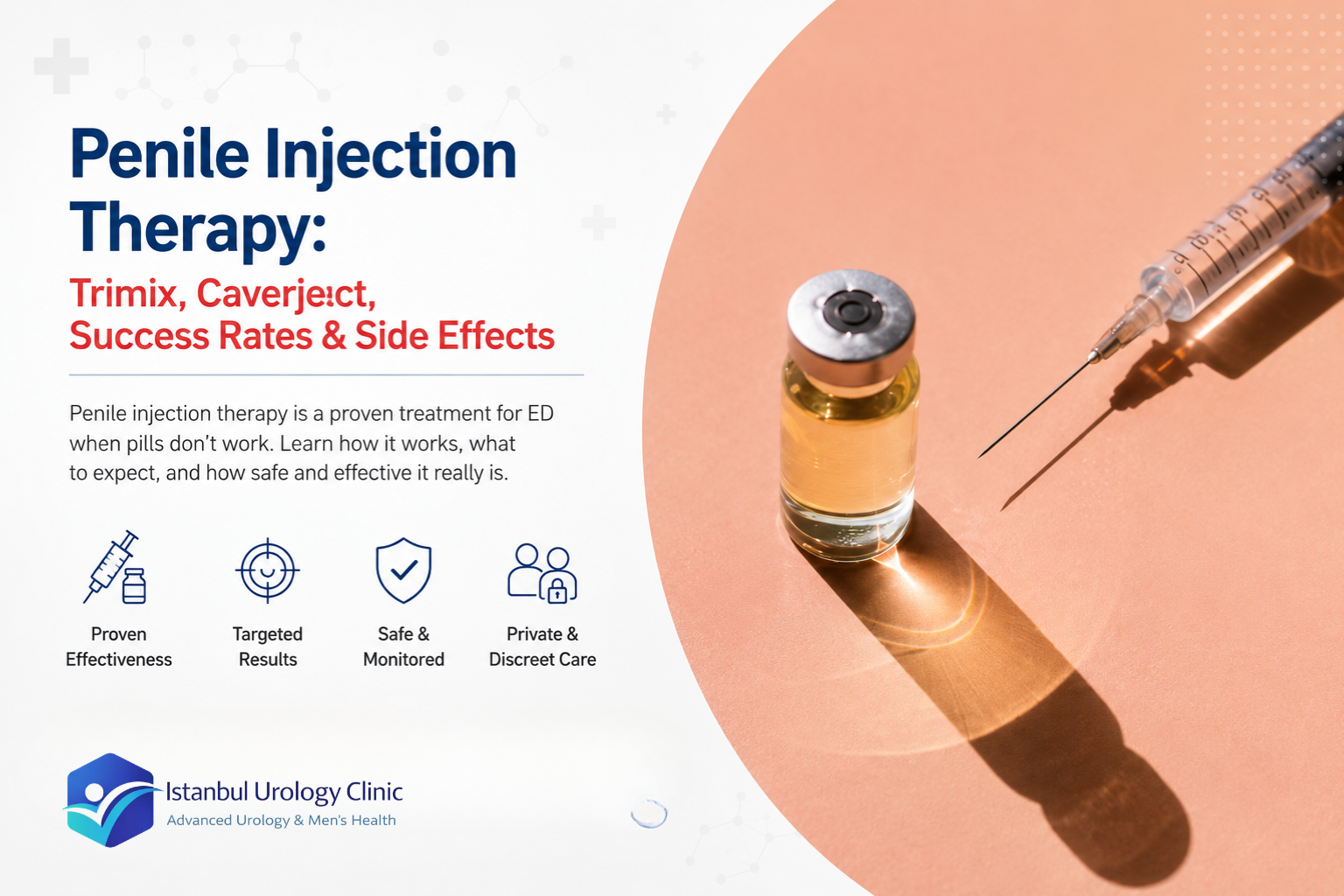
Penile injection therapy is one of the most effective second-line treatments for erectile dysfunction. When oral medication has stopped producing reliable results, intracavernosal injection can restore strong erections in the majority of patients whose tissue still responds. The treatment is well-established, the medications are regulated, and the success rates are higher than most men expect when they first hear the word injection.
The treatment also has a complicated reputation, and not without reason. Used correctly, under proper medical supervision, ED injections deliver years of reliable function for the right patient. Used outside that framework, the same medications produce the late-stage complications that bring men to urology clinics with damage that proper care would have prevented. The difference is not in the drug. It is in how the treatment is conducted.
This article covers what penile injection therapy actually is, how the main formulations differ, who responds well to it, how it compares to other ED treatments, the success rates by patient profile, and the side effects and long-term risks involved. Read it as a clinical guide, not a sales document. The patients who do best with this treatment tend to be the ones who started with the full picture rather than the abbreviated one.
- How Penile Injection Therapy Works
- When Penile Injection Therapy May Be Appropriate
- How Successful Is Penile Injection Therapy?
- What Is Actually Inside the Syringe: Trimix, Caverject, and Bimix
- Penile Injection Therapy Compared to Other ED Treatments
- What the Erection From an Injection Actually Feels Like
- Why This Treatment Must Be Conducted Under Urology Supervision
- Side Effects and Long-Term Complications
- What the Late-Stage Clinical Pattern Looks Like
- The Decision in Front of You
- How Penile Injection Therapy Works
- When Penile Injection Therapy May Be Appropriate
- How Successful Is Penile Injection Therapy?
- What Is Actually Inside the Syringe: Trimix, Caverject, and Bimix
- Penile Injection Therapy Compared to Other ED Treatments
- What the Erection From an Injection Actually Feels Like
- Why This Treatment Must Be Conducted Under Urology Supervision
- Side Effects and Long-Term Complications
- What the Late-Stage Clinical Pattern Looks Like
- The Decision in Front of You
How Penile Injection Therapy Works
Oral medications like Viagra and Cialis amplify a signal that the nerves are already sending to the blood vessels of the penis. When the signal is strong, the pill helps. When the signal has weakened from diabetes, prostate surgery, vascular disease, or age, the pill has little to work with, and the result is the inconsistent response most men describe before they reach penile injection therapy.
Intracavernosal injection works through a different mechanism entirely. The medication is delivered directly into one of the two chambers inside the penis that fill with blood during an erection. Once inside, the drug forces the local blood vessels open mechanically. No nerve signal is required. No arousal is required for the erection to begin. The chemistry alone produces the response.
This is why ED injections succeed where pills fail. The treatment bypasses the system that has stopped functioning. A man with diabetic nerve damage, post-prostatectomy nerve injury, or vascular signaling problems can still produce an erection from an injection, because the injection does not depend on those pathways being intact.
The trade-off is that the body no longer initiates the erection on its own. The medication does, one injection at a time, and the dose, timing, and technique all become variables that need to be managed correctly for the treatment to deliver its results safely.
When Penile Injection Therapy May Be Appropriate
Penile injection therapy is most commonly considered in four clinical situations. None of them should be assumed; each one should be confirmed through proper urological assessment before a first injection is given.
Oral Medication Failure with Responsive Tissue
Men who used to respond well to pills and have gradually lost that response, but whose Doppler imaging confirms that the chambers of the penis can still expand and trap blood when the medication forces them open.
Penile Rehabilitation After Prostate Surgery
Men in the first six to twenty-four months after radical prostatectomy, where intracavernosal injection helps maintain tissue oxygenation and supports nerve recovery during the healing window.
Moderate Diabetic ED
Patients with diabetes whose vascular damage has progressed beyond the point of reliable response to pills, but whose corporal tissue has not yet developed advanced scarring.
Men Who Are Not Yet Candidates for Surgery
Patients aware that an implant will eventually be the right answer but who are not ready, medically or emotionally, to make that decision yet.
Injection therapy is less appropriate, and sometimes inappropriate, for men with severe venous leakage on Doppler, where the erection forms but does not hold the way it should. The same applies to advanced corporal fibrosis from long-standing diabetes or prior priapism, where the tissue itself can no longer cooperate with the medication.
Mild ED with responsive tissue is usually better served by regenerative therapy or shockwave before injections enter the conversation, and uncorrected bleeding disorders make the needle itself a significant risk that needs to be addressed first.
The deciding factor in every one of these cases is the diagnostic picture, not the symptoms alone. Two men with the same complaint can need very different next steps depending on what their Doppler shows, and the assessment is what determines whether injection therapy belongs in the conversation at all.
How Successful Is Penile Injection Therapy?
Success rates in ED treatment depend heavily on what is causing the dysfunction and how advanced the underlying damage already is. The figures below reflect the response rates seen in clinical practice and are consistent with the international urology literature on intracavernosal injection therapy.
| Patient Profile | Response Rate | What This Means |
|---|---|---|
| Vascular ED with responsive tissue | Around 80 to 90 percent achieve usable erections | The profile injection therapy was designed for; most reach reliable function within the first month |
| Post-prostatectomy ED, nerve-sparing surgery | Around 70 to 85 percent during the recovery window | Particularly useful as part of rehabilitation in the first 6 to 18 months after surgery |
| Post-prostatectomy ED, non-nerve-sparing | Around 60 to 75 percent | Effective but often requires higher doses; tissue health matters more than nerve recovery here |
| Diabetic ED with moderate damage | Around 70 to 85 percent | Response depends heavily on glycemic control and the degree of existing corporal scarring |
| Confirmed venous leakage | Often below 60 percent in sustained quality | The erection forms but does not hold the way it should; a different path is usually more honest |
| Advanced long-standing diabetes with corporal fibrosis | Often below 50 percent | Tissue elasticity has been lost; medication cannot expand chambers that no longer cooperate |
← Swipe to see the full table →
These numbers improve when the dose is properly titrated in clinic, when injection technique is taught and verified, and when underlying issues such as smoking, uncontrolled blood sugar, or hormonal imbalance are addressed in parallel. Skipping any of these steps means the treatment usually underperforms compared to what it could deliver.
What Is Actually Inside the Syringe: Trimix, Caverject, and Bimix
Three formulations dominate penile injection therapy worldwide. They are not interchangeable. Each suits a different patient, and the selection should be made by a prescribing urologist based on the underlying condition, not on patient preference or pharmacy availability alone.
Trimix
Compounded, three-drug formulation
Combines alprostadil, papaverine, and phentolamine in a single syringe. The three drugs work through different mechanisms, which allows each to be used at a lower dose. Lower doses translate into less pain at the injection site and less inflammatory stress on tissue over time. Trimix injections are the formulation most often preferred for long-term use because they tend to produce strong erections with the lowest biological cost. The practical trade-off is preparation: Trimix must be compounded by a specialized pharmacy and stored under refrigeration.
Caverject
Alprostadil alone, regulatory-approved
The original intracavernosal therapy and the most extensively studied. Caverject injections are effective, but at the doses required for a reliable erection, alprostadil causes a burning sensation in roughly a third of patients. The pain is not dangerous, but it is unpleasant enough that a meaningful number of men abandon the treatment within a few months. Caverject also tends to be more inflammatory to tissue than Trimix when used over many years. It remains a valid choice when compounded Trimix is not available or when specific contraindications exclude the other drugs.
Bimix
Two-drug formulation, no alprostadil
Papaverine and phentolamine without alprostadil. Used when a patient cannot tolerate the pain of alprostadil but still needs reliable erection support. The erection produced is usually slightly less firm than with Trimix, though the trade-off is acceptable for many patients. Bimix carries a higher risk of prolonged erection than the other formulations, which is precisely why clinical dose titration matters even more here than elsewhere.
For any of these formulations, the appropriate dose, recommended frequency, and choice of formulation should be set and reviewed by a urologist familiar with the patient’s specific condition. The drugs themselves are well-understood; the decisions around them are individualized.
Penile Injection Therapy Compared to Other ED Treatments
ED treatment is not a single ladder that every patient climbs in the same order. Different conditions point toward different paths, and intracavernosal injection therapy occupies a specific position in that landscape. The comparison below shows where ED injections fit relative to the other main options.
| Treatment | Best For | How It Compares to Injection Therapy |
|---|---|---|
| Oral medication (Viagra, Cialis, Levitra) | Mild to moderate ED with intact nerve signaling | Less effective when nerve signal is weak; easier to use; no needle; lower long-term tissue cost |
| Penile injection therapy (Trimix, Caverject, Bimix) | Moderate to severe ED where pills no longer work, post-prostatectomy rehabilitation | Reliable erections regardless of nerve function; per-use; carries real long-term tissue risks |
| Vacuum erection device | Tissue maintenance, particularly post-prostatectomy; men avoiding medication | Mechanical not chemical; safer long-term; produces a different quality of erection; less convenient |
| Low-intensity shockwave therapy | Early vascular ED, mild to moderate cases | Aims to improve underlying tissue function rather than producing an immediate erection; results vary |
| Regenerative therapy (PRP, stem cell) | Selected mild to moderate cases with reversible damage | Structural and slow-acting; injection therapy is reactive and immediate; sometimes used in sequence |
| Penile implant surgery | Severe ED, treatment-resistant cases, advanced tissue damage | Permanent solution; surgical and irreversible; the highest reliability of all ED treatments |
← Swipe to see the full table →
The right comparison depends on the underlying diagnosis. A man with mild vascular ED is not really choosing between pills and injections; he is choosing between pills and shockwave.
A man whose pills no longer work and who has advanced fibrosis is not really choosing between injections and an implant; the injection path is unlikely to deliver, and an implant assessment is the more relevant comparison. The treatment ladder is a useful framework, but only when applied to the specific patient.
What the Erection From an Injection Actually Feels Like
An injection-driven erection is not identical to a natural one, and knowing this in advance prevents disappointment that has nothing to do with the treatment failing.
The erection begins five to fifteen minutes after the injection. There is no arousal-driven build. The body does not warm up the way it normally would. The chambers fill, the penis becomes firm, and the firmness arrives whether the patient feels sexually engaged at that moment or not. For most men this is fine, since the treatment is taken in the context of intimacy and arousal builds alongside the medication. For some, particularly in the first few weeks, the disconnect between the mind and the body takes some getting used to.
The firmness itself is usually equal to or stronger than a natural erection. The duration is typically thirty to sixty minutes from the moment the erection arrives, which is more than enough for intercourse. The texture is sometimes described as slightly cooler or more rigid than natural, but partners generally do not notice the difference, and most patients adjust within the first month.
What the injection-driven erection does not do is respond to mental focus the way a natural erection does. If the patient mentally disengages, a natural erection softens. The injection-driven erection does not. For men whose problem was losing that responsiveness in the first place, this is mostly an advantage.
Why This Treatment Must Be Conducted Under Urology Supervision
Penile injection therapy is sometimes described as a self-administered treatment, and in one sense that is accurate: the patient eventually performs the injection at home. The framing is misleading, though, because the steps that determine whether this treatment helps a man or harms him all happen around the self-injection, not during it. Each of those steps requires a urologist.
Dose Titration
The correct dose varies between patients by a factor of five or six. Finding that dose safely requires observing the response to a test injection in clinic, where the erection can be timed and managed if it lasts longer than expected. A dose set on paper, without that observation, is a guess.
Verified Injection Technique
The injection must reach the right tissue layer at the right angle. Technique that looks correct on a printed sheet often is not, and the difference between proper placement and slightly off placement is the difference between a clean erection and progressive tissue damage. Direct, verified training is the only reliable way to learn this.
Long-Term Monitoring
The most serious complications develop gradually over years. Early fibrosis, small dose increases, subtle curvature changes; none of these announce themselves clearly. They are detectable in their earliest, most reversible stages only through periodic urological examination by someone watching for them.
Emergency Access
The most acute emergency this treatment can produce, a prolonged erection, requires immediate medical intervention. A patient with an established urologist has a relationship, a record, and a direct path to care. A patient without one is searching for help in an emergency department that has never seen him before.
The medications used in penile injection therapy are not the problem. They are well-established, regulated treatments that have helped a large number of men regain sexual function.
The serious complications almost always appear in patients who used the treatment for years without consistent medical follow-up, who titrated their own dose, or who never had their injection technique verified in the first place. Proper supervision does not eliminate every risk.
It does eliminate most of the preventable ones, and the difference between supervised and unsupervised use is significant enough that the supervision itself should be considered part of the treatment.
Side Effects and Long-Term Complications
The complications described below are real, and several of them are progressive. They appear most often in patients whose injection therapy continued for years without consistent follow-up, but every one of them is worth understanding before the first injection rather than after.
Priapism: An Erection That Will Not Stop
The most acute danger of intracavernosal therapy is an erection that does not resolve on its own. If the dose is too high for the patient’s tissue sensitivity, the erection can last hours beyond what was intended.
The textbook threshold for medical concern is four hours. Past that point, the trapped blood inside the chambers becomes deoxygenated, and the tissue itself begins to suffer. Cases of injection-induced priapism lasting twelve, eighteen, and even twenty-four hours appear in clinical literature and in emergency departments more often than most patients realize.
They occur when the patient hopes the erection will resolve on its own. It does not. After four hours, the situation only worsens with time.
An Erection Lasting More Than 4 Hours Is a Medical Emergency
Tissue damage begins after four hours. After six to eight hours, parts of that damage start to become permanent. After twelve hours, the risk of lasting erectile dysfunction is significant. After twenty-four hours, the chambers themselves can develop scar tissue that no future treatment will fully reverse. Do not wait at home. Do not try cold showers, exercise, or any home remedy found online. Go to an emergency department immediately and explain that the erection followed a penile injection. Hospitals with urology coverage know how to manage this. The treatment is straightforward when performed early and progressively more difficult the longer it is delayed.
The risk of priapism is much lower when the dose has been properly titrated by a urologist. It is highest during the first weeks of treatment, while the dose is still being individualized, and lowest once a stable dose has been established under supervision.
Penile Fibrosis and Acquired Curvature
Repeated injection into the same anatomical area causes localized scarring inside the outer covering of the penis. Over months and years, that scarring develops into a hardened plaque, which is the same biological process behind Peyronie’s disease.
What makes this complication serious is its progression. Once the plaque is large enough, the injection-driven erection becomes distorted, with a new curvature pulling the shaft in the direction of the scarred tissue.
The erection also becomes progressively painful. The same plaque that distorts the shape now resists expansion, and every injection-induced erection stretches against scar tissue that does not stretch easily. What used to be a comfortable thirty-minute window for intercourse becomes a painful one, and the medication that was the solution starts producing the discomfort.
At this stage the medication is still doing its pharmacological job. The tissue is no longer cooperating. Continuing injections without addressing the underlying fibrosis only deepens it. Detection during regular follow-up appointments, when the plaque is still small and the curvature is still minor, is the only reliable way to interrupt this trajectory.
Other Recognized Complications
Beyond priapism and fibrosis, four additional complications appear with enough frequency to be worth understanding. None of them is dangerous in the same acute sense, but each one shapes the long-term experience of penile injection therapy and each one is more manageable when caught early.
| Complication | What It Looks Like | Why It Matters |
|---|---|---|
| Pain at the injection site | A burning sensation lasting several minutes after the injection, most common with Caverject (affects roughly a third of users); Trimix and Bimix are considerably gentler | The most common reason patients abandon ED injections within the first three months; usually resolved by adjusting formulation or technique under medical guidance |
| Bruising and small vessel damage | Small bruises at the injection site, harmless individually; repeated trauma in the same area can scar small blood vessels over years | Affects local blood supply over time when sites are not rotated; rotating between left and right reduces the risk substantially |
| Loss of effectiveness | The dose that produced a full erection at month six produces a partial one by year three, due to tissue changes and receptor desensitization | The natural response is to increase the dose, which accelerates every other complication on this list; early detection allows for adjustment |
| Psychological dependency | Inability to attempt intercourse without an injection, even on days the body might have managed alone; anxiety builds around the absence of the medication | Not a physical side effect but a clinically recognized pattern in long-term unsupervised use; harder to reverse the longer it continues |
← Swipe to see the full table →
Clinical positioning and safety guidance for intracavernosal injection therapy is reflected in the European Association of Urology guidelines on Sexual and Reproductive Health and the Sexual Medicine Society of North America position statements. The figures above are consistent with the international literature on long-term ICI therapy.
What the Late-Stage Clinical Pattern Looks Like
The clinical trajectory in long-term unsupervised use is recognizable enough to describe as a pattern. A representative case looks something like this: a man in his late fifties, long-term diabetic, arrives after both sildenafil and tadalafil have stopped producing reliable erections.
His Doppler shows moderate vascular damage but tissue that still responds. Trimix is prescribed and titrated in clinic. What follows over the next four years is the pattern that defines most late-stage cases urologists see.
First Year: Treatment Works as Designed
He injects two or three times per week and reports strong erections with minimal discomfort. He attends his early follow-up visits in the first six months, but by the end of the year he stops returning. The treatment is working, the routine has become familiar, and the appointments feel unnecessary.
Second Year: Stable but Unwatched
The injections continue to work. The dose remains roughly the same. From the patient’s perspective, nothing has changed and nothing requires medical attention. From a clinical perspective, the early signs that would be detectable on examination are not being looked for, because no one is examining him.
Third Year: First Warning Signs Appear
His dose has crept up by about half, adjusted at home each time the previous dose felt weaker. He has noticed a small firm area on the left side of his shaft, and a slight new curvature in his erections. The treatment is still producing erections, but the routine has become heavier and the changes in his tissue are no longer subtle. He decides to ignore it for another year.
Fourth Year: The Threshold He Cannot Cross Back
The curvature is more pronounced. The erection from each injection is painful, and the pain lingers afterward. The plaque under the skin has hardened. Intercourse is still possible but no longer comfortable for either partner. Continuing injections at the same intensity worsens the tissue further. Surgical correction of the fibrotic damage, often combined with placement of a penile implant to restore reliable erection function, becomes the clinical recommendation.
This trajectory is not unusual, and it is not the medication’s fault. The first two years showed exactly what the treatment is designed to do. The years that followed showed what happens when the treatment continues without supervision. The same patient, attending follow-up every three to six months, would almost certainly have caught the early fibrosis when it was still manageable and adjusted the plan before the situation became irreversible.
Frequently Asked Questions
Penile injection therapy is considered safe when it is conducted under proper urological supervision. The medications themselves are well-established and regulated, and the major risks are predictable and largely preventable through correct dose titration, verified injection technique, and regular follow-up. The treatment becomes unsafe when these steps are skipped. The serious complications described in this article (priapism, penile fibrosis, painful erections, progressive curvature) appear far more often in patients who used the treatment for years without consistent medical oversight than in patients who maintained regular urology visits throughout their treatment. The safety of penile injection therapy is largely determined by how it is conducted, not by the medication alone.
Yes, in the right patients. Response rates of 80 to 90 percent are common in men with vascular ED whose tissue still responds, and rates above 70 percent are typical in post-prostatectomy and moderate diabetic patients. The treatment works less well in confirmed venous leakage and in advanced corporal fibrosis, where the tissue itself can no longer cooperate with the medication. Diagnostic imaging before starting treatment is what determines whether a patient is in the responsive range.
Repeated needle trauma at the same site causes localized scarring that mimics the biological process behind Peyronie's. Roughly 5 to 10 percent of long-term users develop curvature and plaque formation. The risk is reduced by rotating injection sites and by using Trimix rather than alprostadil-only formulations, but it cannot be eliminated entirely. Regular urological follow-up catches early fibrosis before it progresses.
Go to an emergency department immediately. Do not wait. Do not try home remedies. Tissue damage begins after four hours and can become permanent after twelve. Cases lasting twenty-four hours can leave damage that no future treatment will fully reverse. Hospital staff with urology coverage know how to manage this. The treatment is straightforward when performed early.
There is no fixed answer, because tissue tolerance varies. Many men use ICI therapy successfully for three to five years before complications begin to outweigh the benefits. Some go longer with no significant issues. Others develop curvature or dose creep within two years. The right answer for an individual patient is the one his follow-up appointments produce.
Less than most patients expect. The needle is similar in size to an insulin needle, and the injection itself is a brief pinch. The medication, particularly Caverject, can produce a burning sensation for several minutes afterward in some patients. Trimix is much gentler. By the third or fourth supervised home injection, most patients have stopped thinking about the needle.
They are completely different treatments that share only the word injection. Penile injection therapy uses pharmacological drugs to force an immediate erection that lasts for one intercourse. Stem cell injection uses regenerative cells to attempt to rebuild damaged tissue over months. One is reactive and short-acting. The other is structural and slow-acting. The regenerative path is covered in the stem cell injection for erectile dysfunction guide.
A reasonable schedule is an early check-in within four to six weeks of the first home injection, then follow-up every three to six months for the first year, then at least once a year thereafter. The urologist should examine the injection sites, review the dose history, and ask about erection quality, pain, and any new curvature. This is particularly important for patients using injections as part of post-prostatectomy rehabilitation, where the treatment plan evolves alongside nerve recovery. If the prescribing physician does not offer this kind of follow-up, finding a urologist who does matters more than continuing convenient access to the medication.
Significantly. Smoking damages the same small blood vessels the injection is trying to dilate. Patients who continue smoking through injection therapy report less reliable erections, faster dose creep, and quicker onset of tissue changes than those who quit. Addressing smoking is part of any responsible treatment plan involving ICI therapy.
The Decision in Front of You
Penile injection therapy is real medicine. It helps the right patients reliably, and for many men it represents the first treatment in years that actually restores function rather than promising to. Nothing in this article is meant to discourage someone who would benefit from this treatment from receiving it.
What this article is meant to discourage is the version of the treatment that produces the late-stage complications described above. Self-administration without proper titration. Home use without verified technique. Years of continued injections without follow-up appointments. These are not minor shortcuts. They are the difference between a treatment that helps for a long time and one that creates problems that did not need to exist.
For a man considering penile injection therapy, the most important step is finding a qualified urologist who will manage the full pathway, not only the prescription. For a man already on the treatment without close medical follow-up, returning to regular supervision is more urgent than any other decision. The medication is not the variable that determines whether this treatment ends well or badly. The medical care around it is.