
Last updated: June 23, 2026

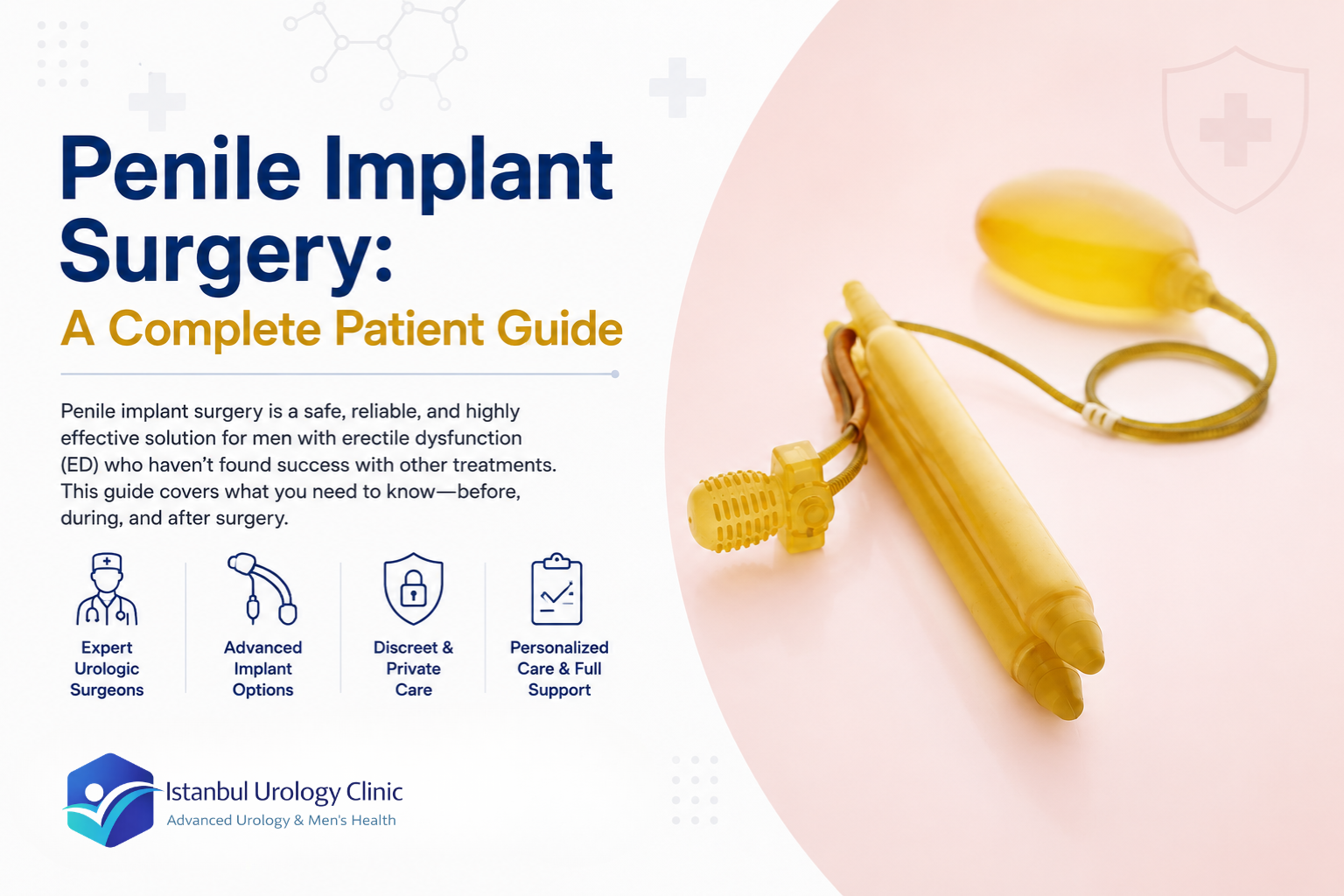
Penile Implant Surgery: A Complete Patient Guide

Medically reviewed by:

Op. Dr. N. Arici

Urology Surgeon

20 min read
Copy link
Penile Implant Surgery: A Complete Patient Guide

Most men researching penile implants spend weeks asking the wrong questions. Which brand is best? How much will it cost? Will recovery hurt? These matter, but none of them is what actually determines whether a man is satisfied with his implant five years from now.

The factor that matters most is timing. Specifically, how long severe erectile dysfunction has been left untreated before surgery. When erections become consistently unreliable and nothing is done about it, the penile tissue quietly changes. Blood flow decreases. Scar tissue develops. The erectile chambers lose flexibility.

Over months and years, the penis itself often becomes measurably shorter than it used to be. Not because of age, but because of what prolonged dysfunction does to internal tissue. By the time an implant is placed, some of that change is irreversible.

This is not meant to create urgency where none exists. It is meant to give you accurate information, because most men we speak with were never told this clearly by anyone.

This guide walks through the same decision sequence a prosthetic urology team uses in clinic: whether you are actually a candidate, which implant type fits your anatomy and daily life, why one brand is selected over another in specific cases, what surgery and recovery look like week by week, and what realistic results look like one, five, and ten years out.

The goal is not to convince you of anything. It is to give you the same clinical reasoning a surgeon would share across the desk, so that when you do decide, you decide with the right information.

A penile implant is a medical device surgically placed inside the penis to restore the ability to get a firm, reliable erection, specifically for men whose erectile dysfunction no longer responds to medications, injections, or other non-surgical treatments.

The core difference between an implant and everything that came before it is this: it does not depend on anything working correctly inside the body. No blood flow. No medication timing. No hoping today is a good day. The implant provides mechanical rigidity directly, whenever the patient wants it, for as long as needed.

Penile implant surgery in Turkey

How Does It Actually Work?

Erectile dysfunction develops when the mechanism that creates a natural erection breaks down, usually because of vascular disease, diabetes, nerve damage, Peyronie’s disease, or the effects of pelvic surgery. The blood vessels stop delivering enough flow, or the nerves stop sending the right signals, or the tissue inside the penis has scarred to the point where it can no longer expand properly.

A penile implant bypasses all of that. Instead of trying to repair a system that has become unreliable, it replaces the erection mechanism entirely with one that works on demand. Depending on the type of implant, this is done either through bendable cylinders that the patient positions manually, or through an inflatable hydraulic system controlled by a small pump placed discreetly inside the scrotum.

The result is an erection that no longer depends on luck, timing, or whether the medication decided to cooperate.

What Does a Penile Implant Solve?

A penile implant surgery solves one problem specifically: the inability to achieve or maintain an erection firm enough for intercourse. It is the right treatment when that problem has become severe and consistent, and when everything else has been tried without giving the patient reliable control over his own sexual function.

The conditions that most commonly lead men to this point are diabetes-related erectile dysfunction, vascular disease and poor penile blood flow, nerve damage after prostate or pelvic surgery, Peyronie’s disease combined with erectile dysfunction, and long-standing ED that no longer responds to oral medications, injections, or vacuum devices.

What a Penile Implant Surgery Does Not Treat

This is something we are always direct about in consultation, because misunderstanding it leads to disappointment after surgery.

A penile implant restores the ability to get an erection. It does not restore sexual desire, fix low testosterone, resolve ejaculation disorders that existed before surgery, or address orgasm problems unrelated to erection quality. It also does not treat erectile dysfunction that has a purely psychological cause, in those cases, the appropriate first step is usually a different kind of support entirely.

If any of these issues are present alongside erectile dysfunction, they need to be identified and addressed as part of the evaluation process, not discovered after the implant is already in place.

Important to Understand Before Surgery

A penile implant restores rigidity. It does not restore sexual desire, fix low testosterone, resolve pre-existing ejaculation disorders, or address orgasm problems unrelated to erection quality. If any of these issues are present alongside erectile dysfunction, they need to be identified and addressed during evaluation — not discovered after the implant is already in place.

Who is a penile implant suitable for?

The short answer: men with moderate to severe erectile dysfunction whose erections have become consistently unreliable despite treatment, and for whom non-surgical options are no longer giving them control over their own intimate life.

But the longer answer matters more, because the decision is permanent and it should be right for the individual patient, not just technically correct on paper.

The most common situations we see are men with diabetes-related ED, where long-term vascular or nerve damage has made erections progressively less reliable despite increasing medication doses. Men with venous leak, who can sometimes start an erection but cannot maintain it long enough for intercourse.

Penile implant surgery

Men whose erectile function did not recover after prostate cancer surgery, and who have given the recovery process a fair amount of time. Men with Peyronie’s disease combined with erectile dysfunction, where curvature and weak erections are occurring together. And men who have been through the full sequence, pills, then injections, then possibly a vacuum device, and found that none of it gives them the consistency they are looking for.

What these situations have in common is not a specific diagnosis. It is a specific experience: trying to manage something that keeps getting less manageable, and reaching a point where a permanent solution makes more sense than continuing to work around a problem that is not going away.

When an Implant Is Not the Right Step

A penile implant surgery is not the right choice for men who still respond reliably to medications, or whose erectile dysfunction is mild enough that less invasive options have not been properly explored. It is also not appropriate when the underlying cause, low testosterone, uncontrolled diabetes, a medication side effect, has not been identified and addressed first.

We do not recommend surgery to men who are not genuinely ready for a permanent solution. The evaluation process exists partly for this reason: to make sure the timing is right, the expectations are realistic, and the implant being recommended is the one that actually fits the patient’s anatomy, lifestyle, and long-term goals.

Types of Penile Implants

There is no single implant that works best for every man. The right choice depends on how you live, what your anatomy allows, how important concealment is to you in daily life, and what you are realistically looking for from surgery. Here is how the three main types differ, not just technically, but in actual everyday experience.

Malleable Penile Implant

A malleable implant uses two bendable cylinders placed inside the penis. The device stays semi-rigid at all times. You position it downward for daily life and upward when you want intercourse. No pump, no inflation, nothing to learn or operate. It works every time, immediately, without any preparation.

malleable penile implant

The tradeoff is concealment. Because the penis remains firm continuously, some men find it noticeable under certain clothing, particularly thinner trousers or swimwear. For men with an active professional or social life, this can become a practical concern that affects daily comfort.

The malleable implant is typically the right choice in specific situations: men with neurological conditions or reduced hand function that would make operating an inflatable pump difficult, or patients over 70 who prioritize simplicity above everything else. For men without these considerations, the inflatable system almost always gives a better long-term daily experience. Read the full Malleable Penile Implant guide.

Two-Piece Inflatable Penile Implant

The two-piece system adds inflatable function, the penis softens when deflated and firms up when the patient uses the pump, without requiring a separate reservoir placed in the abdomen. The reservoir is built into the device itself, which simplifies the surgical approach.

Two-Piece Inflatable Penile Implant

This makes it a practical option for men who have had previous abdominal or pelvic surgery that makes reservoir placement more complex. It offers meaningfully better concealment than a malleable implant, and a more natural daily experience, while keeping the internal design simpler than a three-piece system.

Read the full Inflatable Penile Implant guide

Three-Piece Inflatable Penile Implant

The three-piece system is what the overwhelming majority of our patients choose, and for good reason. It consists of cylinders inside the penis, a pump positioned discreetly inside the scrotum, and a separate fluid reservoir in the lower abdomen. When deflated, the penis returns to a completely soft, natural state. When activated, it provides firm, reliable rigidity suitable for intercourse.

The experience is as close to a natural erection as current implant technology allows, both in how it feels during sex and in how it looks and feels during the rest of the day. For men who are physically active, professionally visible, or who simply want to stop thinking about their implant between uses, this is almost always the right choice.
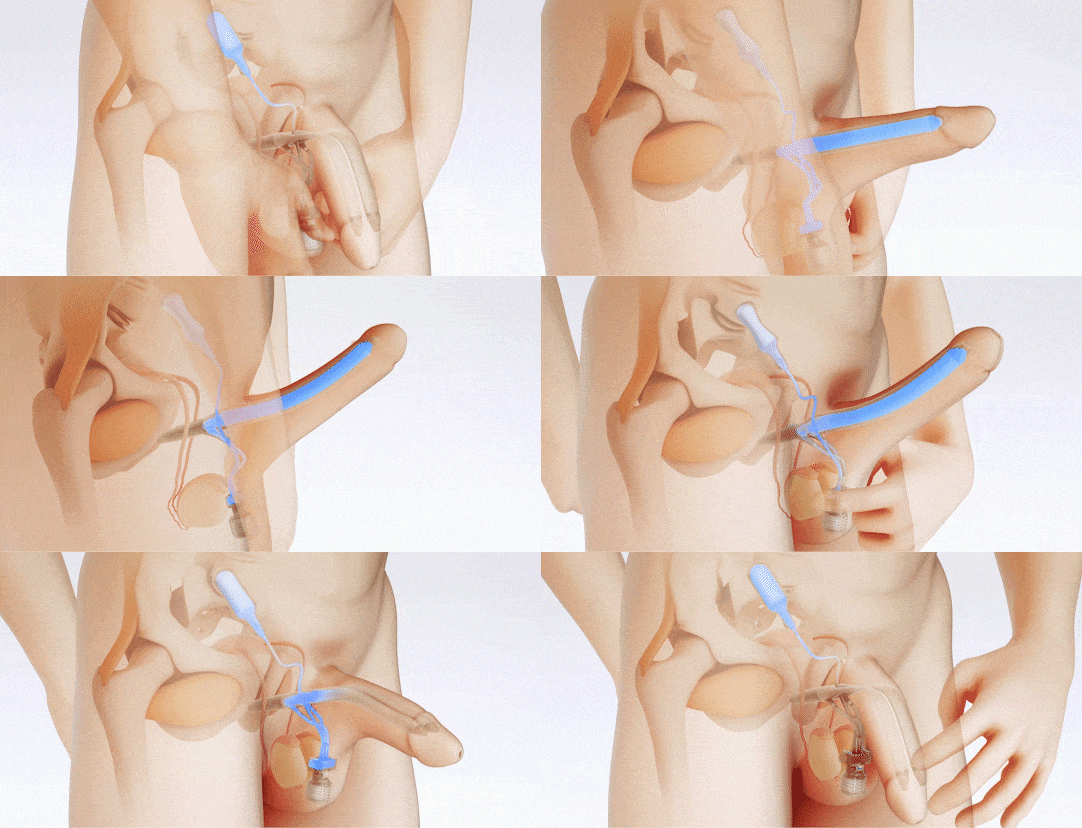
Inflatable Penile Implant

Within the three-piece category, there are meaningful differences between models and brands. Some prioritize maximum rigidity. Others are engineered specifically for length and girth expansion over time. Choosing between them is part of what we assess during consultation.

Read the full Three-Piece Penile Implant guide

← Swipe to see full table →
FeatureMalleable Implant2-Piece Implant3-Piece Implant
RigidityAlways semi rigidInflatable when neededInflatable when needed
Flaccid AppearanceLess naturalMore naturalMost natural
Ease of UseVery simpleModerateRequires pump use
Mechanical ComplexityLowestModerateHighest
ConcealmentModerateGoodExcellent
Typical CandidatesLimited hand dexterity, neurological conditionsPrior abdominal surgery historyMost men seeking the most natural experience

Choosing the Right Implant: How We Think About It

Every patient who comes to us for consultation eventually asks the same question: which implant is best? The honest answer is that there is no universally best implant. There is only the implant that best fits a specific patient’s anatomy, lifestyle, medical history, and what they are actually looking for from surgery.

Here is how we approach that decision in practice.

1
Can You Operate a Pump?
The first question is not about the implant at all. It is about hand function. Operating an inflatable pump requires reasonable grip strength and finger dexterity. For most men, this is not an issue. But for patients with significant arthritis, neurological conditions, reduced hand strength from diabetes, or partial paralysis, the malleable implant becomes the practical choice regardless of other preferences. If hand function is not a limiting factor, an inflatable system is the right starting point for almost every patient.
2
Is There Significant Fibrosis or Peyronie’s Disease?
When significant scar tissue is present inside the erectile chambers, or when Peyronie’s disease has caused substantial curvature and tissue changes, the implant needs to provide strong structural support during inflation. In these situations, the Coloplast Titan is often strongly considered; its Bioflex cylinders are engineered specifically for the mechanical demands of fibrotic tissue. The AMS 700 CX is the alternative for patients on the AMS platform who need maximum cylinder stability. For less severe fibrosis or Peyronie’s cases, other models remain viable depending on the patient’s other priorities.
3
Is Penile Shortening a Concern?
Men who have experienced measurable penile shortening from years of erectile dysfunction, Peyronie’s disease, or tissue fibrosis often ask whether an implant can help recover some of that lost length. The honest answer is: sometimes, partially, and only with specific implants combined with consistent post-operative cycling. The AMS 700 LGX and the Rigicon Infla10 AX are the only two implants currently engineered for controlled expansion in both length and girth. Between them, the LGX has the longer clinical track record. The AX is a newer platform with comparable expansion mechanics and a lifetime warranty.
4
What Are the Concealment and Lifestyle Priorities?
For patients without the considerations above, no significant hand limitation, no advanced fibrosis, no particular concern about length, the decision often comes down to daily lifestyle and concealment preferences. The AMS 700 LGX offers a notably soft flaccid state when deflated, making it one of the most discreet options under normal clothing. The Coloplast Titan, while firmer during inflation, also deflates to a manageable flaccid profile. The Rigicon AX offers comparable concealment to the LGX with a pump system designed for easier operation with less hand effort.

The Decision in Summary

Implant selection comes down to specific patient situations rather than abstract device features. We’ve published a complete scenario-based decision framework in our Inflatable Penile Implant guide, which walks through exactly which implant we recommend for each clinical situation. The basic logic is:

  • Limited hand function or simplicity priority: Malleable implant
  • Severe fibrosis or advanced Peyronie’s: Coloplast Titan or AMS 700 CX
  • Length recovery is a priority: AMS 700 LGX or Rigicon Infla10 AX
  • Standard ED without complications: Three-piece inflatable based on pump preference

For each scenario, the detailed reasoning and pump-specific recommendations are in our Inflatable guide.

After more than 23 years in prosthetic urology, the single biggest predictor of long-term satisfaction is not the brand of the device. It is whether the device matches the patient’s anatomy, hand function, and what they actually need from surgery. The conversation matters more than the catalog.
ÖO.
Prof. Dr. Ö. Onuk
Professor of Andrology · Istanbul Urology Clinic

Major Penile Implant Brands

Three manufacturers dominate prosthetic urology worldwide: Boston Scientific, Rigicon, and Coloplast. Each has a different engineering philosophy, and the differences between them matter clinically, not just on paper. No single brand is the right answer for every patient. The choice depends on penile anatomy, fibrosis severity, hand function, concealment priorities, and what the patient is primarily looking for from surgery. Here is how each one compares.

Boston Scientific – AMS 700 Series

The AMS 700 is one of the most established inflatable penile implant platforms in the world, with decades of clinical data behind it. Within the series, the CX model prioritizes maximum rigidity and cylinder stability, often the right choice when fibrosis or Peyronie’s disease is present and strong structural support matters. The LGX model adds bidirectional expansion, making it the preferred option for patients concerned about penile shortening related to long-standing erectile dysfunction. The CXR is designed for narrower anatomy or more challenging corporal spaces.

All AMS 700 models include InhibiZone, an integrated antibiotic coating that releases locally during the early healing period to reduce infection risk.

Read the full AMS 700 guide

Rigicon – Infla10 and Rigi10 Series

Rigicon has established itself as a serious option in prosthetic urology with a range of implants designed around modern engineering priorities. The Infla10 AX is one of only two implants available globally, alongside the AMS 700 LGX, that supports controlled expansion in both length and girth. The Infla10 X offers reliable inflatable function without the expansion focus. The Infla2P is a two-piece system for patients where a separate abdominal reservoir is not suitable. The Rigi10 is Rigicon’s malleable option, notable for its wide diameter range and flexible rod design.

Rigicon offers a lifetime warranty on its devices, and its Pulse pump system is designed to require less hand effort than competing pumps, a practical advantage for diabetic patients or those with reduced grip strength.

Read the full Rigicon guide

Coloplast – Titan and Genesis

The Coloplast Titan is the implant we reach for most often when axial rigidity and structural durability are the primary requirements. Its Bioflex cylinders are engineered for strong firmness during inflation, and they handle the mechanical demands of fibrosis cases and revision surgery particularly well. The Titan Touch pump system reduces the hand effort required for inflation and deflation. Coloplast also offers lifetime device replacement coverage under its warranty program.

The Genesis is Coloplast’s malleable option, considered in selected patients where simplicity and reduced mechanical complexity are the priority.

Read the full Coloplast guide

Recovery Timeline

Recovery after penile implant surgery follows a predictable pattern. The first three days are about managing initial swelling and discomfort. The first six weeks are about healing safely. The first six months are about full adaptation, where the implant stops feeling like something that was placed and starts feeling like part of how your body works.

Here is what each stage actually looks like.

Before Surgery

The day before the penile implant surgery, you will meet with the surgical team for a pre-operative evaluation. This includes blood work, a review of your medications and medical history, cardiac assessment if indicated, and a final discussion about which implant model has been selected for your case and why. By the time you go into surgery, there should be no open questions.

During Surgery

The procedure is performed under general or spinal anesthesia, the anesthesiologist decides which is safer for your specific health profile. Surgery takes around one hour in straightforward cases. For patients with fibrosis, Peyronie’s disease, or revision surgery, it takes longer. The surgical team places the cylinders inside the penis and, for inflatable systems, positions the pump inside the scrotum and the reservoir in the lower abdomen, all through a single small incision.

After Surgery

You spend the first night in the hospital under observation. Swelling and mild to moderate discomfort during the first two to three days are expected and well managed with prescribed medication. Most patients are surprised by how manageable the early recovery is.

By day five, the majority of our international patients are comfortable enough to fly. Before departure, you return for a follow-up check, dressing review, and a clear set of instructions for the weeks ahead, what to avoid, what to watch for, and when to contact us.

Sexual activity and device activation typically begin around week six, once healing is confirmed. For inflatable implant patients, the surgical team guides you through inflation and deflation during a follow-up appointment or via video call before that first use.

Full adaptation, where the implant feels like a natural part of daily life rather than something you are aware of, usually develops between months three and six.

Expected Results

The most honest thing we can tell patients about expected results is this: the men who are most satisfied after surgery are almost never the ones who went in hoping for dramatic change. They are the ones who went in wanting one specific thing, a reliable erection, and got exactly that.

Reliable Rigidity

This is what the implant is designed to deliver, and it delivers it consistently. No planning around whether a pill will work today. No injections. No vacuum devices. When you want an erection, you have one. That predictability, after years of uncertainty, is what most patients describe as the biggest change in their lives after surgery.

Satisfaction Rates

Patient satisfaction after penile implant surgery is among the highest of any procedure in urology, consistently above 90% in properly selected patients. The key phrase is properly selected, satisfaction rates drop when the implant is the wrong type for the patient’s anatomy, or when expectations were not aligned with reality before surgery. This is why the evaluation process matters as much as the surgery itself.

Orgasm and Sexual Pleasure

The implant changes how an erection is created. It does not change how orgasm feels. In the vast majority of patients, the ability to reach orgasm is completely preserved after surgery, because the nerves responsible for sensation and climax are not affected by the procedure. Many men actually report that pleasure feels better psychologically, because the anxiety about losing the erection is no longer there.

Ejaculation

Whether you ejaculate after surgery depends on your underlying medical condition, not on the implant. If ejaculation was normal before surgery, it almost always continues normally afterward. If it was already affected, by prostate surgery, diabetes-related nerve damage, or another condition, the implant does not change that. This is one of the things we discuss clearly during evaluation, so there are no surprises.

Size Expectations

A penile implant restores rigidity. It is not a cosmetic enlargement procedure, and we are direct about that with every patient.

What some men do notice over time, particularly with the AMS 700 LGX or Rigicon Infla10 AX, is a gradual recovery of length that was lost during years of erectile dysfunction. When erections stop happening regularly, the penile tissue loses elasticity and can shorten measurably over time. The expansion-focused implants, combined with consistent post-operative cycling, can help recover some of that lost dimension. This is not enlargement beyond what the patient had before. It is recovery of what erectile dysfunction gradually took away.

Patients who understand this distinction, and who approach surgery with that framing, are the ones who report the highest long-term satisfaction.

Penile Implant Success Rates

Penile implant surgery has one of the strongest long-term outcome profiles of any elective surgical procedure in urology. These are not marketing claims, they are figures drawn from published clinical literature, and they matter because they tell you what to realistically expect over the years following surgery.

96%
Device survival at five years for modern three-piece inflatable penile implants. At ten years, the figure remains at 86%, and around 60% of patients are still on their original device at twenty years.

Device Survival

Modern three-piece inflatable implants are built to last. Published data consistently show device survival rates of approximately 96% at five years and 86% at ten years, meaning the vast majority of patients are still using the same implant without revision a decade after surgery. At twenty years, around 60% of patients remain on their original device. Mechanical failure, when it does occur, is manageable and in most cases involves a straightforward revision rather than a complicated reoperation. (Amini et al., AME Medical Journal, 2024) (Blum et al., International Journal of Impotence Research, 2024)

Patient Satisfaction

Across the published literature, patient satisfaction rates after penile implant surgery range from 83% to over 90%, with some studies reporting figures as high as 96% in carefully selected patients. A 2025 systematic review and meta-analysis covering data from 1969 to 2023 found an overall patient satisfaction rate of 83%, rising to above 90% specifically for three-piece inflatable systems. (Corona et al., Andrology, 2025) The pattern is consistent across decades of research: when the right implant is matched to the right patient with realistic expectations, satisfaction is high. (Barton et al., reviewed in Journal of Clinical Medicine, 2025)

The patients who report dissatisfaction almost always fall into one of two categories: those who expected the implant to do something it was never designed to do, or those who received the wrong implant type for their anatomy and lifestyle. This is exactly why the evaluation process at our clinic is not a formality.

Partner Satisfaction

Partner satisfaction is less frequently reported in the literature than patient satisfaction, but the data that exists is consistently positive. Studies show partner satisfaction rates in the range of 70% to 85%, with research confirming that patient and partner satisfaction correlate directly, when the patient is satisfied, the partner almost always is too. (Scientific Reports, 2025) (SMSNA, Penile Implants From a Partner’s Perspective) Partners most commonly report that intercourse feels natural after recovery, and that the predictability and reliability of the implant improves intimacy in ways that medication-dependent erections never could.

Penile Implant vs Other ED Treatments

Not every treatment for erectile dysfunction is trying to solve the same problem. Some are designed to support or improve natural erections when the underlying mechanism is still partially working. Others are designed to replace that mechanism entirely when it has stopped working reliably. Understanding which category applies to your situation is the most important step in choosing the right treatment.

Pills and injections work by enhancing blood flow into the penis. When the vascular and nerve systems are still functional enough to respond, they can be very effective. The problem is that for men with diabetes-related vascular damage, significant nerve injury, advanced Peyronie’s disease, or long-standing severe ED, that underlying system becomes progressively less responsive. Increasing the dose helps for a while. Then it stops helping.

Shockwave therapy and stem cell therapy aim to stimulate tissue repair and improve natural erectile function. For carefully selected patients with mild to moderate ED and some residual function, they can produce meaningful results. For men whose erectile tissue has already sustained significant damage, the results are inconsistent and often temporary.

A penile implant does not try to fix what is broken. It replaces the erection mechanism entirely, which is why it is the most reliable option for men who have reached the point where everything else has become unpredictable.

← Swipe to see full table →
TreatmentBest ForDuration of EffectReliability
ED PillsMild to moderate EDHours per doseMay become less effective over time
Penile InjectionsModerate to severe EDPer injectionOften effective but requires ongoing use
Shockwave TherapySelected mild vascular ED casesVariableResults vary between patients
Stem Cell TherapySelected patients with residual erectile functionVariableMay improve function in selected cases
Penile ImplantSevere ED or failed treatmentsLong termMost reliable option for restoring erections


The right time to consider an implant is not when every other option has failed completely. It is when the pattern has become clear, when treatments that used to work are becoming less reliable, when the uncertainty is affecting your relationship and your confidence, and when a permanent solution makes more sense than continuing to manage around a problem that is not going to improve on its own.

Risks and Possible Complications

Penile implant surgery has one of the highest satisfaction rates of any procedure in urology, consistently above 90% in properly selected patients. But satisfaction rates only mean something if you also understand what can go wrong. Here is an honest breakdown.

Infection

Infection is the complication we take most seriously, because if it occurs and is not managed correctly, it can mean implant removal.

The good news: with modern antibiotic-coated implants, strict sterile protocols, and proper patient selection, our infection rate in primary procedures is at or below 1%. That is not a marketing claim, it reflects what the clinical literature consistently shows for experienced prosthetic urology centers using current-generation devices.

The risk is higher in specific situations: poorly controlled diabetes, previous implant surgery, or significant scar tissue inside the penis. This is exactly why we are particular about HbA1c levels before surgery, and why we sometimes delay a procedure until glucose control improves. A slightly later surgery date is a much better outcome than a compromised one.

Mechanical Failure

Modern implants are built to last. Most continue functioning well for 10 to 15 years or longer , and mechanical failure rates in that period are typically just a few percent across the major brands.

When a device does eventually develop a problem, warranty coverage applies. Rigicon offers a lifetime warranty. Coloplast offers lifetime device replacement coverage. AMS provides limited warranty coverage with terms that vary by model. What all three have in common: the warranty covers the device itself. Hospital fees, anesthesia, and surgical costs are separate, and that is something we explain clearly before any patient commits to a brand.

Revision Surgery

If your implant develops a mechanical problem years down the line, the news is usually better than you’d expect.

When the original device is still in place and the surgery is simply replacing a malfunctioning implant, revision is typically more straightforward than the first operation, shorter operative time, faster recovery, and in many cases a lower complication risk than when you had the implant placed the first time. The anatomy is already adapted. The surgeon knows what they’re working with.

The more complex situation is when an implant was removed, usually because of infection, and the patient has been without one for a significant period. Scar tissue forms. The erectile chambers narrow and lose flexibility. By the time reimplantation is considered, the internal anatomy has changed, and the surgery requires a higher level of reconstructive expertise to do it safely and effectively.

We see both types of cases regularly. Men who come to us after a mechanical failure elsewhere, and men who had an implant removed years ago and assumed they’d lost their chance permanently. For most of these men, a new implant is still possible. But the path to get there, and what to realistically expect from the outcome, depends entirely on what happened before and what the anatomy looks like now.

That is why a detailed evaluation is not optional in revision cases. It is the only way to give you an honest answer about what’s achievable.


Considering Having Penile Implant Surgery Abroad?

For patients in countries where penile implant surgery carries long waiting lists or out-of-pocket costs above $15,000, having the procedure abroad has become a practical option. Turkey, in particular, has built medical tourism infrastructure specifically around prosthetic urology, using the same implant brands available in the US and Western Europe at a fraction of the cost.

If you are specifically considering having your penile implant surgery in Turkey, the clinical packages, all-inclusive pricing, surgeon credentials, and what the five-day patient journey actually looks like are covered in detail on our service page: Penile Implant Surgery in Turkey at Istanbul Urology Clinic.

Frequently Asked Questions

Age alone is not the deciding factor. Successful implant procedures are performed on men in their thirties and men in their seventies. What matters is whether erectile dysfunction is severe enough, whether other treatments have genuinely been tried and failed, and whether the patient has realistic expectations about what surgery will and will not change.

Yes, but blood sugar control matters significantly. Poorly controlled diabetes raises infection risk, so HbA1c levels are checked before surgery. If glucose control is not where it needs to be, the procedure is delayed until it improves. A slightly later surgery date is a much better outcome than a compromised one.

Venous leak is one of the conditions where a penile implant is most clearly indicated. When blood leaks back out of the penis faster than it flows in, no medication or injection can fix the underlying mechanism. The implant bypasses the problem entirely by providing mechanical rigidity that does not depend on blood retention.

Yes. When Peyronie's disease and erectile dysfunction occur together, the curvature correction and implant placement are performed in the same operation. This avoids two separate surgeries and gives the best functional outcome.

Around one hour for straightforward cases. For patients with significant fibrosis, Peyronie's disease, or revision surgery, the procedure takes longer, sometimes up to two hours.

Most patients describe the first two to three days as uncomfortable rather than painful. Prescribed medication manages early swelling and discomfort effectively. By the end of the first week, most pain has resolved.

Yes. One night of hospital observation after surgery is standard. This allows the surgical team to monitor for any immediate concerns and ensures pain management is well established before discharge.

Office work and light desk-based activity can usually resume within 7 to 10 days. Physical labor or jobs requiring heavy lifting need 4 to 6 weeks of recovery.

Sexual activity and device activation typically begin around week six, once healing is confirmed by the surgical team. For inflatable implant patients, guidance through inflation and deflation is provided during a follow-up appointment or video call before that first use.

Light walking is encouraged from the first week. Cardio and lower-body workouts can resume around week four. Heavy lifting, cycling, and core-intensive exercise should wait until week six at minimum.

Yes. The implant changes how an erection is created, not how orgasm feels. In the vast majority of patients, the ability to reach orgasm is completely preserved because the nerves responsible for sensation and climax are not affected by the procedure.

Whether you ejaculate normally after surgery depends on your underlying medical condition, not the implant. If ejaculation was normal before surgery, it almost always continues normally afterward. If it was already affected by prostate surgery, diabetes-related nerve damage, or another condition, the implant does not change that.

No. The nerves responsible for sensation are not touched during the procedure. Skin sensitivity, arousal, and the physical pleasure of intercourse remain intact.

In the vast majority of cases, no. Modern three-piece inflatable implants feel natural during intercourse because the pump and reservoir are positioned discreetly. Partners almost always describe the experience as feeling like a natural erection.

Modern three-piece inflatable implants show approximately 96% device survival at five years and 86% at ten years. Around 60% of patients are still using their original device at twenty years. Mechanical failure, when it does occur, is typically straightforward to revise.

When a device develops a mechanical problem years down the line, warranty coverage applies. Rigicon offers a lifetime warranty. Coloplast offers lifetime device replacement coverage. AMS provides limited warranty coverage with terms varying by model. The warranty covers the device itself; surgical replacement fees are separate.
There is no universally best brand. The right choice depends on penile anatomy, fibrosis severity, hand function, concealment priorities, and whether length recovery is a goal. The decision is made case by case during evaluation, not before.
Yes. Modern penile implants are MRI-conditional, meaning MRI scans can be performed safely. Always inform the radiologist that you have an implant before the scan so appropriate protocols are followed.

The Decision Is Yours

If you have read this far, you are probably not someone who makes decisions quickly. That is not a problem. Most men who eventually choose penile implant surgery spent months, sometimes years, researching before they made contact with a surgical team. The research is part of the process.

What this guide aimed to give you is clarity. Not pressure, not urgency, not a list of reasons why surgery is the only answer. Clarity about what a penile implant actually does, who it is genuinely right for, what the experience of surgery and recovery looks like, and what realistic results mean for the men who choose this path.

If you are at the point where medications have stopped giving you reliable control, where the uncertainty has started affecting your relationship or your confidence, and where you are genuinely considering a permanent solution, the next step is a private consultation. Not a commitment. Not a deposit. Just a conversation about your specific situation, your anatomy, your medical history, and whether surgery is the right timing for you.

An honest evaluation includes telling you when surgery is not the right step. That conversation is worth more than any guide.

Was this helpful?

Yes
No
Thanks for your feedback!
Share:
WhatsApp
Facebook
X
LinkedIn
5 1 vote
Article Rating
0 Comments
Oldest
Newest Most Voted

Ready To Begin?

Request a Call Back Now!
Fill out our quick form to request your appointment, and our team will be in touch to confirm all the details and answer any questions

Recognized for

European Care Standards
Trusted by International Patients
Please fill the form
to start your consultation

Our specialists will review your details and respond with personalized guidance privately and within 24 hours.

Step 1 of 2
Join Thousands of
Men Who Took the First Step
International patients who found expert urological care in Istanbul with discretion and confidence.

Redirecting You To WhatsApp

Our patient coordinators will respond to your inquiry privately — typically within minutes during business hours.

Please enter your phone number below